







Customer Data Platforms (CDP): Consulting on a single source of truth for marketing
 February 7, 2026
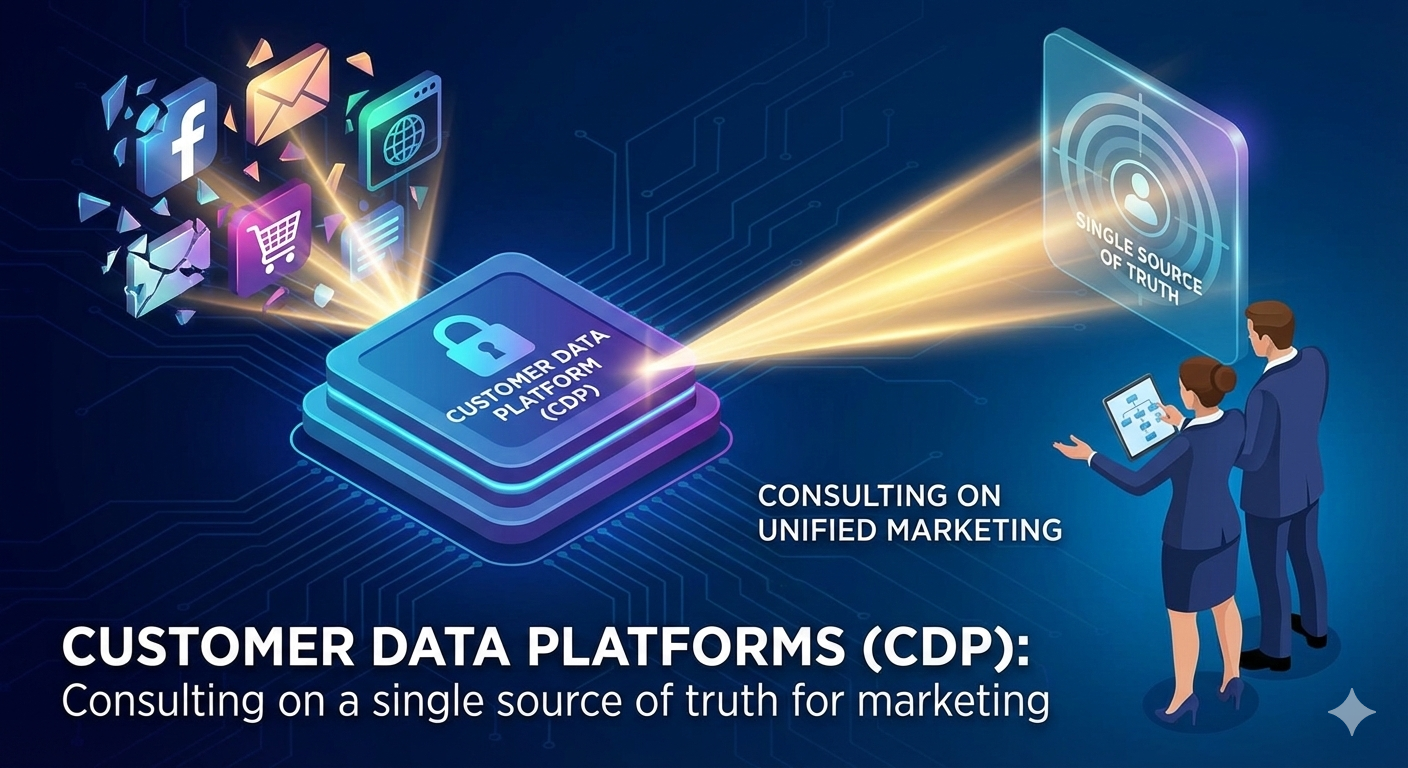
In today’s digital economy, customers don’t experience brands through channels—they experience them through moments. A website visit, a mobile app interaction, a support ticket, a social media comment, or an in-store purchase all shape how a customer perceives a brand. Yet behind the scenes, many organizations still manage customer data in silos, spread across disconnected tools and platforms.
This disconnect creates a fundamental challenge for modern marketing: how can you deliver personalized, relevant, and timely experiences without a unified view of the customer?
The answer lies in Customer Data Platforms (CDPs)—and, more importantly, in the strategic consulting required to implement them correctly.
At cvDragon IT Consulting, we help organizations design and deploy CDPs as a true single source of truth for marketing, aligning technology, data, and business goals. This article explores what CDPs are, why they matter, and how expert consulting ensures they deliver real value rather than becoming just another data repository.
The Problem: Fragmented Customer Data
Most organizations already collect vast amounts of customer data. The problem isn’t data scarcity—it’s fragmentation.
Typical data sources include:
- CRM systems
- Marketing automation platforms
- E-commerce platforms
- Web and mobile analytics tools
- Customer support systems
- Loyalty and POS systems
Each system captures a partial view of the customer. When these views are not unified, marketing teams struggle with:
- Inconsistent customer profiles
- Conflicting metrics and KPIs
- Poor personalization
- Delayed insights
- Inefficient campaign execution
Without a single source of truth, marketing decisions are often based on incomplete or outdated information.
What Is a Customer Data Platform (CDP)?
A Customer Data Platform is a centralized system that collects, unifies, and activates customer data from multiple sources to create persistent, unified customer profiles.
Unlike traditional databases or analytics tools, CDPs are designed specifically for marketing and customer experience use cases.
Core CDP capabilities include:
- Data ingestion from multiple online and offline sources
- Identity resolution across devices and channels
- Creation of unified, persistent customer profiles
- Real-time or near-real-time data updates
- Activation of data across marketing and engagement tools
A CDP doesn’t just store data—it makes customer intelligence usable.
Why CDPs Are Becoming Essential for Modern Marketing
The rise of CDPs is driven by both customer expectations and regulatory realities.
1. Personalization at Scale
Customers expect brands to recognize them and respond accordingly.
CDPs enable:
- Personalized messaging across channels
- Context-aware offers and recommendations
- Consistent experiences throughout the customer journey
Without unified data, personalization efforts remain superficial.
2. Privacy-First Marketing
With increasing data privacy regulations and the decline of third-party cookies, organizations must rely more on first-party data.
CDPs help:
- Centralize consent and preference management
- Reduce reliance on external data brokers
- Ensure compliant data usage
A well-designed CDP supports trust as well as performance.
3. Faster, Data-Driven Decisions
Marketing teams need real-time insights, not monthly reports.
CDPs provide:
- Up-to-date customer profiles
- Dynamic audience segmentation
- Immediate campaign feedback
This agility is critical in competitive markets.
CDP vs CRM vs DMP: Clearing the Confusion
One of the most common challenges organizations face is understanding how CDPs differ from existing systems.
- CRM focuses on known customers and sales/service interactions
- DMP manages anonymous data for advertising, often using third-party sources
- CDP unifies known and unknown customer data across all touchpoints
CDPs complement—not replace—CRMs and marketing platforms. Consulting plays a key role in defining clear system boundaries and integrations.
The Role of Consulting in CDP Success
Technology alone does not create a single source of truth. Strategy does.
At cvDragon IT Consulting, we see CDP initiatives fail when organizations treat them as plug-and-play tools rather than transformation programs.
1. Defining the “Single Source of Truth”
Not all data belongs in a CDP.
Consulting helps organizations decide:
- Which data attributes matter most for marketing
- How frequently data should be updated
- Which system owns which data fields
Clarity upfront prevents duplication, conflict, and confusion later.
2. Aligning Marketing, IT, and Data Teams
CDPs sit at the intersection of multiple functions.
Successful implementations require alignment between:
- Marketing (use cases and activation)
- IT (integration and security)
- Data teams (quality and governance)
Consulting bridges these groups, ensuring shared ownership and accountability.
3. Data Quality and Identity Resolution
A CDP is only as good as the data it unifies.
Key consulting activities include:
- Data audits and cleansing strategies
- Identity resolution logic design
- Rules for merging and splitting profiles
Poor identity resolution undermines trust in the entire platform.
Key CDP Use Cases Enabled by a Unified Customer View
When implemented correctly, CDPs unlock high-impact marketing capabilities.
Omnichannel Campaign Orchestration
Marketers can design campaigns that respond to customer behavior across channels, not in isolation.
This leads to:
- Consistent messaging
- Reduced customer fatigue
- Higher engagement rates
Advanced Audience Segmentation
Unified profiles enable richer segmentation based on:
- Behavior, not just demographics
- Lifecycle stage
- Predicted intent
Segments become dynamic, not static lists.
Customer Journey Analytics
CDPs provide visibility into how customers move across touchpoints.
Insights include:
- Drop-off points
- Channel effectiveness
- Conversion paths
These insights drive smarter investment decisions.
AI-Driven Marketing Activation
CDPs serve as a foundation for AI and machine learning in marketing.
They enable:
- Predictive scoring
- Next-best-action recommendations
- Personalized content delivery
AI performs best when trained on unified, high-quality data.
Common Challenges in CDP Implementations
Despite their promise, CDPs are not a silver bullet.
Common pitfalls include:
- Overloading the CDP with unnecessary data
- Poor integration planning
- Lack of governance and ownership
- Unrealistic expectations of instant ROI
- Insufficient change management
Consulting helps organizations avoid these traps by focusing on phased, value-driven delivery.
Governance: Keeping the Single Source of Truth Trustworthy
As CDPs become central to marketing operations, governance becomes critical.
Effective governance defines:
- Data ownership and stewardship
- Access controls and permissions
- Consent and compliance rules
- Monitoring and quality metrics
At cvDragon IT Consulting, we embed governance into CDP design—not as an afterthought, but as a foundation.
Measuring Success: From Platform to Performance
A CDP’s success should be measured by business outcomes, not technical metrics.
Key indicators include:
- Improvement in campaign performance
- Reduction in time to launch campaigns
- Increase in personalization effectiveness
- Higher customer retention and lifetime value
A single source of truth is only valuable if it drives action.
The Strategic Advantage of a Well-Implemented CDP
Organizations that succeed with CDPs gain more than cleaner data.
They achieve:
- Stronger customer relationships
- Faster marketing execution
- Better alignment across teams
- Greater resilience to privacy and platform changes
In a world where customer expectations evolve rapidly, unified data becomes a competitive differentiator.
Conclusion: From Data Silos to Customer Clarity
Modern marketing demands more than creativity—it demands clarity.
Customer Data Platforms, when guided by the right consulting approach, transform fragmented data into a reliable, actionable single source of truth. They empower marketing teams to move with confidence, deliver relevance at scale, and build trust with customers.
At cvDragon IT Consulting, we help organizations turn CDPs into strategic assets—not just another tool in the stack. By aligning data, technology, and people, we ensure your customer data works as hard as your marketing teams do.
Because in the end, great marketing starts with knowing your customer—and knowing them well.