


Custom LLM Development: Tailoring large language models for proprietary data
 February 6, 2026
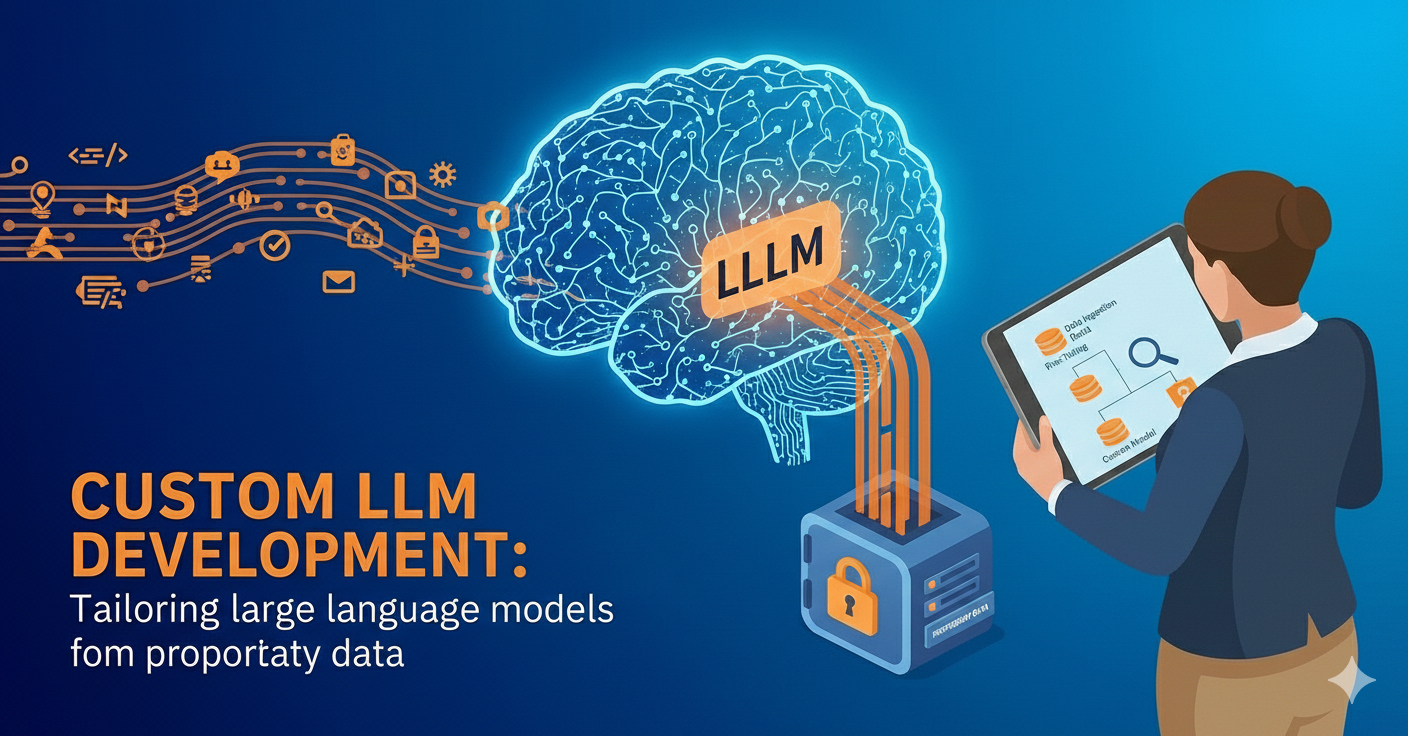
Large Language Models (LLMs) like GPT, Claude, and Gemini have transformed how organizations interact with data, automate knowledge work, and deliver digital experiences. Yet for many enterprises, off-the-shelf LLMs only scratch the surface of what is possible. Generic models are trained on public data, which means they lack deep understanding of a company’s internal processes, terminology, policies, and proprietary knowledge.
This is where custom LLM development becomes a strategic advantage.
At cvDragon IT Consulting, we help organizations move beyond generic AI adoption by designing and deploying LLMs that are purpose-built for proprietary data, industry-specific workflows, and enterprise-grade governance. In this article, we explore what custom LLM development really means, why it matters, and how organizations can unlock measurable business value by tailoring AI to their unique context.
Why Generic LLMs Fall Short for Enterprises
Public LLMs are powerful—but they are not designed for enterprise specificity.
Common limitations include:
- Lack of awareness of internal data and documents
- Inability to understand company-specific terminology
- Risk of hallucinations in regulated or mission-critical use cases
- Data privacy and compliance concerns
- Limited control over model behavior and outputs
For organizations operating in finance, healthcare, legal, manufacturing, or enterprise SaaS, these limitations can become deal-breakers.
Custom LLMs address these gaps by aligning AI capabilities with proprietary data, business logic, and governance requirements.
What Is Custom LLM Development?
Custom LLM development is the process of adapting, extending, or building large language models to work effectively with an organization’s internal data, processes, and objectives.
This can involve:
- Fine-tuning pre-trained models
- Retrieval-Augmented Generation (RAG) architectures
- Domain-specific prompt engineering
- Secure data pipelines and embeddings
- Model governance and monitoring
The goal is not to reinvent AI from scratch, but to make AI context-aware, reliable, and business-ready.
Key Business Drivers for Custom LLMs
Organizations invest in custom LLM development for several strategic reasons.
1. Unlocking Value from Proprietary Data
Most enterprise value is locked inside:
- Internal documents and reports
- Knowledge bases and SOPs
- Customer interactions and CRM data
- Emails, tickets, and chat logs
- Product documentation and code repositories
Generic LLMs cannot access or understand this data securely. Custom LLMs transform internal knowledge into a conversational, actionable asset.
2. Improving Accuracy and Reducing Hallucinations
In enterprise environments, incorrect answers are not just inconvenient—they can be costly or dangerous.
Custom LLMs:
- Ground responses in verified internal sources
- Apply domain-specific constraints
- Enable human-in-the-loop validation
This significantly improves trust and reliability.
3. Data Privacy and Compliance
Sending sensitive data to public LLM APIs is often unacceptable due to regulatory and contractual obligations.
Custom LLM solutions can be:
- Deployed in private cloud or on-prem environments
- Designed with strict access controls
- Aligned with data residency and compliance requirements
This makes AI adoption feasible in regulated industries.
Approaches to Custom LLM Development
There is no one-size-fits-all approach. The right strategy depends on business goals, data maturity, and risk tolerance.
1. Retrieval-Augmented Generation (RAG)
RAG is often the fastest and safest path to customization.
How it works:
- Proprietary data is indexed and embedded
- Relevant content is retrieved at query time
- The LLM generates responses grounded in retrieved data
Benefits include:
- No need to retrain the base model
- Better data freshness
- Lower risk of data leakage
At cvDragon IT Consulting, RAG is frequently the first step for enterprises entering custom LLM development.
2. Fine-Tuning Pre-Trained Models
Fine-tuning involves training an existing LLM on curated, domain-specific datasets.
Use cases include:
- Adopting company tone and language
- Learning structured response formats
- Improving performance in narrow domains
Fine-tuning offers deeper customization but requires careful data preparation and governance.
3. Hybrid Architectures
Many enterprise solutions combine:
- RAG for factual grounding
- Fine-tuning for style and task optimization
- Prompt orchestration for workflow control
Hybrid approaches balance flexibility, performance, and cost.
Use Cases for Custom LLMs with Proprietary Data
Custom LLMs unlock value across functions.
Enterprise Knowledge Assistants
Employees can query internal knowledge in natural language instead of searching multiple systems.
Benefits include:
- Faster onboarding
- Reduced dependency on subject-matter experts
- Improved productivity
Customer Support and Service Automation
Custom LLMs trained on historical tickets and product documentation deliver:
- Accurate, brand-consistent responses
- Faster resolution times
- Better customer experience
Legal, Compliance, and Risk Analysis
LLMs grounded in internal policies and regulations help:
- Draft compliant documents
- Analyze contracts
- Support audits and reporting
Sales and Marketing Intelligence
AI tailored to CRM data and customer history can:
- Generate personalized outreach
- Summarize account insights
- Support proposal development
Engineering and IT Operations
Custom LLMs assist with:
- Code understanding and documentation
- Incident analysis
- Internal IT support
Challenges in Custom LLM Development
While the benefits are compelling, custom LLM initiatives come with real challenges.
1. Data Quality and Readiness
LLMs amplify the quality of the data they consume.
Common issues include:
- Inconsistent documentation
- Outdated or duplicated content
- Unstructured data silos
Data preparation is often the most time-consuming phase.
2. Governance and Access Control
Without proper controls, AI systems can expose sensitive information.
Strong governance must define:
- Who can access what data
- How outputs are logged and monitored
- How errors and misuse are handled
3. Cost and Infrastructure Management
Custom LLMs require thoughtful design to avoid runaway costs.
Considerations include:
- Model hosting and inference costs
- Scaling strategies
- Performance optimization
Strategic architecture choices make a significant difference.
The Role of IT Consulting in Custom LLM Development
Custom LLM development sits at the intersection of data, AI, security, and business strategy.
At cvDragon IT Consulting, we support organizations through every phase:
- AI readiness and use-case assessment
- Data architecture and preparation
- Model selection and customization strategy
- Secure deployment and integration
- Governance, monitoring, and optimization
Our focus is not just technical success, but business impact and long-term sustainability.
Best Practices for Successful Custom LLM Initiatives
Based on real-world implementations, successful organizations follow a few key principles:
- Start with high-value, low-risk use cases
- Prioritize explainability and trust
- Invest early in data quality
- Design governance alongside technology
- Treat AI as a living system, not a one-time project
AI maturity is built iteratively.
Custom LLMs as a Competitive Differentiator
As AI becomes mainstream, competitive advantage will no longer come from using LLMs—but from how well they are tailored.
Organizations with custom LLMs benefit from:
- Faster decision-making
- Better knowledge utilization
- More consistent customer experiences
- Reduced operational friction
Proprietary data, when paired with custom AI, becomes a strategic moat.
Conclusion: AI That Understands Your Business
Generic AI understands the world.
Custom AI understands your organization.
Custom LLM development enables enterprises to transform internal knowledge into intelligence that is secure, accurate, and deeply aligned with business goals. It bridges the gap between powerful AI capabilities and real-world enterprise complexity.
At cvDragon IT Consulting, we believe the future of enterprise AI lies not in bigger models—but in smarter, context-aware ones. By tailoring LLMs to proprietary data, organizations can move from experimentation to true AI-driven advantage.
The question is no longer whether to adopt AI—but how well it understands you.