






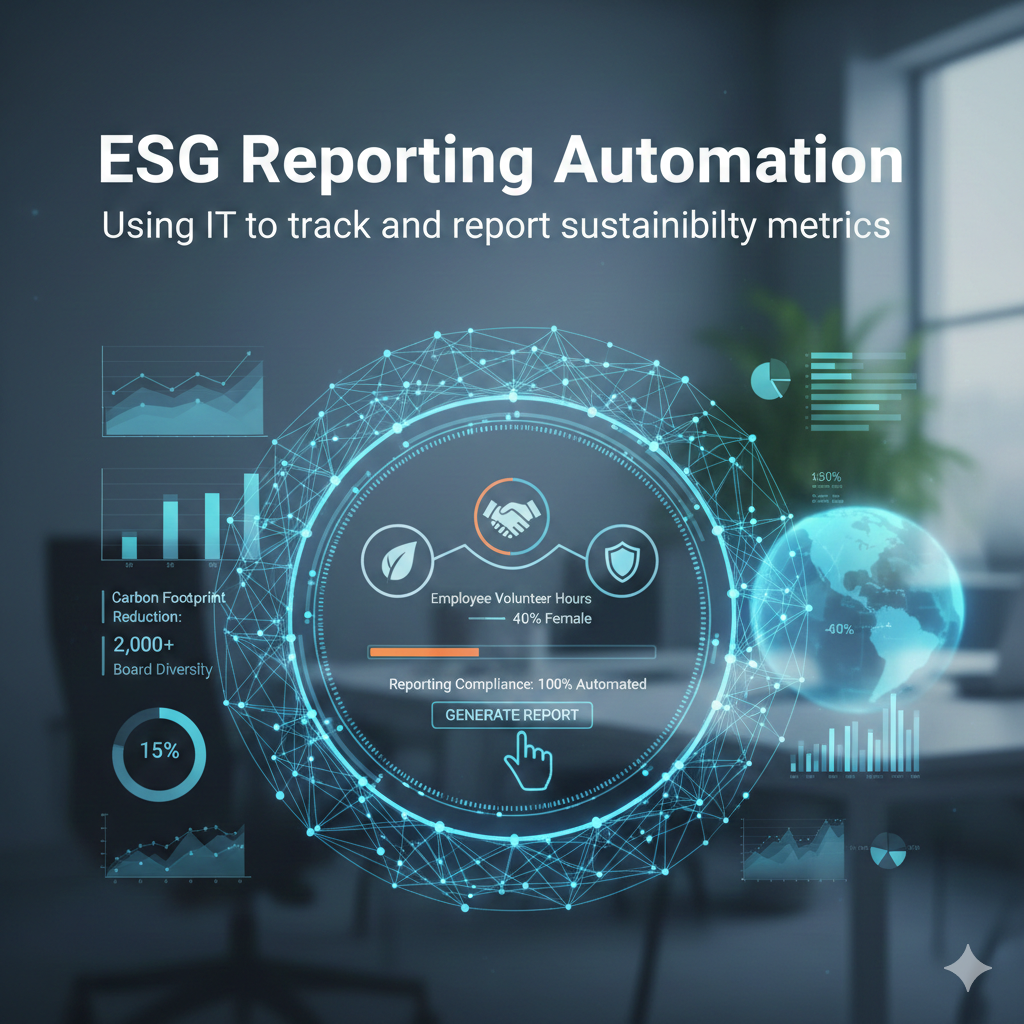
ESG Reporting Automation: Using IT to track and report sustainability metrics
 February 19, 2026
Introduction: Sustainability Meets Digital Transformation
Environmental, Social, and Governance (ESG) reporting has moved from being a voluntary initiative to a strategic business necessity. Investors, regulators, customers, and stakeholders now expect organizations to demonstrate measurable progress toward sustainability and ethical governance.
However, ESG reporting is complex. It involves collecting vast amounts of data across departments, ensuring accuracy, meeting regulatory requirements, and presenting information in standardized formats. Manual processes are time-consuming, error-prone, and difficult to scale.
This is where IT-driven ESG reporting automation is transforming the landscape. By leveraging digital tools, organizations can track sustainability metrics in real time, improve transparency, and ensure compliance—while saving time and resources.
Understanding ESG Reporting
ESG reporting refers to the disclosure of data related to an organization’s:
Environmental Factors
- Carbon emissions
- Energy consumption
- Waste management
- Water usage
- Resource efficiency
Social Factors
- Employee well-being
- Diversity and inclusion
- Labor practices
- Community engagement
Governance Factors
- Corporate ethics
- Board diversity
- Compliance
- Risk management
Frameworks such as Global Reporting Initiative and Sustainability Accounting Standards Board help standardize reporting and ensure consistency.
Organizations must collect, verify, and present this data regularly.
The Challenges of Manual ESG Reporting
Many organizations still rely on spreadsheets, emails, and manual tracking. This approach creates several challenges.
1. Data Fragmentation
ESG data comes from multiple sources:
- HR systems
- Energy meters
- Supply chains
- Finance systems
Manually consolidating this data is inefficient and increases the risk of errors.
2. Lack of Real-Time Visibility
Manual reporting provides only periodic snapshots.
Organizations cannot:
- Monitor progress continuously
- Identify issues quickly
- Make proactive decisions
This limits strategic impact.
3. Regulatory Complexity
Governments and regulators are introducing stricter ESG requirements.
For example, regulations such as the European Commission’s Corporate Sustainability Reporting Directive (CSRD) require detailed disclosures.
Manual systems struggle to keep up.
4. Increased Risk of Errors
Human errors in data collection and reporting can lead to:
- Compliance issues
- Reputational damage
- Loss of investor trust
Accuracy is critical.
How IT Enables ESG Reporting Automation
Technology simplifies and strengthens ESG reporting.
Automation tools can collect, process, analyze, and report data efficiently.
Key Technologies Driving ESG Automation
1. Cloud-Based ESG Platforms
Cloud platforms centralize ESG data.
They allow organizations to:
- Collect data automatically
- Access information from anywhere
- Scale easily
Cloud systems improve efficiency and collaboration.
2. Internet of Things (IoT)
IoT devices collect environmental data automatically.
Examples include:
- Energy meters tracking electricity usage
- Sensors monitoring water consumption
- Equipment measuring emissions
This eliminates manual data entry.
3. Data Analytics and Dashboards
Analytics tools convert raw data into meaningful insights.
Dashboards show:
- Emission trends
- Sustainability progress
- Performance metrics
Leadership can make informed decisions.
4. Artificial Intelligence (AI)
AI improves ESG reporting by:
- Identifying patterns
- Predicting risks
- Automating analysis
- Detecting anomalies
AI enhances accuracy and efficiency.
5. Integration with Enterprise Systems
ESG platforms integrate with:
- ERP systems
- HR software
- Financial systems
This ensures seamless data flow.
Automation reduces duplication.
Benefits of ESG Reporting Automation
1. Improved Accuracy
Automation reduces human errors.
Data is collected directly from systems.
This improves reliability.
2. Real-Time Monitoring
Organizations can track sustainability performance continuously.
This allows faster action.
3. Regulatory Compliance
Automated systems ensure compliance with:
- Global standards
- Government regulations
- Industry requirements
Compliance risks are minimized.
4. Time and Cost Savings
Manual reporting requires significant time and manpower.
Automation reduces workload.
Teams can focus on strategic initiatives.
5. Enhanced Transparency
Accurate ESG reporting builds trust with:
- Investors
- Customers
- Regulators
Transparency strengthens reputation.
ESG Reporting and Investor Expectations
Investors increasingly consider ESG performance in decision-making.
Strong ESG reporting helps organizations:
- Attract investment
- Improve valuation
- Reduce risk perception
Sustainability is now linked to financial performance.
Real-World Example of ESG Automation
Consider a manufacturing company tracking carbon emissions.
Without automation:
- Employees manually collect data
- Reports take weeks to prepare
- Errors occur frequently
With automation:
- Sensors collect emissions data automatically
- Dashboards show real-time metrics
- Reports generate instantly
The company improves efficiency and compliance.
Implementation Challenges and How to Overcome Them
Despite the benefits, implementation requires careful planning.
Challenge 1: Lack of Standardization
Different departments use different systems.
Solution: Implement a centralized ESG platform.
Challenge 2: Data Quality Issues
Incomplete or inaccurate data reduces effectiveness.
Solution: Use automated data collection.
Challenge 3: Integration Complexity
Connecting multiple systems is challenging.
Solution: Work with experienced IT partners.
Challenge 4: Organizational Resistance
Employees may resist new systems.
Solution: Provide training and support.
Steps to Implement ESG Reporting Automation
Organizations should follow a structured approach.
Step 1: Assess Current ESG Processes
Identify:
- Data sources
- Reporting gaps
- Manual processes
Assessment helps define requirements.
Step 2: Define ESG Metrics
Organizations must determine:
- What to measure
- How to measure
- Reporting frequency
Clear metrics ensure consistency.
Step 3: Select the Right Technology
Choose platforms that offer:
- Integration capabilities
- Scalability
- Security
- Compliance support
Technology selection is critical.
Step 4: Integrate Systems
Connect ESG platforms with existing systems.
Integration ensures automation.
Step 5: Train Teams
Employees must understand:
- How to use the system
- How to interpret data
Training ensures success.
Step 6: Monitor and Improve
Continuously monitor performance.
Improve processes over time.
The Role of IT Consulting in ESG Automation
IT consulting firms help organizations implement ESG automation successfully.
Their services include:
- ESG readiness assessment
- Technology selection
- Platform implementation
- System integration
- Data security
- Ongoing support
Expert guidance reduces risks and ensures smooth implementation.
ESG Automation and Competitive Advantage
Organizations that automate ESG reporting gain advantages.
They can:
- Respond faster to regulations
- Improve sustainability performance
- Enhance brand reputation
- Attract investors
Sustainability becomes a business strength.
The Future of ESG Reporting
ESG reporting will become more advanced.
Future trends include:
Real-Time ESG Reporting
Continuous monitoring instead of periodic reporting.
AI-Driven Sustainability Insights
AI will recommend sustainability improvements.
Increased Regulatory Requirements
Governments will demand more detailed reporting.
Greater Stakeholder Expectations
Customers and investors will demand transparency.
Organizations must prepare now.
Conclusion: Building a Sustainable Future with Technology
ESG reporting is no longer optional—it is essential for modern businesses.
Manual processes cannot keep up with growing complexity and regulatory requirements.
IT-driven ESG reporting automation enables organizations to:
- Track sustainability metrics accurately
- Ensure compliance
- Improve efficiency
- Build stakeholder trust
Technology transforms ESG reporting from a compliance task into a strategic advantage.
At CVDragon IT Consulting, we help organizations leverage advanced IT solutions to automate ESG reporting, improve transparency, and achieve sustainability goals.
The future belongs to organizations that combine sustainability with digital innovation.
ESG automation is not just about reporting—it is about building a better, more responsible future.