









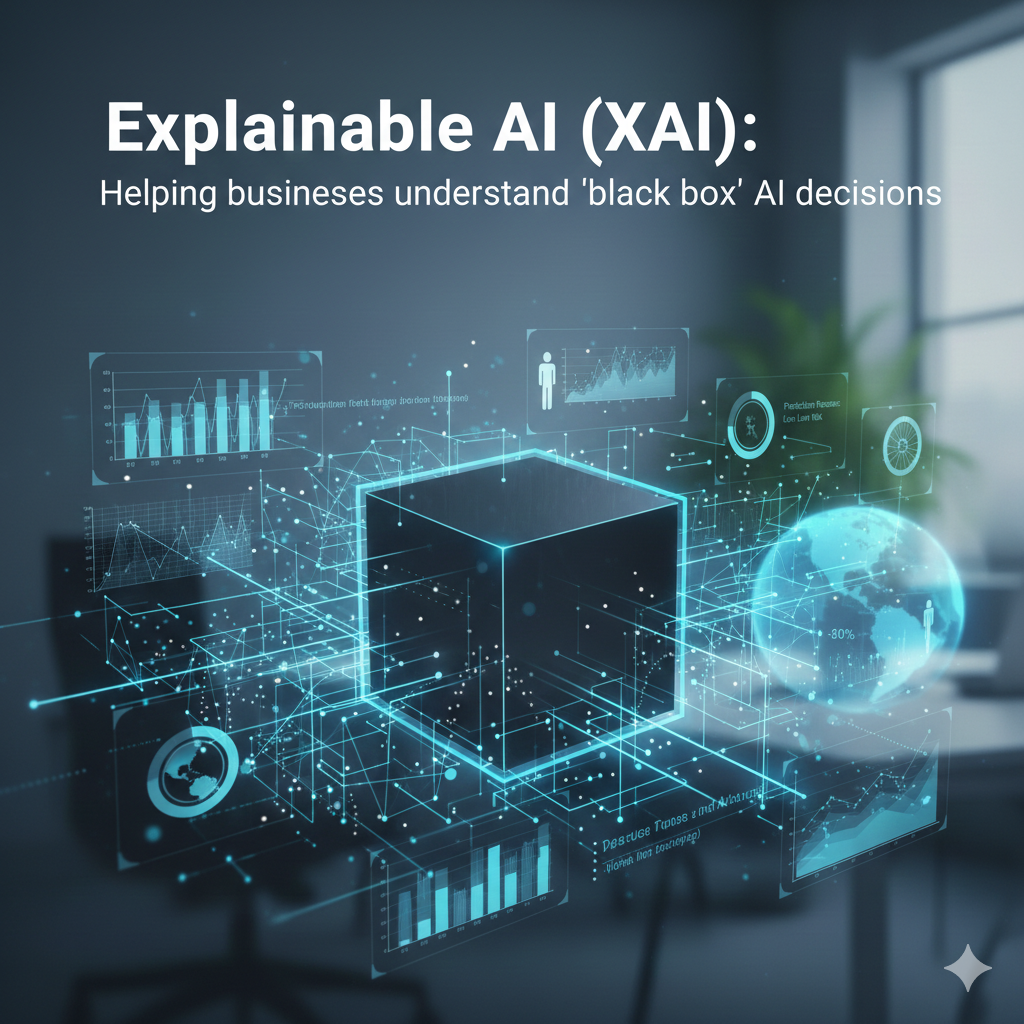
Explainable AI (XAI): Helping businesses understand “black box” AI decisions
 February 20, 2026
Introduction: The Trust Gap in Artificial Intelligence
Artificial Intelligence (AI) is transforming how businesses operate. From approving loans and detecting fraud to recommending products and predicting customer behavior, AI has become a powerful decision-making tool.
However, many AI systems operate as “black boxes.” They produce results without clearly explaining how they reached those conclusions. While the outputs may be accurate, the lack of transparency creates a major challenge: trust.
Business leaders, regulators, and customers increasingly want to understand not just what decision was made—but why it was made.
This is where Explainable AI (XAI) comes in. Explainable AI helps organizations understand, trust, and manage AI systems by making their decisions transparent and interpretable.
What Is Explainable AI?
Explainable AI (XAI) refers to methods and technologies that make AI decisions understandable to humans.
Instead of simply producing an output, XAI provides explanations such as:
- Which factors influenced the decision
- How important each factor was
- Why one outcome was chosen over another
In simple terms, XAI turns AI from a mystery into a transparent tool.
This is especially important for complex AI models like deep learning, which are often difficult to interpret.
Understanding the “Black Box” Problem
Many modern AI models, particularly neural networks, are highly complex. They process vast amounts of data and identify patterns that humans cannot easily see.
While this makes them powerful, it also makes them difficult to explain.
For example:
- A bank’s AI rejects a loan application
- A healthcare AI recommends a treatment
- A hiring AI rejects a candidate
Without explanation, organizations cannot answer critical questions such as:
- Was the decision fair?
- Was it biased?
- Was it correct?
- Can it be trusted?
This lack of transparency creates risks.
Why Explainable AI Matters for Businesses
Explainable AI is not just a technical feature—it is a business necessity.
1. Building Trust
Trust is essential for AI adoption.
When employees and customers understand AI decisions, they are more likely to accept and rely on them.
Transparency builds confidence.
2. Regulatory Compliance
Governments and regulators increasingly require AI transparency.
For example, regulations from organizations like the European Commission emphasize the importance of explainability in automated decision-making.
Businesses must be able to explain AI decisions to remain compliant.
3. Identifying and Reducing Bias
AI systems can unintentionally develop bias.
For example:
- Hiring AI may favor certain demographics
- Lending AI may discriminate unfairly
Explainable AI helps identify these issues.
Organizations can then improve fairness.
4. Improving Decision Quality
XAI helps businesses understand how AI works.
This allows them to:
- Identify errors
- Improve models
- Make better decisions
Explainability improves performance.
5. Risk Management
Unexplained AI decisions can create legal and reputational risks.
Explainable AI helps organizations:
- Justify decisions
- Defend against challenges
- Reduce liability
Transparency protects businesses.
Real-World Examples of Explainable AI
Banking and Finance
Banks use AI for:
- Loan approvals
- Fraud detection
- Credit scoring
Explainable AI helps banks explain:
- Why a loan was approved or rejected
- What factors influenced the decision
This improves customer trust.
Healthcare
Healthcare organizations use AI to:
- Diagnose diseases
- Recommend treatments
Doctors need explanations to trust AI recommendations.
Explainable AI supports better patient care.
Human Resources
Companies use AI for:
- Resume screening
- Hiring decisions
Explainable AI ensures hiring decisions are fair and unbiased.
Retail and E-Commerce
Retailers use AI for:
- Product recommendations
- Customer insights
Explainable AI helps businesses understand customer behavior.
This improves marketing strategies.
Key Techniques Used in Explainable AI
Explainable AI uses several techniques to make decisions understandable.
1. Feature Importance
This shows which factors influenced a decision most.
For example:
- Income level may influence loan approval
- Purchase history may influence recommendations
This helps businesses understand key drivers.
2. SHAP (SHapley Additive exPlanations)
SHAP explains individual predictions.
It shows:
- How each input contributed to the output
This is widely used in business applications.
3. LIME (Local Interpretable Model-Agnostic Explanations)
LIME explains specific decisions.
It helps understand:
- Why a particular prediction was made
This improves transparency.
4. Decision Trees and Rule-Based Models
These models are naturally explainable.
They show:
- Clear decision paths
- Logical rules
They are easier to understand.
5. Visualization Tools
Graphs and dashboards help visualize AI decisions.
Visual explanations are easier to interpret.
Benefits of Explainable AI for Organizations
Increased Trust in AI
Employees and customers trust transparent systems.
Trust increases adoption.
Better Business Decisions
Explainable insights help leaders make informed decisions.
AI becomes a strategic tool.
Improved Compliance
Organizations can meet regulatory requirements.
Compliance risks are reduced.
Faster Problem Detection
Explainable AI helps identify errors quickly.
This improves reliability.
Competitive Advantage
Businesses that use transparent AI gain a competitive edge.
Transparency builds reputation.
Challenges in Implementing Explainable AI
Despite its benefits, implementing XAI can be challenging.
Complexity of AI Models
Some AI models are difficult to explain.
Advanced techniques are required.
Performance vs Explainability Trade-Off
Highly accurate models may be less explainable.
Businesses must balance both.
Lack of Expertise
Explainable AI requires specialized knowledge.
Organizations may need expert support.
Integration with Existing Systems
Implementing XAI requires system integration.
This requires planning and resources.
Best Practices for Implementing Explainable AI
Organizations should follow these best practices.
Choose Explainable Models When Possible
Use simpler models when appropriate.
This improves transparency.
Use Explainability Tools
Implement tools such as SHAP and LIME.
These improve understanding.
Monitor AI Decisions
Continuously review AI performance.
Ensure fairness and accuracy.
Train Employees
Help teams understand AI systems.
Training improves adoption.
Partner with IT Experts
Expert support ensures successful implementation.
The Role of IT Consulting in Explainable AI
IT consulting firms play a key role in helping businesses implement Explainable AI.
They help with:
- AI strategy development
- Model selection
- Explainability implementation
- Compliance support
- System integration
- Ongoing monitoring
With expert guidance, businesses can use AI confidently and responsibly.
The Future of Explainable AI
Explainable AI will become increasingly important.
Future trends include:
Stronger Regulations
Governments will require explainable AI.
Transparency will become mandatory.
Wider Adoption
More industries will adopt Explainable AI.
It will become standard practice.
Improved Tools
New tools will make AI easier to explain.
Explainability will improve.
Human-AI Collaboration
Humans and AI will work together more effectively.
Explainability will support collaboration.
Conclusion: Turning AI into a Trusted Business Partner
Artificial Intelligence is transforming business—but trust is essential.
Explainable AI helps businesses understand AI decisions, reduce risks, and improve outcomes.
It transforms AI from a black box into a transparent, reliable, and strategic tool.
Organizations that adopt Explainable AI will gain:
- Greater trust
- Better compliance
- Improved decision-making
- Competitive advantage
At CVDragon IT Consulting, we help businesses implement transparent and explainable AI solutions that drive innovation while ensuring accountability and trust.
The future of AI is not just powerful—it is explainable.