








Multi-Cloud Strategy
 May 6, 2026
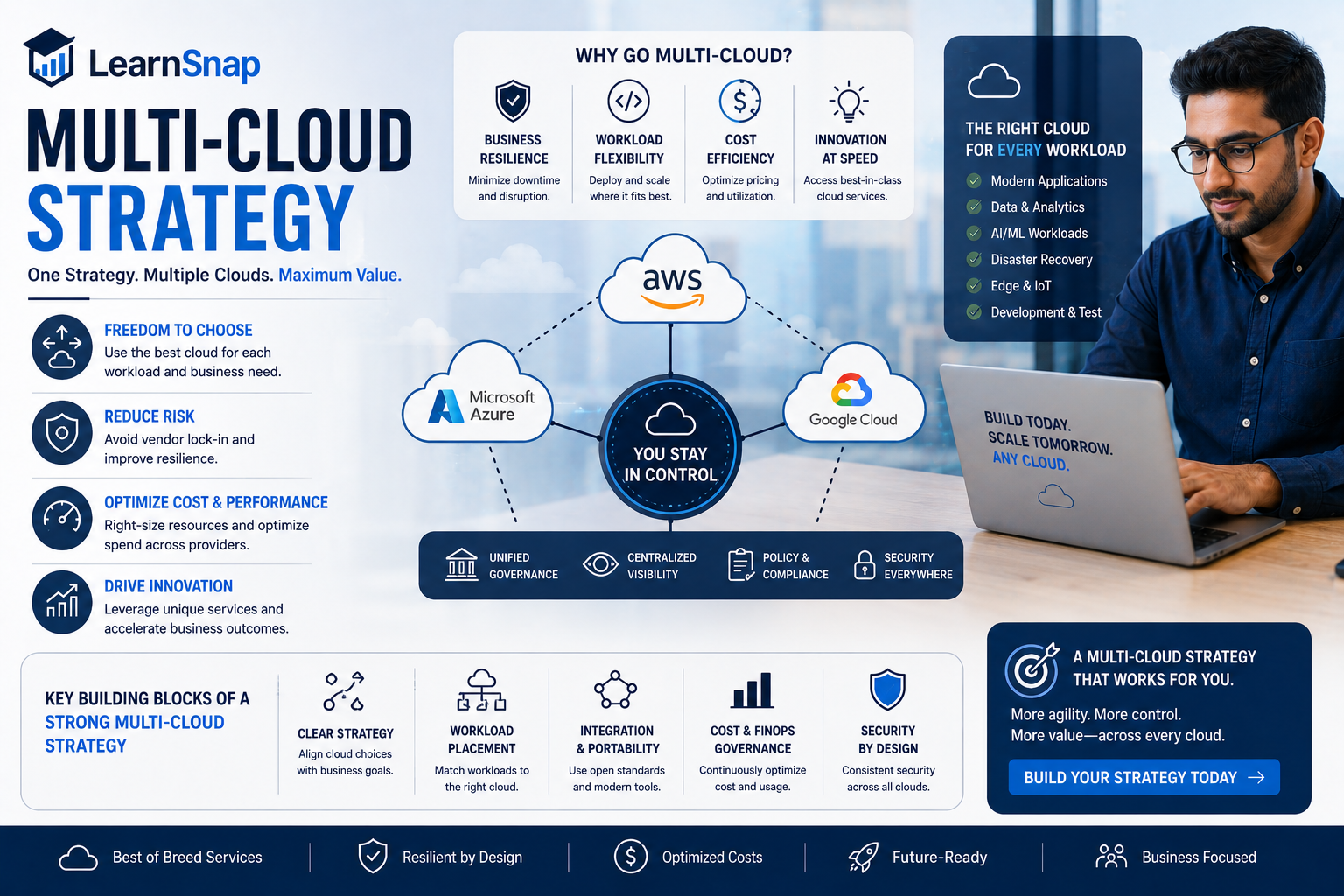
As businesses accelerate their digital transformation journeys, reliance on a single cloud provider is no longer the only option. Organizations today are increasingly adopting a multi-cloud strategy to improve flexibility, reduce risk, and optimize performance. By leveraging multiple cloud platforms, businesses can avoid vendor lock-in, enhance resilience, and choose the best services for different workloads. At CVDragon IT Consulting, we help organizations design and implement multi-cloud strategies that align with their business goals and deliver long-term value.
A multi-cloud strategy refers to the use of two or more cloud service providers within a single organization. Instead of depending on one platform, businesses distribute their applications, data, and services across multiple providers such as Amazon Web Services, Microsoft Azure, and Google Cloud Platform. Each provider offers unique strengths, and a multi-cloud approach allows businesses to leverage the best features of each.
One of the primary benefits of a multi-cloud strategy is vendor flexibility. Relying on a single provider can create dependency risks, including pricing changes, service limitations, or outages. Multi-cloud eliminates this dependency by allowing businesses to switch or balance workloads across providers as needed.
Another major advantage is improved resilience and reliability. By distributing applications across multiple cloud platforms, businesses can reduce the impact of outages or disruptions. If one provider experiences downtime, workloads can continue running on another platform, ensuring business continuity.
Performance optimization is another key driver. Different cloud providers excel in different areas—some may offer better analytics tools, while others provide superior machine learning capabilities or global infrastructure. A multi-cloud strategy allows organizations to choose the most suitable platform for each workload, improving overall performance.
Cost optimization is also a significant benefit. Cloud providers have different pricing models, and costs can vary based on usage patterns. By using multiple providers, businesses can take advantage of competitive pricing and optimize their cloud spending.
However, implementing a multi-cloud strategy comes with challenges. One of the biggest is complexity. Managing multiple cloud environments requires advanced skills, tools, and governance frameworks. IT consultants play a crucial role in simplifying this complexity by designing unified management systems and processes.
Integration is another critical aspect. Applications and data must be able to move seamlessly between different cloud platforms. IT consultants implement APIs, middleware, and integration tools to ensure smooth communication and interoperability.
Security is a top priority in multi-cloud environments. Each cloud provider has its own security model, and managing security across multiple platforms can be challenging. IT consultants establish consistent security policies, identity management systems, and monitoring tools to ensure data protection across all environments.
Data management is equally important. In a multi-cloud setup, data may be stored in different locations and formats. IT consultants help organizations implement data governance strategies that ensure consistency, accessibility, and compliance.
Automation plays a key role in managing multi-cloud environments. Automated provisioning, monitoring, and scaling help reduce manual effort and improve efficiency. IT consultants implement tools that provide centralized control and visibility across all cloud platforms.
Another important consideration is workload distribution. Not all applications are suitable for every cloud platform. IT consultants analyze workloads and determine the best placement based on performance, cost, and security requirements.
At CVDragon IT Consulting, our multi-cloud strategy approach includes:
- Assessment: Evaluating business needs and current infrastructure
- Strategy design: Defining a multi-cloud architecture
- Provider selection: Choosing the right cloud platforms
- Integration: Ensuring seamless connectivity between environments
- Security: Implementing unified security frameworks
- Optimization: Managing performance and costs
- Monitoring: Providing centralized visibility and control
Real-world examples highlight the effectiveness of multi-cloud strategies. A global enterprise may use one cloud provider for data analytics, another for application hosting, and a third for disaster recovery. This approach ensures optimal performance and resilience.
Another benefit of multi-cloud is innovation enablement. By accessing a wider range of tools and services, businesses can experiment with new technologies and accelerate innovation.
Scalability is also enhanced. Multi-cloud environments allow businesses to scale resources across multiple platforms, ensuring they can handle growing workloads without limitations.
In conclusion, a multi-cloud strategy provides businesses with flexibility, resilience, and the ability to optimize performance and costs. While it introduces complexity, the right consulting approach can turn it into a powerful competitive advantage. At CVDragon IT Consulting, we help organizations design and manage multi-cloud environments that support growth, innovation, and long-term success.
Partner with CVDragon IT Consulting to build a multi-cloud strategy that maximizes your technology potential and drives business excellence.