



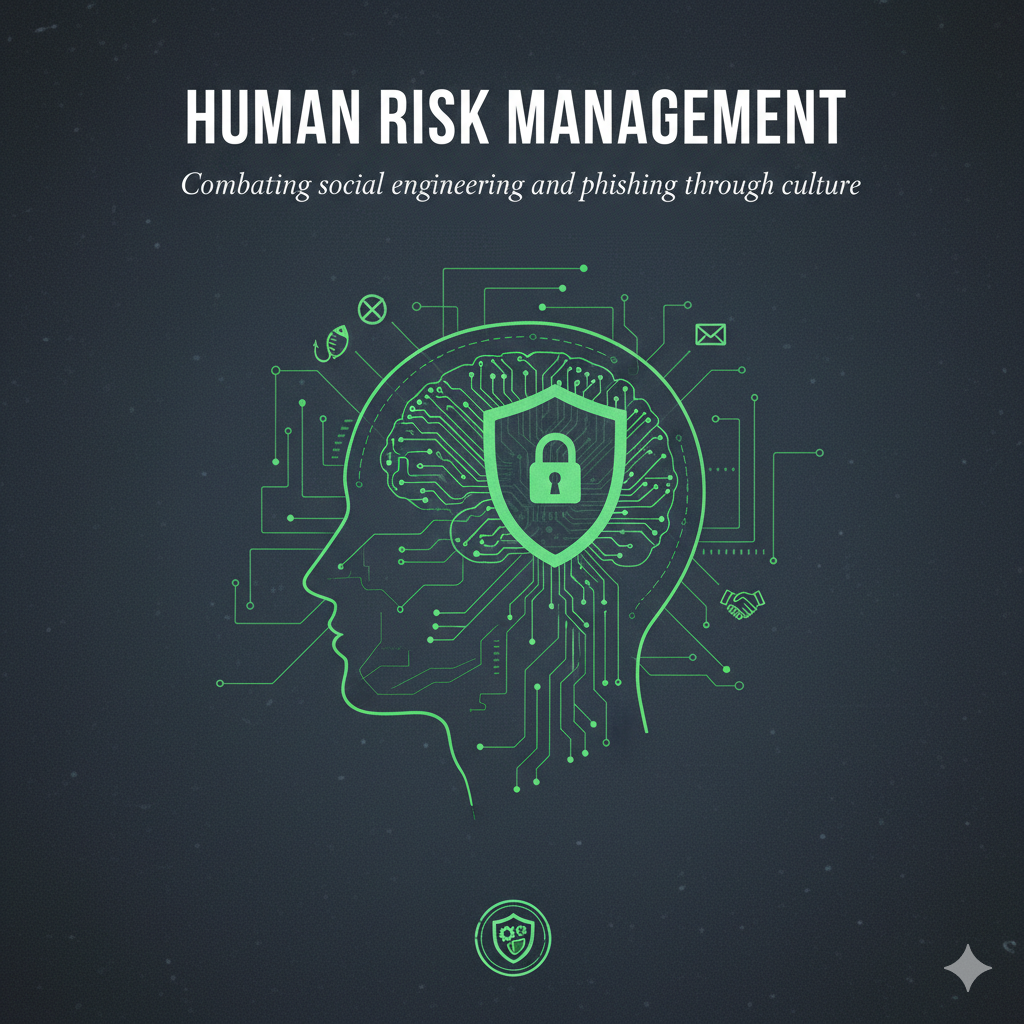
Human Risk Management: Combating social engineering and phishing through culture
 February 25, 2026
Introduction: The Human Element—Cybersecurity’s Greatest Strength and Weakness
Organizations invest heavily in cybersecurity tools—firewalls, encryption, endpoint protection, and advanced monitoring systems. Yet despite these investments, cyberattacks continue to rise. Why?
Because cybercriminals have discovered the easiest way in is not through systems—but through people.
Social engineering and phishing attacks target human psychology, not technical vulnerabilities. A single employee clicking on a malicious email can bypass millions of rupees worth of security infrastructure.
This is why organizations are shifting their focus from traditional cybersecurity to Human Risk Management (HRM)—a strategy that addresses human behavior as a critical part of cyber defense.
Cybersecurity is no longer just an IT issue. It is a people issue.
What Is Human Risk Management?
Human Risk Management is a structured approach to identifying, measuring, and reducing cybersecurity risks caused by human actions.
It focuses on:
- Employee awareness
- Behavior change
- Security culture
- Continuous education
- Risk monitoring
Instead of blaming employees, Human Risk Management empowers them to become the first line of defense.
The goal is to transform employees from security vulnerabilities into security assets.
Understanding Social Engineering and Phishing
Social engineering is the art of manipulating people into revealing confidential information or performing actions that compromise security.
Phishing is the most common form of social engineering.
It typically involves fraudulent emails, messages, or websites designed to trick users.
Cybercriminals often impersonate trusted organizations such as Microsoft or Google to appear legitimate.
Common phishing examples include:
- Fake login pages
- Fraudulent payment requests
- Fake password reset emails
- CEO impersonation scams
These attacks exploit trust, urgency, and human emotion.
Why Employees Are Targeted
Cybercriminals target employees because humans are easier to manipulate than machines.
Common psychological triggers include:
Urgency
“This is urgent. Respond immediately.”
Employees panic and act without thinking.
Authority
Attackers pretend to be senior executives.
Employees hesitate to question authority.
Fear
“Your account will be suspended.”
Fear leads to quick action.
Curiosity
“You received a confidential document.”
Curiosity drives clicks.
Technology cannot fully prevent these emotional responses.
Human Risk Management addresses this gap.
The Cost of Human Cyber Risk
Human error is responsible for a majority of cyber incidents globally.
Consequences include:
Financial loss
Data breaches
Reputation damage
Legal penalties
Operational disruption
Loss of customer trust
A single phishing attack can cost millions.
Prevention is far more cost-effective than recovery.
Why Traditional Security Training Fails
Many organizations conduct annual cybersecurity training.
However, this approach is often ineffective.
Problems include:
One-time training sessions
Generic content
Lack of engagement
No behavior tracking
No reinforcement
Employees forget what they learn.
Human Risk Management takes a continuous, behavior-driven approach.
Building a Human-Centric Security Culture
Security culture is the foundation of Human Risk Management.
It ensures employees think about security in their daily work.
1. Make Security Everyone’s Responsibility
Security is not just the IT team’s job.
Every employee plays a role.
Organizations must communicate this clearly.
Employees should feel responsible—not fearful.
2. Provide Continuous Security Awareness Training
Training should be ongoing.
Not once a year.
Regular training helps employees stay alert.
Modern training platforms like KnowBe4 provide interactive learning and phishing simulations.
These improve awareness.
3. Conduct Phishing Simulations
Simulated phishing attacks help test employees safely.
They help organizations:
Identify high-risk users
Measure improvement
Provide targeted training
This builds real-world readiness.
4. Encourage Reporting Without Fear
Employees should report suspicious emails without fear of punishment.
A blame-free culture encourages reporting.
This helps detect attacks early.
Fear prevents reporting.
Trust encourages it.
5. Leadership Involvement
Security culture starts at the top.
Leaders must:
Promote security awareness
Follow security practices
Support training initiatives
Employees follow leadership behavior.
Measuring Human Cyber Risk
Human Risk Management uses data to measure and reduce risk.
Key metrics include:
Phishing click rates
Reporting rates
Training completion rates
Risk scores
Behavior trends
This helps organizations improve continuously.
Security becomes measurable.
The Role of Technology in Human Risk Management
Technology supports Human Risk Management.
Tools include:
Phishing simulation platforms
Behavior analytics tools
Email security systems
Training platforms
Monitoring solutions
Platforms such as Proofpoint and Cisco provide human-centric security solutions.
Technology and culture work together.
Real-World Example
Consider a company without Human Risk Management.
An employee receives a phishing email.
They click the link.
They enter login credentials.
Attackers gain access.
Data is stolen.
Now consider a company with Human Risk Management.
Employee receives the same email.
Employee recognizes warning signs.
Employee reports email.
Attack is stopped.
The difference is awareness.
Key Components of an Effective Human Risk Management Program
Risk Assessment
Identify human vulnerabilities.
Understand employee risk levels.
Security Awareness Training
Provide engaging, regular training.
Keep employees informed.
Phishing Simulations
Test real-world readiness.
Improve behavior.
Behavior Monitoring
Track improvement.
Identify high-risk users.
Incident Response Training
Teach employees how to respond.
Quick response reduces damage.
Continuous Improvement
Human Risk Management is ongoing.
Threats evolve.
Training must evolve.
Benefits of Human Risk Management
Organizations gain multiple benefits.
Reduced Cyber Incidents
Employees avoid phishing attacks.
Risk decreases.
Improved Security Culture
Employees become security-conscious.
Security becomes part of daily work.
Financial Protection
Preventing attacks saves money.
Regulatory Compliance
Many regulations require security awareness.
Compliance improves.
Increased Employee Confidence
Employees feel empowered.
Confidence improves.
Human Risk Management and Zero Trust Security
Modern cybersecurity follows Zero Trust principles.
Zero Trust assumes no user is automatically trusted.
Human Risk Management supports Zero Trust.
It ensures employees verify before trusting.
This strengthens overall security.
Challenges in Human Risk Management
Organizations may face challenges.
Employee Resistance
Some employees may resist training.
Engaging content helps overcome this.
Lack of Awareness
Organizations may underestimate human risk.
Education helps leadership understand importance.
Limited Resources
Smaller organizations may lack expertise.
Consulting support helps implementation.
Maintaining Engagement
Ongoing engagement is essential.
Training must be interesting.
The Role of IT Consulting in Human Risk Management
IT consulting firms help organizations implement effective Human Risk Management programs.
Services include:
Risk assessments
Training implementation
Phishing simulations
Security culture development
Technology deployment
Monitoring and reporting
Expert guidance ensures success.
Future of Human Risk Management
Human Risk Management is becoming essential.
Future trends include:
AI-driven phishing attacks
Personalized security training
Behavior-based risk scoring
Integration with cybersecurity strategies
Human-focused security will become standard.
Organizations must prepare.
Why Culture Is the Strongest Cybersecurity Defense
Technology alone cannot stop social engineering.
Culture is the strongest defense.
When employees are aware, alert, and empowered, attackers fail.
Security culture transforms organizations.
People become protectors.
Not targets.
Conclusion: Turning Employees into Cybersecurity’s First Line of Defense
Cybersecurity is no longer just about technology.
It is about people.
Social engineering and phishing attacks exploit human behavior—but Human Risk Management transforms that vulnerability into strength.
By building a strong security culture, providing continuous training, and empowering employees, organizations can significantly reduce cyber risk.
Human Risk Management protects not just systems—but the entire organization.
At CVDragon IT Consulting, we help organizations implement human-centric cybersecurity strategies that build awareness, reduce risk, and create a strong security culture.
Because the most powerful cybersecurity defense is not a tool—it is an informed and empowered employee.