









Generative AI Governance: Establishing Ethical Guardrails and Bias Prevention
 January 27, 2026
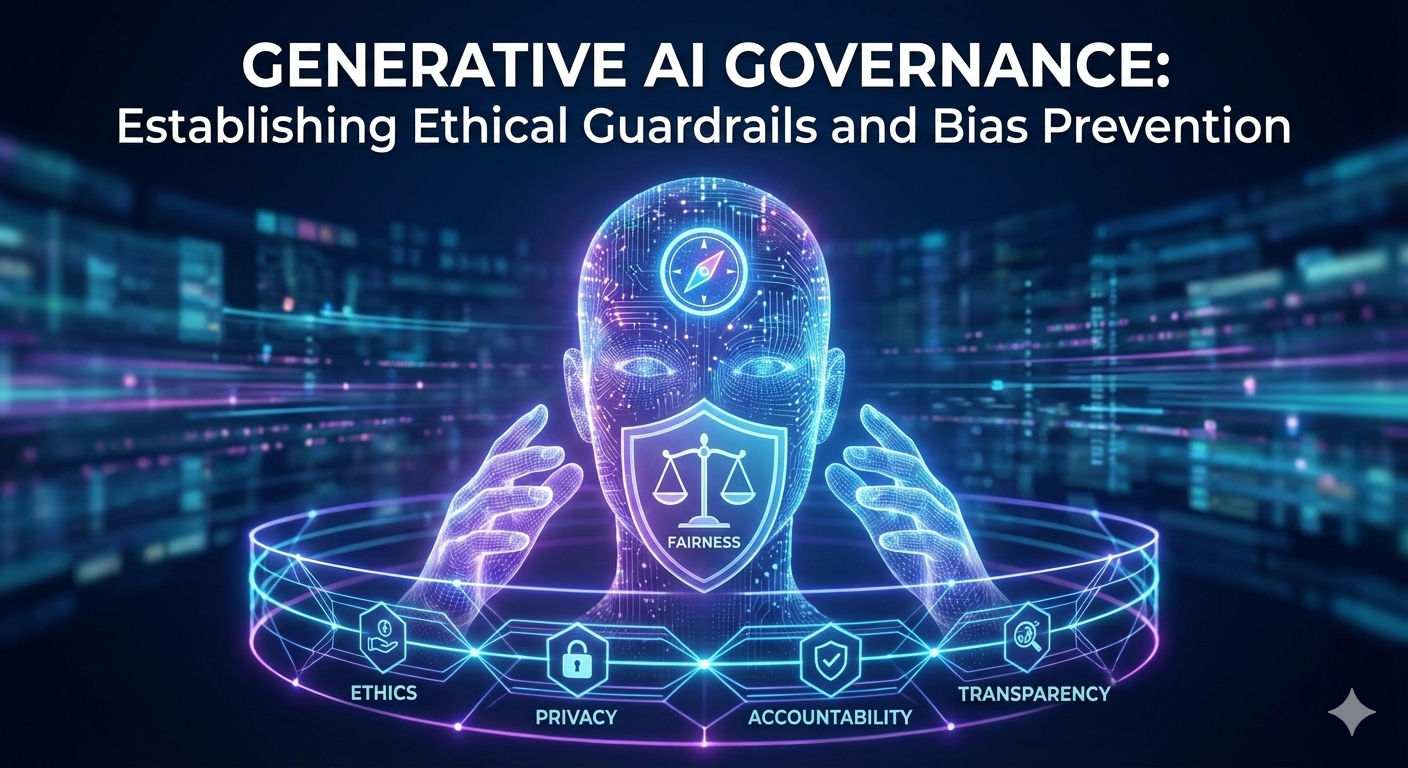
Generative AI is reshaping how organizations create content, write code, analyze data, interact with customers, and make decisions. From marketing copy and financial summaries to HR screening tools and customer service bots, generative AI systems are now deeply embedded in enterprise workflows.
But with this power comes responsibility.
As adoption accelerates, organizations are facing uncomfortable questions:
Can we trust AI-generated outputs?
How do we prevent bias, discrimination, or misinformation?
Who is accountable when AI makes a mistake?
These questions cannot be solved with technology alone. They require Generative AI Governance—a structured framework that establishes ethical guardrails, ensures fairness, and aligns AI usage with legal, cultural, and organizational values.
At cvDragon IT Consulting, we help enterprises move beyond experimental AI use toward governed, responsible, and scalable adoption. This article explores why generative AI governance matters, how bias enters AI systems, and what organizations must do to build ethical, trustworthy AI ecosystems.
Why Generative AI Governance Is No Longer Optional
Early AI adoption focused on speed and innovation. Governance was often an afterthought. Today, that approach is no longer sustainable.
Uncontrolled generative AI use can lead to:
- Biased or discriminatory outputs
- Legal and regulatory exposure
- Reputational damage
- Loss of customer and employee trust
- Inconsistent or misleading business decisions
Regulators worldwide are increasing scrutiny of AI systems, particularly around fairness, transparency, and accountability. At the same time, customers and employees expect organizations to use AI responsibly.
Generative AI governance provides the structure needed to scale AI safely and confidently.
What Is Generative AI Governance?
Generative AI governance is a set of policies, processes, roles, and controls that guide how AI systems are designed, deployed, used, and monitored within an organization.
It ensures that AI:
- Aligns with ethical principles
- Minimizes bias and harm
- Respects privacy and security requirements
- Remains transparent and auditable
- Has clear accountability
Governance does not slow innovation—it enables sustainable innovation by creating trust and clarity.
Understanding Bias in Generative AI
Bias is one of the most significant risks associated with generative AI.
Where Does Bias Come From?
Bias can enter AI systems through multiple channels:
- Training data bias: Historical data often reflects societal inequalities
- Selection bias: Overrepresentation or underrepresentation of groups
- Prompt bias: How users frame questions influences outputs
- Feedback loops: AI-generated content reinforcing existing patterns
Generative AI does not “invent” bias—it amplifies what already exists unless actively mitigated.
The Business Impact of AI Bias
Unchecked bias is not just an ethical issue—it is a business risk.
Potential consequences include:
- Discriminatory hiring or promotion recommendations
- Biased customer interactions
- Inaccurate market insights
- Regulatory penalties and lawsuits
- Erosion of brand credibility
Bias prevention must be embedded into AI governance from the start.
Core Principles of Generative AI Governance
At cvDragon IT Consulting, we help organizations build governance frameworks around a few foundational principles.
1. Accountability and Ownership
AI systems should never operate in a responsibility vacuum.
Organizations must clearly define:
- Who owns AI outcomes
- Who approves AI use cases
- Who is responsible for monitoring and remediation
Human accountability remains essential—even when AI is involved.
2. Transparency and Explainability
While generative AI models are complex, organizations should strive for transparency in:
- How AI is used
- What data it relies on
- Where its limitations lie
Users and stakeholders should understand when they are interacting with AI and how outputs are generated.
3. Fairness and Bias Mitigation
Governance frameworks must explicitly address fairness by:
- Testing outputs across demographic groups
- Monitoring for discriminatory patterns
- Updating models and prompts when bias is detected
Fairness is not a one-time checkbox—it requires continuous attention.
4. Privacy and Data Protection
Generative AI systems often process sensitive data.
Strong governance ensures:
- Compliance with data protection regulations
- Clear rules on what data AI can and cannot use
- Secure handling of prompts and outputs
Privacy-by-design is a critical component of ethical AI.
Establishing Ethical Guardrails for Generative AI
Ethical guardrails translate values into practical controls.
1. Define Ethical AI Guidelines
Organizations should document clear principles covering:
- Acceptable AI use cases
- Prohibited applications
- Human oversight requirements
- Non-discrimination standards
These guidelines serve as a foundation for all AI initiatives.
2. Implement Use Case Approval Processes
Not every AI use case carries the same level of risk.
High-impact areas—such as hiring, lending, healthcare, or legal analysis—require stricter review and approval.
Governance frameworks should classify AI use cases by risk level and apply controls accordingly.
3. Embed Ethics into Prompt Engineering
Prompts are powerful levers for AI behavior.
Standardized, governed prompts can:
- Instruct AI to avoid stereotypes
- Require balanced perspectives
- Flag uncertainty or limitations
- Enforce neutral and inclusive language
Prompt engineering becomes a frontline defense against bias.
Bias Prevention Strategies in Practice
Bias prevention is an ongoing process, not a one-time fix.
1. Regular Bias Testing and Audits
AI outputs should be tested periodically for:
- Disparate impact
- Inconsistent recommendations
- Harmful language or assumptions
Audits help detect issues before they cause harm.
2. Diverse Review and Oversight Teams
Bias is easier to spot when diverse perspectives are involved.
Governance committees should include representatives from:
- IT and data teams
- Legal and compliance
- HR and ethics
- Business leadership
This cross-functional approach strengthens decision-making.
3. Continuous Learning and Improvement
AI models, data sources, and business contexts evolve.
Governance frameworks must allow for:
- Continuous refinement of policies
- Updating prompts and controls
- Learning from incidents and feedback
Static governance quickly becomes ineffective.
The Role of IT Consulting in AI Governance
Generative AI governance sits at the intersection of technology, ethics, law, and business strategy. Few organizations can address all dimensions alone.
At cvDragon IT Consulting, we help enterprises:
- Assess current AI usage and risks
- Design governance frameworks aligned with regulations and values
- Establish ethical AI policies and guardrails
- Build bias monitoring and reporting mechanisms
- Integrate governance into existing IT and data structures
- Train leaders and employees on responsible AI use
Our goal is to help organizations innovate confidently—without compromising trust or integrity.
Balancing Innovation and Control
One of the biggest misconceptions about AI governance is that it slows innovation.
In reality, the absence of governance creates fear, uncertainty, and resistance. Well-designed governance provides:
- Clear boundaries for experimentation
- Faster approvals for low-risk use cases
- Confidence among leaders and users
- A foundation for scaling AI enterprise-wide
Governance enables speed by reducing risk.
Preparing for the Regulatory Future
AI regulation is evolving rapidly across regions and industries.
Organizations that invest in governance today will be better prepared for:
- New compliance requirements
- Audits and reporting obligations
- Increased public and regulatory scrutiny
Proactive governance is far less costly than reactive crisis management.
Conclusion: Trust as the True Currency of AI
Generative AI has enormous potential—but its long-term value depends on trust. Trust from customers, employees, regulators, and society at large.
Generative AI Governance is how organizations earn and protect that trust. By establishing ethical guardrails and actively preventing bias, enterprises can ensure AI serves as a force for progress rather than risk.
At cvDragon IT Consulting, we believe responsible AI is not a constraint—it is a competitive advantage. Organizations that govern AI well will innovate faster, operate more confidently, and build stronger relationships with the people they serve.
The future of AI belongs to those who combine intelligence with integrity.