




Agentic Orchestration: Managing Autonomous AI Agents in Business Workflows
 January 28, 2026
Artificial intelligence is entering a new phase. Organizations are no longer just experimenting with single AI models responding to isolated prompts. Instead, they are beginning to deploy autonomous AI agents—systems that can plan, decide, act, and collaborate with minimal human intervention.
From automating customer service escalations and managing IT incidents to optimizing supply chains and financial forecasting, these agents promise unprecedented speed and efficiency. But as autonomy increases, so does complexity. Without structure, multiple AI agents operating independently can create chaos rather than value.
This is where Agentic Orchestration becomes critical.
At cvDragon IT Consulting, we help enterprises design, govern, and manage agent-based AI systems so they work together coherently within business workflows. This article explores what agentic orchestration is, why it matters, and how organizations can safely operationalize autonomous AI at scale.
What Are Autonomous AI Agents?
Autonomous AI agents are systems capable of:
- Understanding objectives
- Breaking goals into tasks
- Making decisions based on context
- Interacting with tools, data, and other agents
- Learning from outcomes
Unlike traditional automation or single-response AI tools, agents operate continuously and proactively. They do not simply wait for instructions—they pursue goals within defined boundaries.
Examples include:
- An IT operations agent that detects incidents, diagnoses root causes, and triggers remediation
- A sales agent that analyzes pipeline data, prioritizes leads, and drafts follow-ups
- A finance agent that monitors spending patterns and flags anomalies
- A supply chain agent that coordinates inventory, logistics, and demand forecasts
As these agents multiply, orchestration becomes essential.
The Challenge: When AI Agents Act Alone
Deploying autonomous agents without orchestration introduces significant risks.
Common challenges include:
- Conflicting actions between agents
- Lack of visibility into decision-making
- Redundant or inefficient task execution
- Security and access control gaps
- Difficulty assigning accountability
- Escalation of errors at machine speed
Without coordination, AI agents can optimize locally while harming overall business outcomes.
Agentic orchestration ensures autonomy does not come at the cost of control.
What Is Agentic Orchestration?
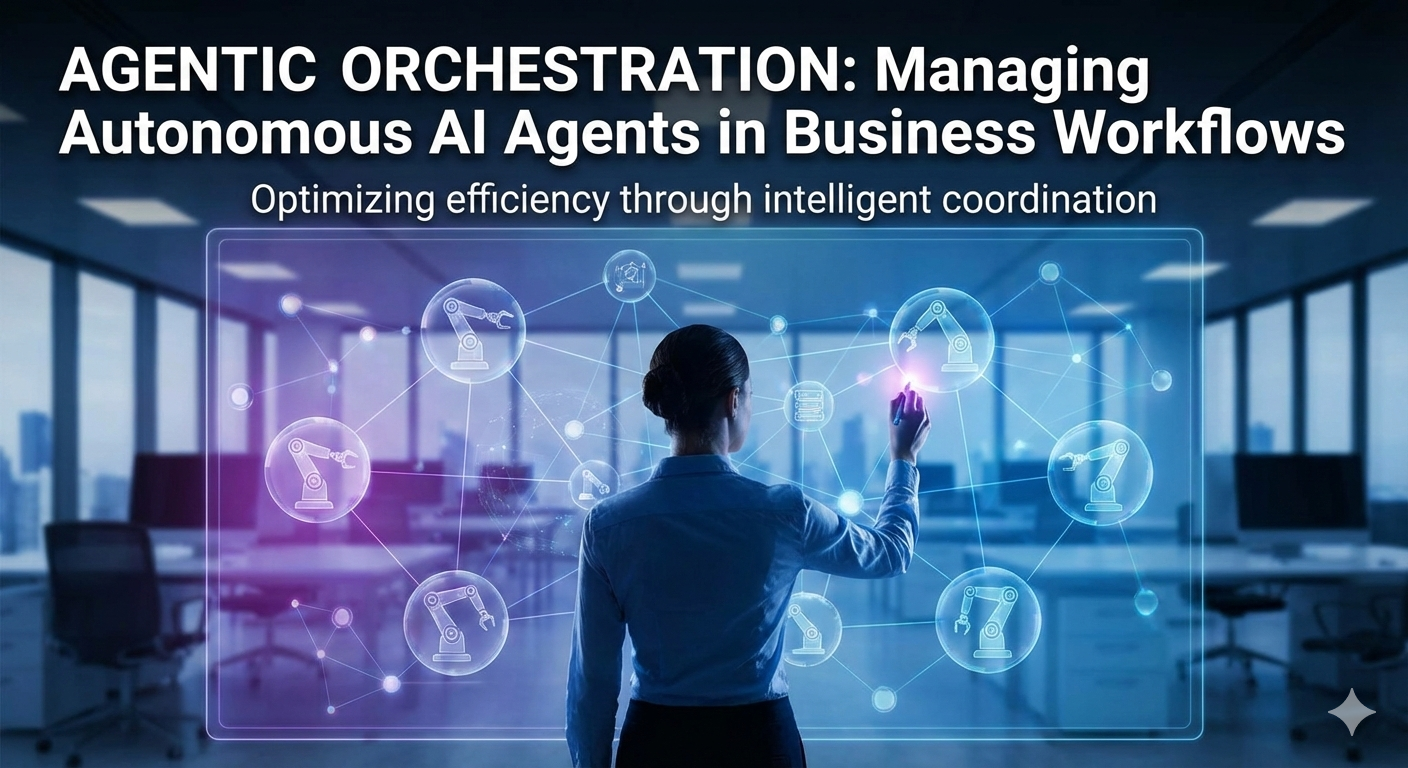
Agentic orchestration is the discipline of coordinating, supervising, and governing multiple autonomous AI agents within enterprise workflows.
It defines:
- How agents communicate and collaborate
- Which agent owns which decisions
- When human oversight is required
- How conflicts are resolved
- How performance, risk, and compliance are monitored
Think of agentic orchestration as the “operating system” for enterprise AI agents—ensuring alignment, safety, and efficiency.
Why Agentic Orchestration Matters for Enterprises
As agent-based AI systems become embedded in core operations, orchestration shifts from a technical concern to a strategic necessity.
1. Aligning AI Actions with Business Objectives
Agents are excellent at optimizing tasks—but business success depends on optimizing outcomes.
Orchestration ensures that:
- Agents act in alignment with enterprise goals
- Short-term optimizations do not undermine long-term strategy
- Decisions reflect organizational priorities
Without orchestration, agents may optimize metrics that no longer matter.
2. Preventing Agent Conflicts and Redundancy
Multiple agents operating independently can:
- Duplicate work
- Compete for resources
- Issue contradictory recommendations
Orchestration introduces coordination logic so agents collaborate rather than collide.
3. Enabling Human-in-the-Loop Control
Not all decisions should be fully autonomous.
Agentic orchestration defines:
- Which decisions require human approval
- When agents must escalate uncertainty
- How humans can intervene or override actions
This balance preserves trust and accountability.
Key Components of an Agentic Orchestration Framework
At cvDragon IT Consulting, we approach agentic orchestration as a layered framework.
1. Agent Role Definition
Each agent must have a clearly defined role, scope, and authority.
This includes:
- Responsibilities and objectives
- Data and system access boundaries
- Decision-making limits
Clear role definitions prevent overreach and confusion.
2. Workflow and Dependency Mapping
Agents rarely operate in isolation.
Orchestration maps:
- Task sequences
- Inter-agent dependencies
- Decision handoffs
This ensures agents act in the right order, at the right time, with the right context.
3. Communication and Coordination Mechanisms
Agents must share information efficiently and securely.
This may include:
- Event-driven messaging
- Shared state repositories
- Context propagation rules
Structured communication prevents misalignment and stale decisions.
4. Policy and Constraint Enforcement
Autonomy must operate within guardrails.
Orchestration enforces:
- Business rules
- Compliance requirements
- Security policies
- Ethical constraints
These policies guide agent behavior without micromanagement.
Governance and Risk Management in Agentic Systems
Agentic orchestration is inseparable from governance.
1. Accountability and Auditability
Organizations must be able to answer:
- Which agent made this decision?
- Why was this action taken?
- What data was used?
Orchestration platforms should provide logging, traceability, and explainability.
2. Bias and Error Containment
Errors in agentic systems can propagate quickly.
Orchestration enables:
- Cross-checking between agents
- Confidence thresholds for decisions
- Automated escalation of anomalies
This limits the blast radius of mistakes.
3. Security and Access Control
Agents often interact with sensitive systems.
Orchestration ensures:
- Least-privilege access
- Secure credential management
- Monitoring for abnormal behavior
Security must scale alongside autonomy.
Agentic Orchestration in Real Business Workflows
Agentic orchestration is already transforming enterprise operations.
IT Operations and Service Management
Multiple agents can monitor infrastructure, diagnose issues, recommend fixes, and execute remediation—while orchestration ensures actions are coordinated and approved when necessary.
Customer Experience and Support
Agents can handle inquiries, analyze sentiment, route escalations, and generate responses—while orchestration ensures consistent tone, policy compliance, and escalation logic.
Finance and Risk Management
Autonomous agents can monitor transactions, detect anomalies, forecast cash flow, and flag risks—coordinated through orchestration to ensure accuracy and governance.
Supply Chain and Operations
Agents can balance demand forecasts, inventory levels, supplier performance, and logistics decisions—aligned through orchestration to avoid conflicting optimizations.
The Role of IT Consulting in Agentic Orchestration
Managing autonomous AI agents requires expertise across architecture, governance, security, and change management.
At cvDragon IT Consulting, we help organizations:
- Assess readiness for agent-based AI
- Design agentic orchestration architectures
- Define agent roles, workflows, and policies
- Integrate orchestration with existing systems
- Establish governance and oversight models
- Train teams to manage and trust autonomous agents
Our approach ensures that autonomy delivers value—not risk.
Common Pitfalls to Avoid
Organizations often stumble when:
- Treating agents as isolated tools
- Underestimating governance complexity
- Allowing uncontrolled agent proliferation
- Ignoring change management and training
- Failing to define ownership and accountability
Agentic orchestration must be intentional, not accidental.
The Future of Agentic Enterprises
As AI agents become more capable, enterprises will increasingly resemble agent ecosystems rather than static systems.
Future trends include:
- Swarms of specialized agents collaborating dynamically
- Agent marketplaces within enterprises
- Cross-organizational agent coordination
- Regulation-driven orchestration standards
Organizations that master agentic orchestration early will gain a significant operational and competitive advantage.
Conclusion: From Autonomous Agents to Intelligent Enterprises
Autonomous AI agents represent a powerful shift in how work gets done. But autonomy without orchestration is risk without reward.
Agentic Orchestration is the key to transforming individual AI agents into a coordinated, governed, and trustworthy enterprise capability. It enables organizations to move faster, make better decisions, and scale AI responsibly.
At cvDragon IT Consulting, we believe the future of business lies not in replacing humans with AI—but in orchestrating intelligent agents that amplify human judgment, creativity, and strategy.
The enterprises that succeed will not be those with the most AI agents—but those who manage them best.