







Prompt Engineering for Enterprise: Standardizing internal AI communication
 January 24, 2026
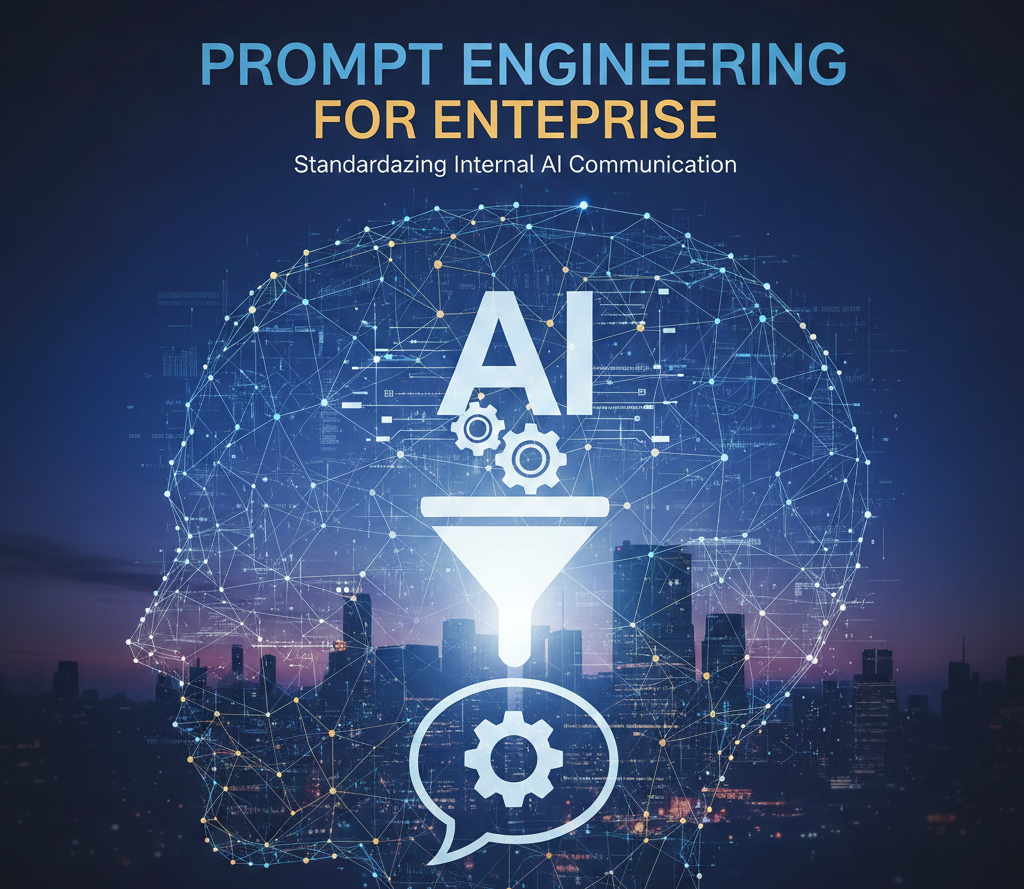
Artificial intelligence is no longer confined to experimental labs or isolated innovation teams. Across enterprises, AI tools are now embedded in marketing, HR, finance, software development, customer support, and strategic planning. Yet as adoption accelerates, many organizations are discovering an unexpected challenge—not with the AI models themselves, but with how people communicate with them.
Employees across departments use different prompts, different styles, and different assumptions when interacting with AI systems. The result? Inconsistent outputs, unreliable insights, compliance risks, and missed productivity gains. This is where Prompt Engineering for Enterprise becomes a strategic capability rather than a technical curiosity.
At cvDragon IT Consulting, we work with organizations to standardize internal AI communication through structured prompt engineering frameworks. This article explores why prompt engineering matters at the enterprise level, how standardization improves outcomes, and what it takes to operationalize prompt engineering across teams.
Why Prompt Engineering Matters in the Enterprise
AI models are powerful, but they are not mind readers. The quality of their output is directly tied to the clarity, structure, and intent of the input they receive.
In an enterprise setting, poor prompt practices can lead to:
- Inconsistent results across teams
- Hallucinated or misleading outputs
- Compliance and data leakage risks
- Wasted time refining or correcting AI responses
- Reduced trust in AI systems
Prompt engineering is the discipline of designing, testing, and refining prompts to consistently produce accurate, relevant, and safe outputs. When scaled across an organization, it becomes a foundation for reliable AI adoption.
The Problem: Fragmented AI Communication
Most enterprises adopt AI tools organically. Teams experiment independently, developing their own prompt styles and workflows. While this experimentation is valuable early on, it creates long-term problems.
Common issues include:
- Marketing prompts focused on creativity but lacking brand governance
- HR prompts generating biased or non-compliant responses
- Developers using AI differently across projects, reducing reusability
- Executives receiving inconsistent summaries and forecasts
Without standardization, AI becomes unpredictable—and unpredictability is unacceptable in enterprise environments.
What Is Enterprise Prompt Engineering?
Enterprise prompt engineering goes beyond writing “better prompts.” It is about creating repeatable, governed, and role-specific communication patterns between humans and AI systems.
Key characteristics include:
- Standard prompt templates for common tasks
- Clear context-setting and constraints
- Role-aware and domain-specific instructions
- Built-in compliance, tone, and accuracy controls
- Versioning and continuous improvement
This approach ensures AI behaves like a reliable digital collaborator—not a random assistant.
Standardization vs. Creativity: Finding the Balance
A common concern is that standardizing prompts will limit creativity or flexibility. In practice, the opposite is true.
Standardization provides:
- A reliable baseline for accuracy and compliance
- Faster onboarding for new users
- Reduced rework and iteration cycles
Creativity thrives when guardrails are clear. Teams can build on standardized prompts rather than starting from scratch every time.
Core Benefits of Standardized Prompt Engineering
1. Consistent AI Outputs Across the Organization
Standard prompts ensure that similar tasks yield comparable results, regardless of who uses the AI or which department initiates the request.
This consistency is critical for:
- Reporting and analytics
- Customer-facing content
- Legal and compliance workflows
- Strategic decision-making
2. Improved Productivity and Efficiency
Well-designed prompts reduce back-and-forth refinement. Employees spend less time “prompt tinkering” and more time applying insights.
Standard prompt libraries allow teams to:
- Reuse proven prompts
- Scale AI usage quickly
- Avoid redundant experimentation
3. Reduced Risk and Better Governance
Enterprise prompts can include built-in safeguards such as:
- Data usage boundaries
- Tone and bias controls
- Regulatory and policy constraints
- Explicit instructions to avoid speculation
This dramatically lowers the risk of non-compliant or misleading AI outputs.
4. Faster AI Adoption Across Roles
When prompts are documented and standardized, non-technical users can confidently adopt AI tools without fear of “doing it wrong.”
This democratizes AI usage while maintaining control.
Designing a Prompt Engineering Framework
At cvDragon IT Consulting, we help enterprises design prompt frameworks that align with business goals, governance needs, and user capabilities.
1. Identify High-Impact AI Use Cases
Not every AI interaction needs a standardized prompt. Focus on high-frequency, high-risk, or high-value use cases, such as:
- Executive summaries and reporting
- Customer communications
- Code reviews and documentation
- HR and policy-related content
- Market and competitive analysis
2. Define Prompt Structure Standards
Effective enterprise prompts typically include:
- Role definition: “You are acting as a compliance analyst…”
- Task clarity: What exactly needs to be done
- Context: Relevant background information
- Constraints: What to avoid or include
- Output format: Tables, summaries, bullet points, tone
Standardizing this structure improves predictability and quality.
3. Create Role-Specific Prompt Templates
Different roles need different AI behaviors.
For example:
- Marketing prompts emphasize brand voice and creativity
- Finance prompts prioritize accuracy and traceability
- IT prompts focus on logic, structure, and security
Prompt libraries should reflect these differences.
4. Embed Compliance and Ethics by Design
Prompt engineering is a powerful governance tool. Prompts can explicitly instruct AI to:
- Avoid personal data
- Flag uncertainty
- Cite assumptions
- Follow internal policies
This proactive approach is far more effective than reactive monitoring.
Operationalizing Prompt Engineering Across the Enterprise
Standardization only works when it is operationalized—not just documented.
1. Build an Internal Prompt Repository
A centralized prompt library allows teams to:
- Access approved prompts
- Share improvements
- Track versions and updates
This repository becomes a living knowledge asset.
2. Train Employees on Prompt Literacy
Prompt engineering is a new form of digital literacy. Training should focus on:
- How prompts influence outputs
- When to use standardized vs. custom prompts
- How to evaluate AI responses critically
The goal is not to turn everyone into an AI expert, but to create confident, responsible users.
3. Establish Prompt Governance
Enterprises need clear ownership for:
- Prompt approval and updates
- Compliance reviews
- Performance measurement
IT, legal, and business teams must collaborate closely.
4. Measure and Refine Continuously
Prompt effectiveness should be measured using metrics such as:
- Output accuracy
- User satisfaction
- Time saved
- Error reduction
Prompt engineering is iterative. Continuous refinement ensures long-term value.
The Role of IT Consulting in Prompt Engineering
Prompt engineering sits at the intersection of technology, governance, and business strategy—making it a natural fit for IT consulting.
At cvDragon IT Consulting, we support organizations by:
- Assessing current AI usage and risks
- Designing enterprise prompt frameworks
- Building role-specific prompt libraries
- Integrating prompt governance into IT policies
- Training teams and leaders
- Aligning AI communication with ESG, security, and compliance goals
Our approach ensures that AI scales safely, efficiently, and strategically.
Prompt Engineering and the Future of Work
As AI becomes embedded in daily workflows, prompt engineering will shape how knowledge work is performed.
Future trends include:
- Prompt-as-code integrated into workflows
- AI copilots guided by enterprise prompt standards
- Cross-model prompt portability
- Increased regulatory scrutiny of AI-generated outputs
Organizations that invest early in standardized AI communication will gain a lasting competitive advantage.
Common Pitfalls to Avoid
Enterprises should be cautious of:
- Over-standardization that ignores real-world nuance
- Treating prompts as static documents
- Leaving prompt design solely to technical teams
- Ignoring change management and training
Prompt engineering is as much about people as it is about technology.
Conclusion: Making AI a Reliable Enterprise Partner
AI has enormous potential—but only when it is used consistently, responsibly, and strategically. Prompt Engineering for Enterprise transforms AI from an unpredictable tool into a dependable organizational capability.
By standardizing internal AI communication, organizations can unlock higher productivity, reduce risk, and build trust in AI-driven decision-making.
At cvDragon IT Consulting, we believe the future of enterprise AI will not be defined by who has the best model—but by who communicates with AI most effectively. Prompt engineering is the bridge between AI capability and business value.