
Agile Beyond Software: Applying Agile Methodologies to Enterprise IT Operations
 January 30, 2026
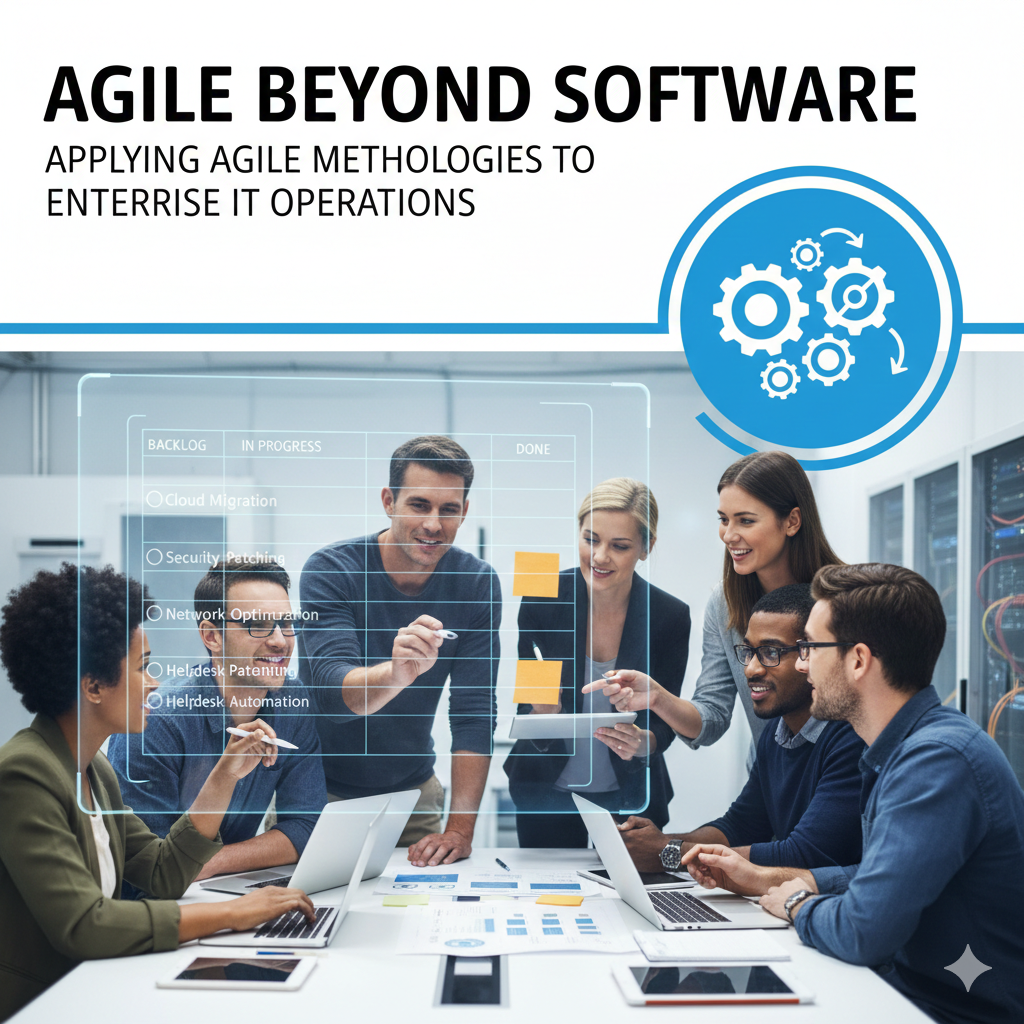
For years, Agile was seen as a methodology reserved for software development teams—scrums, sprints, backlogs, and stand-ups largely confined to developers writing code. But as enterprises face faster market shifts, rising customer expectations, and increasing IT complexity, a powerful realization has emerged: Agile is not just a software practice—it is an operating mindset.
Today, organizations are applying Agile principles across enterprise IT operations, from infrastructure and security to service management and governance. This evolution—often referred to as Agile beyond software—is redefining how IT delivers value to the business.
At cvDragon IT Consulting, we help organizations move Agile out of development silos and into the heart of enterprise IT operations. This article explores why Agile matters beyond software, how it transforms IT operations, and what it takes to adopt Agile successfully at scale.
Why Traditional IT Operations Are Under Pressure
Enterprise IT operations were traditionally designed for stability and predictability. Processes emphasized control, documentation, and long planning cycles. While this approach worked in slower environments, it struggles in today’s reality.
Modern IT operations face:
- Rapidly changing business requirements
- Hybrid and multi-cloud complexity
- Continuous cybersecurity threats
- Always-on digital services
- Rising expectations for speed and reliability
Rigid, sequential processes cannot keep up. Enterprises need IT operations that are adaptive, responsive, and customer-centric—the very strengths of Agile.
What Does Agile Mean Beyond Software?
At its core, Agile is not about tools or ceremonies. It is about principles:
- Deliver value early and continuously
- Respond to change over rigid plans
- Encourage collaboration over silos
- Enable transparency and feedback
- Empower teams to make decisions
When applied to enterprise IT operations, Agile reshapes how services are delivered, how teams collaborate, and how value is measured.
From Projects to Products and Services
One of the most important shifts in Agile IT operations is moving from a project-centric to a service- or product-centric mindset.
Traditional IT often treats infrastructure upgrades, security initiatives, or process improvements as one-time projects. Agile reframes these as ongoing services that evolve continuously based on business needs.
This shift enables:
- Continuous improvement instead of periodic overhauls
- Better alignment with business outcomes
- Faster response to operational issues and opportunities
Applying Agile Principles to IT Operations
Agile adoption in IT operations looks different from software development—but the principles remain the same.
1. Agile Infrastructure and Cloud Operations
Infrastructure teams are increasingly adopting Agile ways of working.
Instead of long provisioning cycles and rigid change windows, Agile infrastructure focuses on:
- Incremental improvements
- Automation and Infrastructure as Code
- Short feedback loops
- Cross-functional collaboration
Agile enables infrastructure teams to support rapid application changes without compromising stability.
2. Agile IT Service Management (ITSM)
Traditional ITSM frameworks often prioritize process compliance over customer experience. Agile complements ITSM by emphasizing adaptability and value delivery.
Agile ITSM practices include:
- Iterative service improvement
- Flexible incident and problem management
- Collaborative resolution across teams
- Customer-focused service metrics
The result is IT services that evolve with business needs rather than lag behind them.
3. Agile Security and Operations (DevSecOps Mindset)
Security can no longer be a late-stage checkpoint.
Agile operations integrate security continuously by:
- Embedding security teams into delivery workflows
- Automating compliance checks
- Treating security controls as evolving capabilities
This approach improves resilience while maintaining speed.
Breaking Down Silos with Cross-Functional Teams
Enterprise IT operations are often fragmented—network teams, infrastructure teams, application teams, security teams, and support teams working independently.
Agile promotes cross-functional collaboration, enabling teams to:
- Share responsibility for outcomes
- Resolve issues faster
- Reduce handoffs and delays
By organizing teams around services or value streams rather than technical silos, IT operations become more cohesive and responsive.
Agile Planning for IT Operations
Agile does not eliminate planning—it changes how planning is done.
Instead of annual, rigid plans, Agile IT operations rely on:
- Rolling roadmaps
- Short planning cycles
- Continuous prioritization
- Regular retrospectives
This allows IT leaders to adapt quickly as business priorities shift.
Measuring Success: From Outputs to Outcomes
Traditional IT operations often measure success through outputs—uptime, ticket volumes, or SLA compliance. While important, these metrics do not always reflect business value.
Agile shifts the focus to outcomes, such as:
- Faster service recovery
- Improved user satisfaction
- Reduced time to deliver changes
- Increased operational resilience
Outcome-driven metrics ensure IT efforts align with what truly matters to the business.
The Role of Leadership in Agile IT Operations
Agile transformation in IT operations requires strong leadership support.
Leaders must:
- Empower teams to make decisions
- Encourage experimentation and learning
- Shift from command-and-control to servant leadership
- Accept that not all change is predictable
Without leadership buy-in, Agile becomes a surface-level exercise rather than a cultural shift.
Common Challenges in Adopting Agile Beyond Software
While the benefits are clear, organizations often face obstacles.
1. Cultural Resistance
Teams accustomed to rigid processes may resist Agile practices. Change management and communication are critical.
2. Misunderstanding Agile
Applying software-centric Agile rituals blindly to operations can fail. Agile must be adapted—not copied.
3. Governance and Compliance Concerns
Highly regulated environments worry about losing control. In reality, Agile can strengthen governance through transparency and continuous monitoring.
4. Tool-Centric Transformations
Agile is not achieved by adopting new tools alone. Without mindset and process changes, tools add little value.
How IT Consulting Enables Agile at Scale
Agile beyond software is complex because it touches processes, people, technology, and governance.
At cvDragon IT Consulting, we help organizations:
- Assess operational readiness for Agile
- Design Agile operating models for IT operations
- Align Agile practices with ITSM, security, and governance
- Restructure teams around value streams
- Define Agile metrics and reporting
- Train leaders and teams for sustainable change
Our approach balances agility with stability—ensuring operational excellence is never compromised.
Agile IT Operations and Digital Transformation
Agile IT operations are a cornerstone of successful digital transformation.
They enable organizations to:
- Scale cloud and platform initiatives
- Support AI and data-driven systems
- Respond rapidly to market changes
- Improve customer and employee experiences
Without Agile operations, digital transformation efforts often stall after initial success.
The Future of Agile in Enterprise IT
Agile beyond software will continue to evolve.
Emerging trends include:
- Value stream–based IT operating models
- Integration of Agile with AI-driven operations
- Greater focus on resilience and sustainability
- Agile governance and compliance automation
Enterprises that embrace these trends will be better equipped for continuous change.
Conclusion: Agile as an IT Operating Philosophy
Agile is no longer just a development methodology—it is a way of running IT.
By applying Agile principles to enterprise IT operations, organizations gain the flexibility, speed, and alignment needed to thrive in a digital-first world. The goal is not chaos or constant change, but controlled adaptability.
At cvDragon IT Consulting, we believe Agile beyond software is the natural evolution of enterprise IT. When done right, it transforms IT from a support function into a strategic partner—one that continuously delivers value, resilience, and innovation.
Agile is not about doing more with less. It’s about doing the right things, at the right time, with the right mindset.