







Hyper-Automation in Finance: Integrating RPA with AI for end-to-end accounting
 February 27, 2026
The finance function has long been viewed as the backbone of every organization—responsible for accuracy, compliance, reporting, and strategic decision-making. Yet, despite rapid digital transformation across industries, many finance departments still rely heavily on manual processes, spreadsheets, and fragmented systems. These inefficiencies slow operations, increase operational risk, and prevent finance teams from focusing on strategic growth.
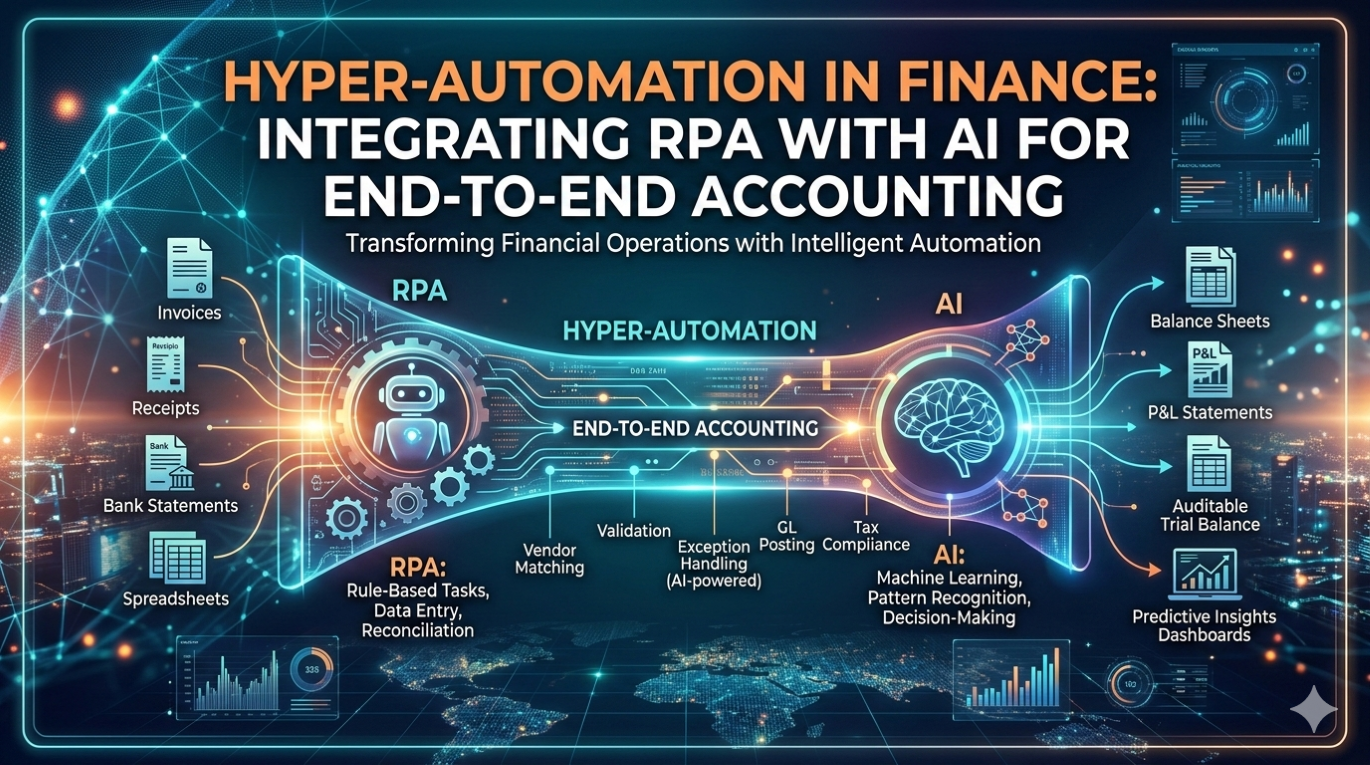
Enter hyper-automation—a transformative approach that combines Robotic Process Automation (RPA), Artificial Intelligence (AI), machine learning, analytics, and workflow automation to create fully integrated, intelligent financial ecosystems. Rather than automating isolated tasks, hyper-automation enables organizations to redesign finance operations from end to end.
At CVDragon IT Consulting, we help businesses move beyond basic automation toward intelligent, scalable finance operations that drive efficiency, accuracy, and real-time insight. This article explores how integrating RPA with AI is reshaping accounting functions and enabling truly autonomous finance systems.
Understanding Hyper-Automation in Finance
Hyper-automation goes beyond traditional automation. While RPA focuses on mimicking repetitive human actions—such as data entry or invoice processing—hyper-automation introduces intelligence into workflows.
It connects multiple technologies to achieve continuous automation across the entire financial lifecycle, including:
- Procure-to-pay processes
- Order-to-cash cycles
- Financial reporting
- Compliance monitoring
- Risk assessment
- Forecasting and planning
Instead of employees manually managing workflows, intelligent systems handle routine operations while humans focus on analysis, governance, and strategic decisions.
In simple terms:
RPA executes tasks, AI understands data, and hyper-automation orchestrates everything together.
Why Finance Departments Need Hyper-Automation
Finance teams today face increasing pressure from multiple directions:
- Growing regulatory requirements
- Rising transaction volumes
- Demand for real-time financial visibility
- Cost optimization expectations
- Increasing cybersecurity risks
Manual accounting systems struggle to keep pace with these demands.
Common challenges include:
- Duplicate data entry across systems
- Delayed month-end closures
- Human errors in reconciliation
- Inefficient audit preparation
- Limited predictive financial insights
Hyper-automation addresses these issues by creating a seamless digital finance environment where processes operate continuously with minimal human intervention.
The Role of RPA in Financial Automation
Robotic Process Automation acts as the operational foundation of hyper-automation.
RPA bots can perform structured, rule-based activities such as:
- Extracting invoice data
- Processing vendor payments
- Updating ERP systems
- Matching purchase orders
- Generating financial reports
- Performing reconciliations
For example, an RPA bot can automatically collect invoices from emails, extract relevant information, validate entries, and update accounting software—reducing hours of manual work into minutes.
However, RPA alone has limitations. It struggles with unstructured data, exceptions, and decision-making scenarios. This is where AI becomes essential.
How AI Enhances Financial Processes
Artificial Intelligence introduces cognitive capabilities into accounting operations.
AI systems can:
- Interpret unstructured documents
- Detect anomalies and fraud patterns
- Predict cash flow trends
- Classify financial transactions
- Identify compliance risks
- Learn from historical financial data
For instance, AI-powered systems can analyze thousands of transactions to identify unusual spending patterns that may signal fraud or accounting errors—something traditional automation cannot easily accomplish.
By combining AI with RPA, organizations achieve intelligent automation capable of adapting and improving over time.
End-to-End Accounting Through Hyper-Automation
True hyper-automation connects every stage of financial management into one continuous workflow.
1. Intelligent Data Capture
AI extracts financial data from invoices, receipts, contracts, and bank statements regardless of format. RPA then transfers validated data into enterprise systems automatically.
2. Automated Transaction Processing
Routine accounting entries, approvals, and validations occur without manual input. Exceptions are flagged for human review.
3. Continuous Reconciliation
Instead of monthly reconciliation cycles, automated systems reconcile accounts in real time—reducing closing timelines significantly.
4. Smart Compliance Monitoring
AI continuously monitors transactions against regulatory rules and internal policies, helping organizations remain audit-ready at all times.
5. Predictive Financial Insights
Machine learning models forecast revenue trends, expenses, and liquidity risks, allowing proactive financial planning.
The result is an accounting ecosystem that operates continuously rather than periodically.
Business Benefits of Hyper-Automation in Finance
Organizations adopting hyper-automation experience measurable improvements across operations.
Increased Efficiency
Automation eliminates repetitive manual tasks, enabling finance professionals to focus on strategic analysis instead of administrative work.
Reduced Operational Costs
Automated workflows lower labor costs while minimizing expensive errors and rework.
Faster Financial Closures
Companies can reduce month-end or year-end closing cycles from weeks to days—or even hours.
Improved Accuracy
AI-driven validation reduces human error in data processing and reporting.
Enhanced Compliance
Continuous monitoring ensures adherence to regulatory requirements and internal controls.
Real-Time Decision Making
Executives gain instant access to financial insights instead of relying on historical reports.
Real-World Use Cases
Automated Accounts Payable
Hyper-automation processes invoices automatically—from receipt to payment—while detecting duplicate billing or policy violations.
Intelligent Expense Management
AI categorizes expenses, verifies compliance, and flags suspicious claims without manual auditing.
Financial Forecasting
Machine learning models analyze historical performance and market variables to produce accurate forecasts.
Audit Automation
Digital audit trails and automated documentation simplify compliance and reduce audit preparation time.
Challenges Organizations Must Address
Despite its advantages, implementing hyper-automation requires thoughtful planning.
Legacy System Integration
Older financial systems may lack compatibility with modern automation tools.
Change Management
Employees may resist automation due to fear of job displacement.
Data Quality Issues
Automation depends heavily on clean, structured financial data.
Governance and Oversight
Organizations must maintain transparency and accountability in automated decisions.
Successful implementation requires balancing technology adoption with organizational readiness.
The Human Role in an Automated Finance Future
A common misconception is that automation replaces finance professionals. In reality, hyper-automation elevates their role.
Finance teams transition from:
- Data entry → Financial analysis
- Transaction processing → Strategic advisory
- Manual auditing → Risk management
Human expertise becomes more valuable in interpreting insights, guiding strategy, and ensuring ethical financial governance.
Automation handles repetition; humans drive innovation.
Implementation Strategy for Hyper-Automation
At CVDragon IT Consulting, we recommend a phased approach:
Step 1: Process Discovery
Identify repetitive, high-volume financial tasks suitable for automation.
Step 2: Automation Prioritization
Focus on processes delivering quick ROI, such as invoice processing or reconciliations.
Step 3: RPA Deployment
Introduce bots to stabilize workflows and eliminate manual effort.
Step 4: AI Integration
Add intelligence for decision-making, anomaly detection, and forecasting.
Step 5: Continuous Optimization
Monitor performance and refine automation using analytics and feedback.
This structured approach ensures sustainable transformation rather than disruptive change.
The Future of Finance: Autonomous Operations
Hyper-automation represents the evolution toward autonomous finance, where systems independently manage operational accounting while leadership focuses on growth strategy.
Emerging trends shaping this future include:
- Self-learning accounting platforms
- Real-time financial ecosystems
- Autonomous compliance monitoring
- AI-driven financial planning
- Intelligent digital CFO dashboards
Organizations adopting these technologies early gain a competitive advantage through agility, transparency, and cost efficiency.
Why Partner with CVDragon IT Consulting?
Implementing hyper-automation is not just a technology upgrade—it is a strategic transformation.
CVDragon IT Consulting supports businesses through:
- Finance automation strategy development
- RPA and AI integration
- Cloud-based accounting transformation
- Compliance-ready automation frameworks
- Continuous optimization and support
Our goal is to help organizations build resilient, scalable, and intelligent finance operations aligned with long-term business objectives.
Conclusion
Finance departments are no longer confined to bookkeeping and reporting. In today’s data-driven economy, they serve as strategic engines guiding organizational growth. Hyper-automation—powered by the integration of RPA and AI—enables finance teams to move from reactive operations to proactive intelligence.
By automating end-to-end accounting processes, businesses achieve faster reporting, improved compliance, reduced costs, and deeper financial insight. More importantly, they empower finance professionals to focus on what truly matters: strategy, innovation, and value creation.
As digital transformation accelerates, organizations that embrace hyper-automation today will define the financial leadership standards of tomorrow.
CVDragon IT Consulting remains committed to helping enterprises unlock the full potential of intelligent finance—turning automation into a competitive advantage rather than just an operational upgrade.