







Incident Response Drills: Consulting on “Tabletop Exercises” for breach readiness
 February 28, 2026
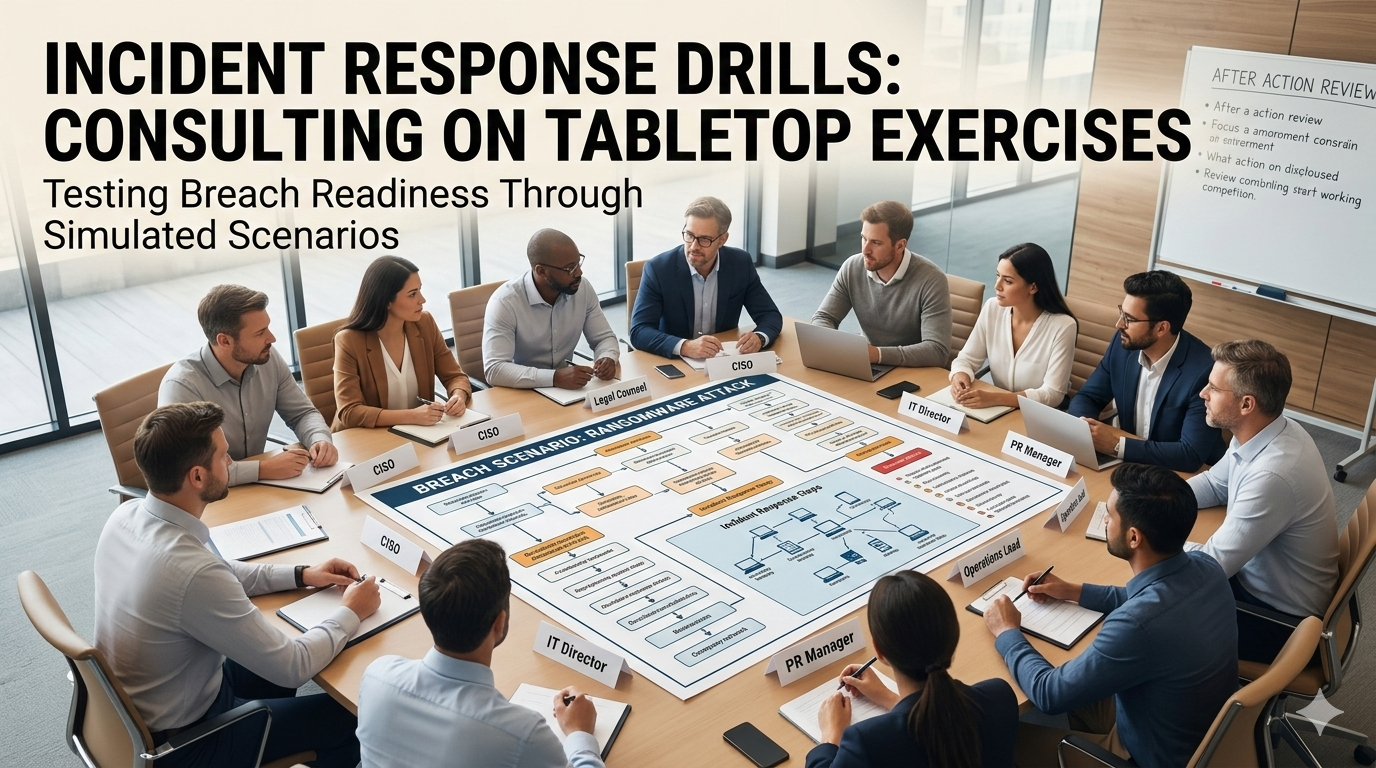
Cybersecurity incidents are no longer a question of if but when. Organizations across industries face increasingly sophisticated cyber threats—from ransomware attacks and insider breaches to phishing-driven compromises and data leaks. While companies invest heavily in firewalls, endpoint protection, and monitoring tools, many overlook a critical aspect of cybersecurity preparedness: how teams respond when an incident actually occurs.
Technology alone cannot stop a crisis. Prepared people and practiced processes do.
This is where Incident Response (IR) tabletop exercises play a vital role. These structured simulations allow organizations to rehearse cyberattack scenarios in a controlled environment, helping leadership and technical teams test decision-making, coordination, and response readiness before a real breach happens.
At CVDragon IT Consulting, we help organizations design and execute realistic tabletop exercises that transform incident response plans from static documents into operational capabilities.
What Are Tabletop Exercises?
A tabletop exercise is a guided simulation of a cybersecurity incident where stakeholders walk through their response to a hypothetical breach scenario.
Unlike technical penetration testing or red-team attacks, tabletop exercises focus on decision-making, communication, and coordination rather than system exploitation.
Participants typically include:
- IT and cybersecurity teams
- Executive leadership
- Legal and compliance officers
- HR representatives
- Communications and PR teams
- Risk management personnel
During the session, participants discuss how they would react step-by-step as the simulated incident unfolds.
Think of it as a fire drill for cyber crises—but focused on organizational response instead of evacuation.
Why Incident Response Drills Are Critical Today
Many organizations possess incident response plans that have never been tested under realistic pressure. When an actual breach occurs, confusion often replaces coordination.
Common real-world failures include:
- Unclear ownership of decisions
- Delayed breach escalation
- Miscommunication between departments
- Regulatory reporting delays
- Poor external communication handling
- Lack of executive visibility
Tabletop exercises expose these weaknesses safely—before attackers do.
Organizations that regularly conduct response drills recover faster, reduce financial losses, and maintain stakeholder trust during incidents.
The Growing Complexity of Cyber Incidents
Modern cyberattacks rarely remain confined to IT systems. A single breach can quickly escalate into:
- Operational downtime
- Legal exposure
- Financial disruption
- Customer data compromise
- Reputation damage
- Regulatory penalties
For example, ransomware incidents now involve negotiation decisions, law enforcement coordination, insurance notification, and public disclosure obligations—all within hours.
Without rehearsed coordination, even technically strong organizations struggle to respond effectively.
Objectives of a Tabletop Exercise
A well-designed tabletop exercise evaluates multiple dimensions of breach readiness.
1. Validate Incident Response Plans
Exercises confirm whether documented procedures are practical, realistic, and aligned with current infrastructure.
2. Clarify Roles and Responsibilities
Participants understand who makes technical, legal, operational, and public communication decisions.
3. Improve Decision-Making Under Pressure
Simulations introduce time-sensitive challenges that mirror real crisis conditions.
4. Strengthen Cross-Department Collaboration
Cyber incidents require enterprise-wide cooperation—not just IT involvement.
5. Test Communication Channels
Internal escalation paths and external messaging strategies are assessed for effectiveness.
Types of Tabletop Scenarios Organizations Should Test
At CVDragon IT Consulting, exercises are customized based on industry risks and organizational maturity.
Ransomware Attack Simulation
A critical system becomes encrypted, forcing decisions on containment, backup restoration, and ransom negotiation.
Data Breach Scenario
Sensitive customer or employee data is exposed, requiring legal assessment and regulatory reporting.
Phishing-Based Account Compromise
Attackers gain executive email access, triggering financial fraud risks.
Insider Threat Incident
A disgruntled employee exfiltrates confidential information.
Cloud Security Breach
Misconfigured cloud storage exposes business-critical data publicly.
Each scenario evolves dynamically during the exercise, forcing participants to adapt in real time.
How a Typical Tabletop Exercise Works
Phase 1: Preparation
Consultants assess organizational structure, existing response plans, and threat landscape to design relevant scenarios.
Phase 2: Scenario Launch
Participants receive an initial incident briefing—such as suspicious network activity or system outage alerts.
Phase 3: Incident Escalation
New developments are introduced progressively:
- Media inquiries
- Regulatory deadlines
- Customer complaints
- Operational disruptions
Teams must decide actions collaboratively.
Phase 4: Decision Analysis
Facilitators observe response effectiveness, communication clarity, and leadership coordination.
Phase 5: Debrief and Improvement
Post-exercise discussions identify strengths, gaps, and improvement opportunities.
The outcome is an actionable roadmap for enhancing incident readiness.
Key Benefits of Tabletop Exercises
Faster Incident Containment
Practiced teams respond quickly, minimizing operational damage.
Reduced Financial Impact
Early coordination prevents prolonged downtime and costly mistakes.
Regulatory Compliance Readiness
Organizations better meet reporting obligations under data protection laws.
Executive Awareness
Leadership gains realistic understanding of cyber risk exposure.
Cultural Preparedness
Cybersecurity becomes a shared organizational responsibility.
Common Gaps Discovered During Exercises
Organizations are often surprised by issues uncovered during simulations, including:
- Lack of decision authority clarity
- Outdated contact lists
- Inefficient escalation processes
- Conflicts between legal and operational priorities
- Inconsistent communication messaging
- Insufficient backup recovery procedures
Identifying these gaps early significantly strengthens resilience.
Moving Beyond Technical Security
Cybersecurity maturity today depends as much on human readiness as technological defense.
Even organizations with advanced security tools fail when:
- Executives delay critical decisions
- Teams operate in silos
- Crisis communication breaks down
- Employees panic or act independently
Tabletop exercises align people, processes, and technology into a unified response framework.
Integrating Tabletop Exercises into Cybersecurity Strategy
Incident response drills should not be one-time events.
Best practices include:
- Conducting exercises at least annually
- Rotating attack scenarios
- Including executive leadership participation
- Testing remote-work crisis coordination
- Updating plans after organizational or technology changes
Continuous rehearsal ensures readiness evolves alongside emerging threats.
The Role of Leadership in Breach Preparedness
Executive participation is essential for successful incident response.
Leadership must be prepared to answer questions such as:
- Should operations be shut down?
- When should customers be notified?
- Who communicates with regulators?
- How is reputational risk managed?
- What business risks outweigh technical recovery timelines?
Tabletop exercises allow leaders to practice these decisions without real-world consequences.
How CVDragon IT Consulting Supports Organizations
CVDragon IT Consulting provides end-to-end incident response readiness consulting, including:
- Customized tabletop exercise design
- Industry-specific breach simulations
- Executive crisis management training
- Incident response plan validation
- Compliance-aligned response frameworks
- Post-exercise improvement roadmaps
Our approach focuses on realism, collaboration, and measurable readiness improvement.
We ensure organizations move from theoretical preparedness to operational confidence.
The Future of Incident Readiness
As cyber threats grow more sophisticated, incident preparedness will become a core governance requirement rather than an optional security activity.
Emerging trends include:
- AI-assisted incident simulations
- Hybrid cyber-physical crisis exercises
- Integrated business continuity testing
- Continuous response readiness programs
Organizations that rehearse today respond decisively tomorrow.
Conclusion
A cybersecurity breach tests more than systems—it tests leadership, communication, and organizational resilience. Incident response tabletop exercises provide a safe yet powerful method for preparing teams to face real cyber crises with clarity and confidence.
By simulating high-pressure attack scenarios, organizations uncover vulnerabilities, strengthen collaboration, and build muscle memory for effective response.
At CVDragon IT Consulting, we believe true cybersecurity readiness begins long before an attack occurs. Through structured incident response drills and tabletop exercises, businesses can transform uncertainty into preparedness and crisis into controlled recovery.
In cybersecurity, preparation is not an expense—it is protection against chaos.