








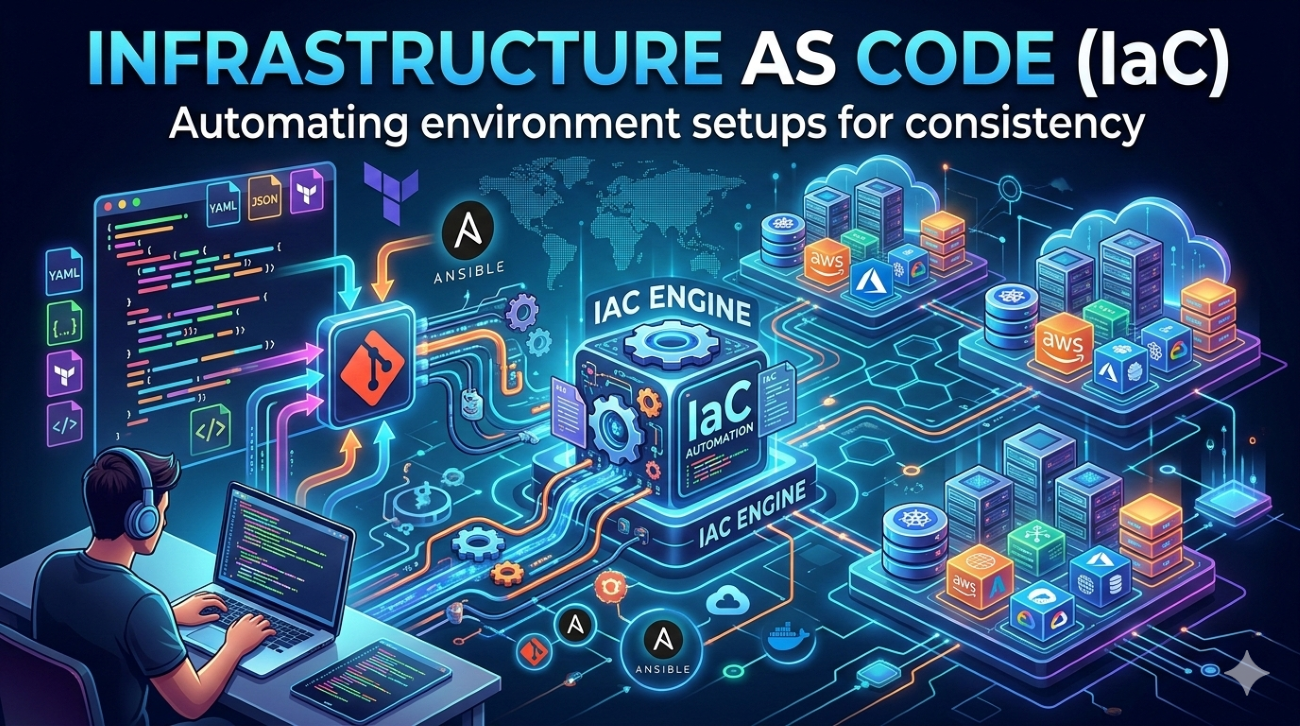
Infrastructure as Code (IaC): Automating Environment Setups for Consistency
 March 2, 2026
In today’s fast-paced digital economy, businesses are expected to deploy applications faster, scale seamlessly, and maintain secure, reliable IT environments across multiple platforms. However, traditional infrastructure management methods—manual server configuration, inconsistent environment setups, and dependency on individual expertise—often create operational bottlenecks and costly errors.
Organizations frequently encounter situations where applications work perfectly in development but fail in production due to configuration differences. These inconsistencies slow innovation, increase downtime risks, and complicate compliance efforts.
Infrastructure as Code (IaC) has emerged as a transformative solution to these challenges. By automating infrastructure provisioning through code, organizations can create standardized, repeatable, and scalable environments with precision and speed.
At CVDragon IT Consulting, we help enterprises modernize infrastructure management through IaC practices that enhance operational consistency, agility, and resilience. This article explores how Infrastructure as Code is reshaping modern IT operations and enabling reliable digital transformation.
Understanding Infrastructure as Code (IaC)
Infrastructure as Code is the practice of managing and provisioning IT infrastructure using machine-readable configuration files instead of manual processes.
Traditionally, setting up infrastructure required administrators to:
- Manually configure servers
- Install operating systems and dependencies
- Adjust networking settings
- Apply security configurations
- Deploy applications individually
These steps were time-consuming and prone to human error.
With IaC, infrastructure components such as servers, storage, networks, databases, and security policies are defined using code scripts. Once written, these scripts automatically create identical environments whenever required.
Simply put:
If software can be version-controlled, infrastructure can be too.
Why Consistency Matters in Modern IT Environments
Modern organizations operate across complex ecosystems that may include:
- On-premise data centers
- Public cloud platforms
- Hybrid and multi-cloud environments
- Containerized applications
- Distributed development teams
Without standardized provisioning, environments quickly drift apart—a problem known as configuration drift.
Common consequences include:
- Deployment failures
- Security vulnerabilities
- Performance inconsistencies
- Difficult troubleshooting
- Delayed product releases
IaC eliminates these risks by ensuring every environment is built from the same validated blueprint.
Core Principles of Infrastructure as Code
Successful IaC implementation relies on several foundational principles.
Declarative Configuration
Teams define the desired infrastructure state, and automation tools ensure systems match that state continuously.
Version Control
Infrastructure definitions are stored in repositories, allowing tracking of changes, rollback capabilities, and collaborative management.
Automation
Provisioning, scaling, and updates occur automatically without manual intervention.
Idempotency
Repeated executions produce the same result, ensuring predictable infrastructure behavior.
These principles bring software engineering discipline into infrastructure management.
How IaC Works in Practice
A typical IaC workflow follows these steps:
- Engineers write infrastructure configuration files.
- Files are stored in version control systems.
- Automation tools interpret the code.
- Infrastructure is provisioned automatically.
- Continuous integration pipelines validate deployments.
For example, launching a new application environment that once took days or weeks can now be completed in minutes with a single automated execution.
Development, testing, staging, and production environments become identical replicas—eliminating surprises during deployment.
Types of Infrastructure as Code Approaches
Declarative IaC
Defines what the final infrastructure should look like without specifying procedural steps.
Benefits include:
- Simplicity
- Reduced operational complexity
- Automatic state management
Imperative IaC
Defines how infrastructure should be created step-by-step.
This approach offers flexibility but requires more maintenance.
Most modern enterprises adopt declarative models for scalability and governance efficiency.
Business Benefits of IaC Adoption
Environment Consistency
Every deployment follows the same configuration standards, eliminating “works on my machine” problems.
Faster Deployment Cycles
Infrastructure provisioning shifts from manual setup to automated execution, accelerating product releases.
Improved Scalability
Organizations can instantly replicate environments to handle growth or seasonal demand.
Enhanced Security
Security policies and access controls are embedded directly into infrastructure templates.
Reduced Operational Costs
Automation reduces manual labor, downtime risks, and configuration-related failures.
Disaster Recovery Readiness
Entire environments can be recreated quickly in case of outages or cyber incidents.
IaC and DevOps Transformation
Infrastructure as Code plays a central role in DevOps adoption by bridging development and operations teams.
Traditionally, developers built applications while operations teams managed infrastructure separately. This separation often caused deployment delays and communication gaps.
IaC enables:
- Automated CI/CD pipelines
- Rapid testing environments
- Continuous delivery models
- Self-service infrastructure provisioning
Developers gain faster access to environments, while operations maintain governance and control.
The result is improved collaboration and accelerated innovation.
Security Advantages of Infrastructure as Code
Security becomes proactive rather than reactive when infrastructure is codified.
Organizations can implement:
- Automated compliance checks
- Standardized access policies
- Secure network configurations
- Continuous vulnerability scanning
Since infrastructure definitions are visible and auditable, security teams can review configurations before deployment rather than correcting issues afterward.
This approach significantly reduces misconfiguration risks—one of the leading causes of cloud breaches today.
Real-World Use Cases
Multi-Environment Application Deployment
Companies deploy identical development, testing, and production environments automatically.
Cloud Migration Projects
IaC simplifies transitions from legacy systems to cloud platforms.
Auto-Scaling Infrastructure
Resources automatically expand or contract based on demand.
Disaster Recovery Automation
Entire systems can be recreated rapidly during outages.
Compliance-Driven Industries
Financial and healthcare organizations maintain standardized, auditable infrastructure setups.
Challenges in IaC Implementation
Despite its advantages, organizations must address certain challenges.
Skill Gaps
Teams may require training in automation and scripting practices.
Governance Complexity
Improperly managed templates can propagate errors at scale.
Tool Integration
Existing legacy systems may require modernization for compatibility.
Cultural Change
Transitioning from manual operations to automated workflows demands organizational alignment.
Partnering with experienced consultants helps organizations navigate these transitions effectively.
Best Practices for Successful IaC Adoption
At CVDragon IT Consulting, we recommend the following practices:
- Maintain infrastructure templates in version-controlled repositories
- Implement peer reviews for infrastructure changes
- Use automated testing before deployment
- Apply least-privilege security principles
- Monitor infrastructure continuously
- Standardize reusable modules
These practices ensure scalable and secure infrastructure automation.
The Future of Infrastructure Management
Infrastructure as Code continues to evolve alongside cloud-native technologies and AI-driven operations.
Emerging trends include:
- Policy-as-Code governance
- Self-healing infrastructure
- AI-assisted provisioning
- Serverless automation models
- GitOps-driven infrastructure management
Future IT environments will increasingly operate autonomously, adapting dynamically to workload demands and security requirements.
Organizations embracing IaC today position themselves for this automated future.
How CVDragon IT Consulting Supports IaC Adoption
CVDragon IT Consulting enables organizations to modernize infrastructure through:
- IaC strategy development
- Cloud and hybrid infrastructure automation
- DevOps pipeline integration
- Security and compliance automation
- Infrastructure standardization frameworks
- Continuous optimization and monitoring
Our approach ensures infrastructure becomes reliable, scalable, and aligned with business objectives.
Conclusion
Infrastructure complexity is one of the greatest barriers to digital agility. Manual provisioning methods can no longer support modern application demands or cloud-scale operations.
Infrastructure as Code transforms infrastructure into a programmable asset—repeatable, secure, and scalable by design. By automating environment setups, organizations eliminate inconsistencies, accelerate deployments, and strengthen operational resilience.
As businesses continue their digital transformation journeys, IaC serves as a foundational capability enabling innovation without compromising stability.
At CVDragon IT Consulting, we help organizations move from manual infrastructure management to intelligent automation—ensuring consistency today and scalability for tomorrow.