IT Mergers & Acquisitions (M&A): Navigating the Technical Debt of Merging Two Firms
 March 3, 2026
Mergers and acquisitions (M&A) are powerful growth strategies that allow organizations to expand market presence, acquire innovation capabilities, and achieve operational scale. While financial and legal integration often receive primary attention during M&A transactions, one of the most complex—and underestimated—challenges lies within IT integration.
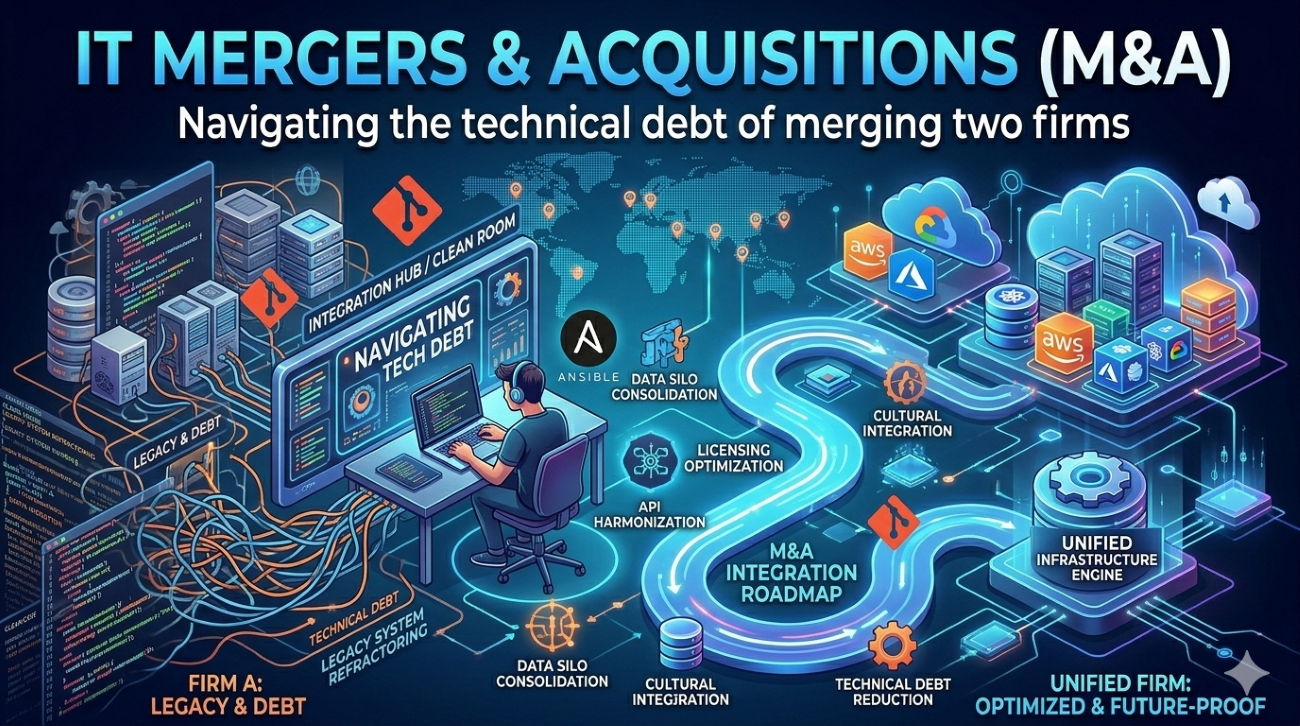
When two companies merge, they do not just combine teams and products; they merge entire technology ecosystems built independently over years or even decades. Differences in infrastructure, applications, cybersecurity standards, data architectures, and operational processes often create significant technical debt, which can delay synergy realization and increase operational risk.
At CVDragon IT Consulting, we support organizations in navigating IT M&A transformations by identifying, managing, and reducing technical debt while ensuring business continuity and long-term scalability. This article explores how companies can successfully integrate technology environments during mergers and acquisitions.
Understanding Technical Debt in IT M&A
Technical debt refers to the accumulated inefficiencies, outdated systems, shortcuts, and incompatible technologies that result from rapid development or legacy decisions.
During an acquisition or merger, technical debt becomes highly visible because organizations must reconcile:
- Different enterprise systems
- Legacy infrastructure
- Conflicting software architectures
- Duplicate applications
- Inconsistent data models
- Varying cybersecurity maturity levels
Without structured planning, integration efforts can lead to operational disruption, rising costs, and employee productivity challenges.
In many cases, companies discover that IT complexity—not financial alignment—is the biggest obstacle to successful mergers.
Why IT Integration Determines M&A Success
Research consistently shows that delayed technology integration is one of the primary reasons M&A initiatives fail to deliver expected value.
Technology directly impacts:
- Customer experience continuity
- Operational efficiency
- Data visibility
- Regulatory compliance
- Workforce collaboration
- Cybersecurity posture
If systems cannot communicate effectively, organizations operate as two separate entities long after the merger is finalized.
Successful IT integration enables organizations to unlock promised synergies such as cost savings, innovation acceleration, and unified digital operations.
Common IT Challenges During Mergers
1. Duplicate Systems and Applications
Both organizations often use separate ERP, CRM, HR, and finance platforms. Maintaining parallel systems increases costs and operational complexity.
2. Legacy Infrastructure
Older systems may lack scalability or compatibility with modern cloud environments.
3. Data Integration Issues
Inconsistent data formats and governance policies complicate analytics and reporting.
4. Cybersecurity Gaps
The merged organization inherits vulnerabilities from both environments, expanding the attack surface.
5. Cultural and Operational Differences
IT teams may follow different development practices, governance models, and service management frameworks.
Addressing these challenges requires structured technical due diligence and integration planning.
The Role of IT Due Diligence
IT due diligence should begin before the merger is finalized.
Key evaluation areas include:
- Infrastructure architecture assessment
- Application portfolio analysis
- Licensing and vendor contracts
- Cybersecurity maturity review
- Cloud adoption status
- Data governance frameworks
- Compliance risks
Early identification of risks allows leadership to estimate integration costs accurately and avoid post-merger surprises.
At CVDragon IT Consulting, due diligence focuses not only on existing systems but also on long-term scalability and modernization opportunities.
Integration Strategies: Choosing the Right Approach
There is no single integration model suitable for every merger. Organizations typically adopt one of the following strategies:
Absorption Model
One company’s IT environment becomes the standard, and the acquired company migrates entirely.
Best suited for:
- Smaller acquisitions
- Mature enterprise platforms
Best-of-Breed Model
Systems from both organizations are evaluated, and the strongest solutions are retained.
Ideal for:
- Innovation-driven mergers
- Technology acquisitions
Coexistence Model
Both environments operate independently for a defined transition period.
Useful when:
- Immediate migration risks business disruption
Choosing the right strategy balances speed, cost, and operational stability.
Managing Technical Debt During Integration
Technical debt cannot simply be eliminated overnight. Instead, organizations must prioritize remediation strategically.
Rationalize Applications
Identify redundant tools and consolidate overlapping systems.
Modernize Legacy Platforms
Migrate outdated infrastructure toward cloud-native or scalable environments.
Standardize Architecture
Adopt unified frameworks for networking, identity management, and data exchange.
Automate Processes
Automation reduces manual dependencies inherited from legacy workflows.
Establish Governance
Unified IT governance prevents future accumulation of technical debt.
A phased modernization approach ensures continuity while enabling improvement.
Data Integration: The Core of Digital Unity
Data integration is often the most sensitive component of IT M&A.
Challenges include:
- Duplicate customer records
- Inconsistent reporting metrics
- Data privacy compliance differences
- Integration latency issues
Organizations must create a single source of truth through:
- Data mapping and cleansing
- Master data management frameworks
- Unified analytics platforms
- Secure data migration strategies
Proper data integration enables accurate decision-making and consistent customer experiences.
Cybersecurity Considerations in IT M&A
Mergers significantly increase cybersecurity risk.
Threat actors frequently target organizations during transition periods due to temporary vulnerabilities and system changes.
Critical steps include:
- Security posture assessments
- Identity and access consolidation
- Endpoint protection alignment
- Network segmentation
- Incident response integration
Cybersecurity integration should occur early—not after systems are merged—to avoid inherited vulnerabilities.
Cloud and Infrastructure Consolidation
Many modern M&A initiatives involve hybrid or multi-cloud environments.
Organizations must determine:
- Which cloud providers to standardize on
- Workload migration priorities
- Infrastructure scalability requirements
- Cost optimization opportunities
Infrastructure consolidation often delivers immediate financial benefits through reduced licensing, maintenance, and operational overhead.
The Human Factor in IT Integration
Technology integration succeeds only when people and processes align.
Common workforce challenges include:
- Tool adoption resistance
- Knowledge silos
- Process inconsistencies
- Cultural differences between IT teams
Transparent communication, structured onboarding, and collaborative governance models help unify teams under a shared technology vision.
Post-Merger IT Optimization
Integration does not end once systems are connected.
Post-merger optimization focuses on:
- Performance monitoring
- Cost rationalization
- Automation expansion
- Service delivery improvement
- Continuous modernization
Organizations that treat M&A as an opportunity for transformation—not just consolidation—achieve greater long-term value.
Best Practices for Successful IT M&A Integration
CVDragon IT Consulting recommends the following approach:
- Conduct early IT due diligence
- Align IT strategy with business objectives
- Prioritize critical systems integration
- Address cybersecurity immediately
- Reduce redundant applications
- Implement standardized governance
- Monitor integration progress continuously
Structured execution minimizes disruption and accelerates synergy realization.
How CVDragon IT Consulting Supports IT M&A
CVDragon IT Consulting provides specialized services for technology integration during mergers and acquisitions, including:
- IT due diligence and risk assessment
- Technical debt evaluation
- Integration roadmap development
- Infrastructure and cloud consolidation
- Cybersecurity alignment
- Data migration and governance
- Post-merger optimization strategies
Our consulting approach ensures organizations achieve operational unity while reducing long-term technical complexity.
Conclusion
Mergers and acquisitions represent moments of tremendous opportunity—but also significant technological risk. Hidden technical debt, incompatible systems, and cybersecurity challenges can undermine even the most promising business deals.
Successful IT M&A integration requires more than system consolidation; it demands strategic planning, disciplined execution, and forward-looking modernization.
By proactively managing technical debt and aligning technology ecosystems, organizations can transform mergers into platforms for innovation, efficiency, and scalable growth.
At CVDragon IT Consulting, we help businesses navigate the complexity of IT mergers with confidence—turning integration challenges into long-term competitive advantages.