


IT Consulting for Zero Downtime Systems: Building Resilient IT Infrastructure for Uninterrupted Business Operations
 July 28, 2026
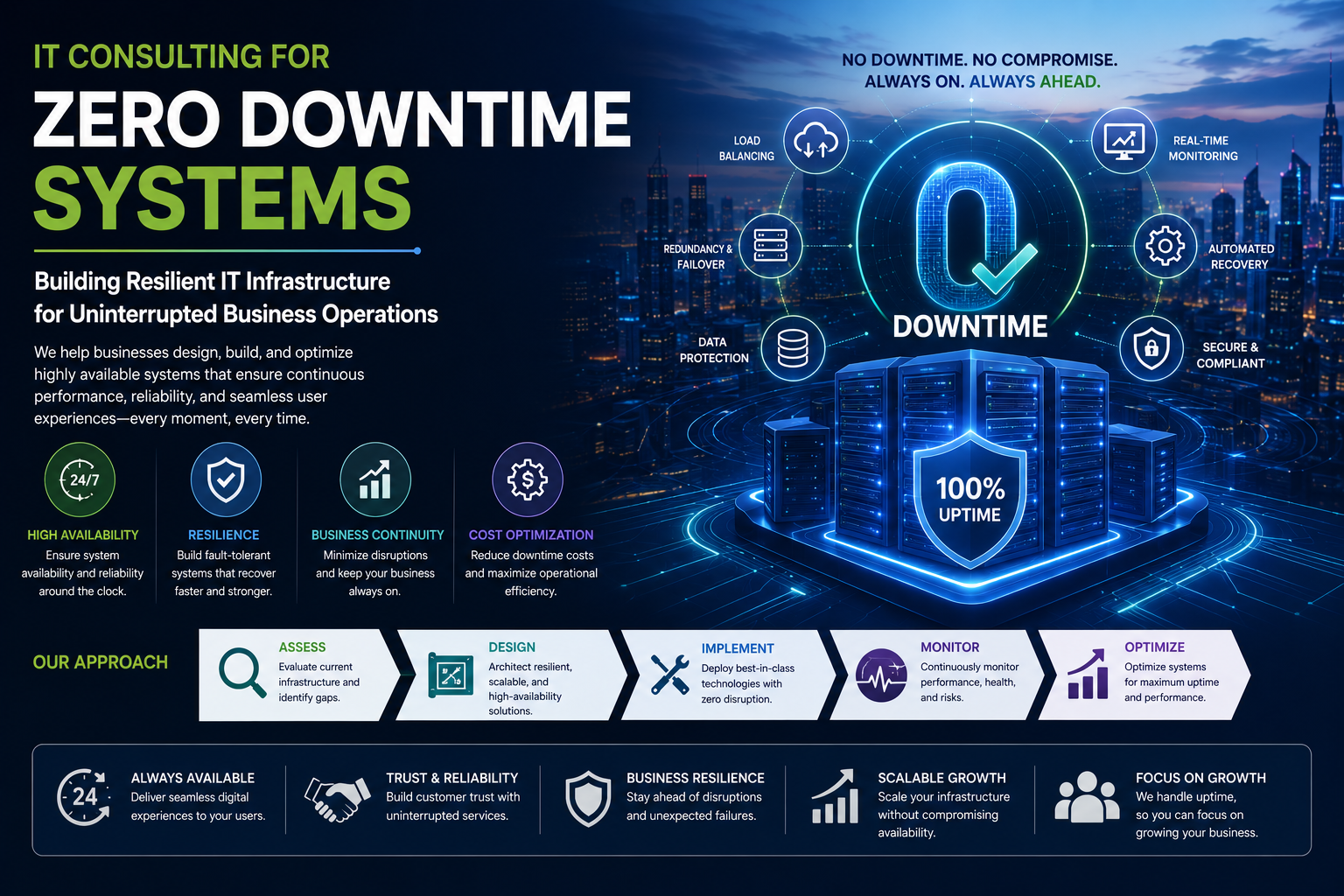
In today’s always-connected digital economy, businesses cannot afford prolonged IT outages. Customers expect websites, applications, online services, and digital platforms to remain available whenever they need them. Employees also depend on reliable systems to communicate, process transactions, manage operations, and deliver services. Even a short period of downtime can result in lost revenue, reduced productivity, customer dissatisfaction, and reputational damage. For organizations operating critical digital services, zero downtime systems have therefore become an important business priority.
Zero downtime refers to an IT environment designed to keep applications and services continuously available, even when hardware fails, software requires maintenance, infrastructure experiences disruptions, or unexpected incidents occur. While achieving absolute zero downtime can be difficult in every environment, organizations can design highly resilient architectures that minimize service interruptions and enable seamless failover. At CVDARGON IT Consulting, we help businesses build resilient, highly available IT environments using cloud technologies, redundancy, automation, disaster recovery, proactive monitoring, and modern infrastructure strategies.
Understanding Zero Downtime Systems
A zero downtime system is an IT architecture designed to maintain continuous service availability during maintenance, failures, upgrades, and unexpected disruptions. Instead of relying on a single server, application, database, or network connection, these environments use redundancy and intelligent failover mechanisms to ensure that services remain operational.
High-availability architectures may include multiple servers, redundant networks, replicated databases, load balancing, geographically distributed infrastructure, and automated recovery processes.
The goal is not simply to prevent failures. Instead, the objective is to ensure that individual component failures do not bring down the entire business service.
Why Zero Downtime Matters
Downtime can affect almost every area of an organization. An e-commerce company may lose sales when its website becomes unavailable. A financial institution may be unable to process transactions. A manufacturing company may experience production delays, while a healthcare provider could face serious operational challenges if critical systems become inaccessible.
The impact of downtime also extends beyond immediate financial losses. Repeated service interruptions can damage customer trust, reduce employee productivity, and negatively affect an organization’s reputation.
A resilient IT environment helps businesses maintain service continuity while reducing the operational and financial consequences of infrastructure failures.
The Role of IT Consulting in Zero Downtime Systems
Creating a highly available IT environment requires careful planning and a deep understanding of business requirements. Not every application needs the same level of availability, and organizations must balance resilience, performance, security, and cost.
CVDARGON IT Consulting works with businesses to identify critical applications, evaluate infrastructure dependencies, analyze potential failure points, and establish availability objectives.
Our consultants design customized architectures that support business continuity and minimize service disruptions. From infrastructure assessment and cloud migration to high-availability architecture and disaster recovery, we help organizations build systems that are prepared for unexpected events.
Assessing Business-Critical Applications
The first step in building a resilient IT environment is identifying which systems require the highest levels of availability.
Organizations may have applications supporting online transactions, customer services, communication, supply chains, financial operations, or internal workflows.
CVDARGON IT Consulting conducts infrastructure assessments to determine application dependencies, potential failure points, recovery requirements, and business impact.
This analysis helps organizations prioritize investments and focus resilience strategies on their most critical services.
Designing High-Availability Architecture
High availability is a fundamental component of zero downtime strategies. It involves designing systems with redundant components so that if one element fails, another can continue serving users.
Organizations may deploy multiple application servers, redundant databases, backup network connections, and geographically distributed infrastructure.
CVDARGON IT Consulting designs high-availability architectures that eliminate single points of failure and provide reliable service continuity.
By distributing workloads across multiple resources, organizations can maintain operations even when individual components experience problems.
Load Balancing for Continuous Availability
Load balancing distributes application traffic across multiple servers or infrastructure resources. This prevents individual systems from becoming overloaded and ensures that workloads can continue if one server becomes unavailable.
Modern load balancers can automatically detect unhealthy systems and redirect traffic to functioning resources.
CVDARGON IT Consulting helps organizations implement intelligent load-balancing strategies that improve performance, scalability, and application availability.
This approach is particularly valuable for websites, e-commerce platforms, enterprise applications, and customer-facing digital services.
Database Replication and High Availability
Databases often contain critical business information, making database availability essential for uninterrupted operations.
Database replication creates synchronized copies of information across multiple systems or locations. If the primary database becomes unavailable, organizations can switch to a replica with minimal disruption.
IT consultants help businesses implement database replication, clustering, failover, and backup strategies appropriate to their operational requirements.
These solutions reduce the risk of data loss while improving application availability.
Cloud-Based Zero Downtime Strategies
Cloud computing provides powerful capabilities for building resilient IT environments. Organizations can distribute applications across multiple availability zones or geographic regions, use automated scaling, and deploy redundant infrastructure.
Cloud platforms also support infrastructure automation, monitoring, backup, and disaster recovery capabilities that help reduce downtime.
CVDARGON IT Consulting assists organizations in designing cloud architectures that maximize availability while maintaining security and cost efficiency.
By adopting cloud-native approaches, businesses can build flexible systems that automatically adapt to changing workloads and infrastructure conditions.
Automated Failover and Recovery
Manual recovery processes can take valuable time, especially during critical incidents. Automated failover allows systems to detect failures and automatically switch operations to healthy resources.
For example, if an application server becomes unavailable, traffic can automatically move to another server. If a primary database fails, a synchronized secondary system can take over.
CVDARGON IT Consulting helps organizations implement automated failover mechanisms that minimize recovery time and reduce human intervention during incidents.
Automation improves resilience while allowing IT teams to focus on resolving the underlying issue.
| Zero Downtime Strategy | Business Benefit |
|---|---|
| High-Availability Architecture | Reduces single points of failure |
| Load Balancing | Distributes traffic and improves performance |
| Database Replication | Protects data availability |
| Automated Failover | Reduces service interruption |
| Cloud Infrastructure | Enables scalable and resilient systems |
| Proactive Monitoring | Identifies potential problems early |
| Disaster Recovery | Supports rapid recovery from major incidents |
Proactive Monitoring and Observability
Preventing downtime requires organizations to identify potential problems before they become major incidents.
Modern monitoring and observability platforms continuously track application performance, infrastructure health, network activity, database performance, and system availability.
CVDARGON IT Consulting helps businesses implement proactive monitoring strategies that provide real-time visibility into their IT environments.
Automated alerts can notify teams when unusual behavior or performance degradation occurs, allowing them to take corrective action before users experience significant disruption.
Zero Downtime During Maintenance and Upgrades
Routine maintenance and software upgrades are necessary but can sometimes cause service interruptions. Modern deployment strategies allow organizations to update applications without taking entire systems offline.
Techniques such as rolling deployments, blue-green deployments, and canary releases enable organizations to introduce changes gradually while keeping existing services available.
CVDARGON IT Consulting helps businesses implement modern deployment approaches that reduce maintenance-related downtime and improve release reliability.
Disaster Recovery and Business Continuity
Even highly available systems can be affected by major incidents such as natural disasters, large-scale cyberattacks, regional infrastructure failures, or widespread cloud outages.
Disaster recovery provides an additional layer of protection by enabling organizations to restore critical services following significant disruptions.
CVDARGON IT Consulting helps businesses develop disaster recovery and business continuity strategies that define recovery objectives, backup requirements, failover procedures, and communication plans.
A comprehensive approach ensures organizations are prepared for both everyday infrastructure failures and major business disruptions.
Zero Downtime and Cybersecurity
Cybersecurity incidents can cause significant service interruptions. Ransomware attacks, distributed denial-of-service (DDoS) attacks, compromised credentials, and other threats may affect system availability.
Zero downtime strategies should therefore be integrated with cybersecurity frameworks.
CVDARGON IT Consulting helps organizations combine resilience with security through technologies such as network protection, identity management, encryption, backup isolation, threat monitoring, and incident response planning.
This integrated approach helps organizations maintain service availability while protecting critical infrastructure.
Testing and Continuous Improvement
A zero downtime strategy is only effective if it is regularly tested. Organizations should conduct failover tests, disaster recovery exercises, backup restoration tests, and application resilience assessments.
Testing helps identify weaknesses before a real incident occurs.
CVDARGON IT Consulting supports organizations in conducting resilience testing and analyzing system performance. Based on the results, businesses can continuously improve their architectures and recovery processes.
Future Trends in Zero Downtime Systems
The future of high availability will be shaped by artificial intelligence, autonomous infrastructure, cloud-native technologies, edge computing, distributed systems, and predictive monitoring.
AI-powered systems will increasingly analyze infrastructure behavior to identify potential failures before they occur. Automated remediation technologies may also resolve certain issues without human intervention.
Organizations will increasingly adopt resilient architectures that distribute workloads across multiple environments, allowing critical applications to continue operating even during localized failures.
Why Partner with CVDARGON IT Consulting
Building zero downtime systems requires expertise in cloud computing, infrastructure architecture, cybersecurity, automation, databases, monitoring, and disaster recovery.
CVDARGON IT Consulting provides end-to-end consulting services that help organizations assess availability requirements, identify infrastructure risks, design high-availability architectures, implement cloud resilience, automate failover, and establish disaster recovery strategies.
Our customized approach ensures that resilience strategies align with business priorities, technical requirements, and operational realities.
Conclusion
Zero downtime systems are becoming increasingly important as organizations depend on digital platforms for everyday operations and customer engagement. While no infrastructure can guarantee that every failure will be invisible in every circumstance, carefully designed high-availability and resilience architectures can dramatically reduce service interruptions and improve business continuity.
With expert guidance from CVDARGON IT Consulting, organizations can build resilient IT environments that combine redundancy, cloud technologies, automated failover, proactive monitoring, secure backups, and disaster recovery.
By treating availability as a strategic business priority rather than simply an IT objective, organizations can protect revenue, maintain customer trust, improve operational resilience, and support continuous digital innovation. Investing in zero downtime strategies today helps businesses remain prepared for the challenges of an increasingly connected and always-on digital world.