






IT Consulting for UX Optimization: Creating Better Digital Experiences for Modern Businesses
 August 1, 2026
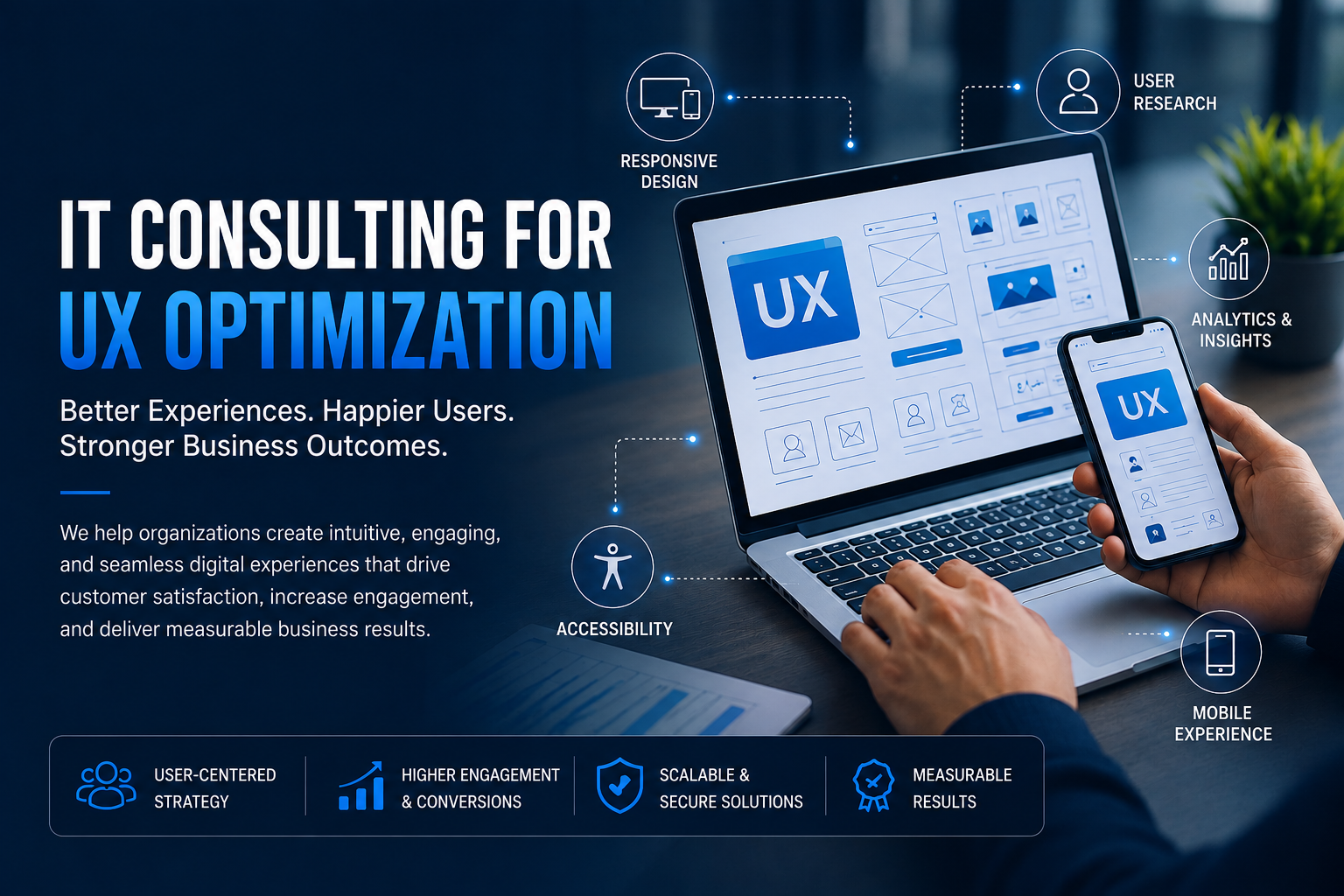
In today’s digital-first world, customers expect websites, mobile applications, software platforms, and digital services to be fast, intuitive, accessible, and easy to use. A technically advanced product can still fail to deliver business value if users struggle to navigate it or cannot quickly accomplish what they came to do. As digital interactions become increasingly important to customer relationships, User Experience (UX) optimization has become a strategic priority for organizations across industries.
UX optimization focuses on improving every aspect of a user’s interaction with a digital product or service. It combines user research, interface design, usability testing, accessibility, performance improvements, analytics, and continuous refinement to create experiences that are simple and engaging. At CVDARGON IT Consulting, we help organizations optimize their digital experiences by combining technology expertise with user-centered strategies. Our goal is to help businesses create digital platforms that meet customer expectations while improving engagement, satisfaction, conversion, and long-term loyalty.
Understanding UX Optimization
User Experience optimization is the process of analyzing and improving how users interact with websites, applications, software platforms, and other digital products. It involves identifying friction points and making strategic improvements that help users complete tasks more efficiently and enjoyably.
UX is broader than visual design. It includes navigation, information architecture, content structure, accessibility, page speed, responsiveness, functionality, and the overall emotional experience of interacting with a product.
A successful UX optimization strategy ensures that technology works for the user rather than forcing users to adapt to complicated systems.
Why UX Optimization Matters
Digital experiences often serve as the first interaction between customers and a brand. A confusing website, slow application, or complicated checkout process can quickly cause users to abandon their journey and move to a competitor.
Poor UX can result in high bounce rates, low conversion rates, increased customer support requests, and negative brand perceptions.
On the other hand, an intuitive and efficient experience makes it easier for customers to find information, complete transactions, and engage with services.
UX optimization can help organizations increase customer satisfaction, improve conversion rates, reduce friction, and strengthen brand loyalty.
The Role of IT Consulting in UX Optimization
Successful UX optimization requires collaboration between business teams, designers, developers, data analysts, and technology specialists. Organizations must understand both what users need and how technology can deliver those experiences effectively.
CVDARGON IT Consulting works with businesses to assess existing digital experiences, identify usability challenges, analyze performance data, and develop practical optimization strategies.
Our consultants connect user experience goals with technical architecture, analytics, cybersecurity, accessibility, and business objectives. This ensures that UX improvements are not only visually appealing but also scalable, secure, and technically sustainable.
Conducting a UX Assessment
The first step in improving a digital experience is understanding the current user journey. Organizations need to identify where users encounter difficulties, abandon processes, or become confused.
CVDARGON IT Consulting conducts comprehensive UX assessments that evaluate navigation, content structure, usability, mobile responsiveness, accessibility, performance, and technical functionality.
Analytics data can also reveal important behavioral patterns, such as pages with high abandonment rates, frequently used features, and common navigation paths.
These insights help organizations prioritize improvements based on measurable user behavior.
Understanding User Needs
Effective UX optimization begins with understanding the target audience. Different users may have different expectations, technical abilities, accessibility requirements, and goals.
User research methods such as interviews, surveys, usability testing, behavioral analytics, and customer feedback can provide valuable insights into user expectations.
CVDARGON IT Consulting helps organizations translate these insights into actionable UX improvements that address real customer needs rather than assumptions.
Improving Website and Application Navigation
Navigation plays a critical role in determining whether users can quickly find what they need. Complicated menus, unclear labels, and inconsistent layouts can create unnecessary frustration.
IT consultants work with design and development teams to simplify information architecture and create intuitive navigation structures.
Clear menus, logical page hierarchies, effective search functionality, and consistent interface patterns help users move through digital platforms with greater confidence.
Optimizing Digital Performance
Performance is an important part of the user experience. Slow-loading websites and applications can frustrate users and negatively affect engagement.
UX optimization therefore includes technical performance improvements such as page speed optimization, efficient code, image optimization, caching, content delivery networks, and infrastructure improvements.
CVDARGON IT Consulting helps organizations identify technical performance bottlenecks and implement solutions that improve responsiveness without compromising functionality or security.
Mobile and Cross-Platform Experience
Users increasingly access digital services through smartphones and tablets. A digital experience that works well on a desktop but performs poorly on mobile devices can result in lost opportunities.
Responsive design ensures that interfaces adapt effectively to different screen sizes and devices.
CVDARGON IT Consulting helps organizations optimize digital experiences across desktops, smartphones, tablets, and other platforms, ensuring consistent usability regardless of the device.
Accessibility and Inclusive Design
Digital experiences should be usable by as many people as possible, including users with disabilities. Accessibility is not only a social responsibility but also an important component of effective UX design.
Organizations can improve accessibility through keyboard navigation, readable typography, appropriate color contrast, alternative text, screen-reader compatibility, and clear interface structures.
CVDARGON IT Consulting helps businesses incorporate accessibility principles into their digital products, enabling more users to interact with their services successfully.
| UX Optimization Area | Business Benefit |
|---|---|
| User Research | Better understanding of customer needs |
| Navigation | Easier and faster task completion |
| Performance | Improved engagement and reduced abandonment |
| Mobile Optimization | Better experiences across devices |
| Accessibility | More inclusive digital services |
| Personalization | More relevant user interactions |
| Analytics | Data-driven continuous improvement |
Personalizing User Experiences
Modern customers increasingly expect personalized digital interactions. Personalization can involve customized recommendations, relevant content, targeted offers, or interfaces adapted to user preferences.
Artificial intelligence and machine learning can help organizations analyze customer behavior and deliver more relevant experiences.
CVDARGON IT Consulting helps businesses explore personalization strategies that balance customer value, privacy, security, and performance.
Using Analytics for UX Improvement
UX optimization should be based on measurable evidence rather than assumptions. Analytics platforms provide valuable information about how users interact with digital products.
Organizations can track metrics such as conversion rates, engagement, bounce rates, task completion, session duration, and customer journeys.
CVDARGON IT Consulting helps businesses establish analytics frameworks that turn behavioral data into actionable UX insights.
Continuous measurement allows organizations to identify new opportunities and evaluate whether improvements are delivering the expected results.
Artificial Intelligence and UX Optimization
Artificial intelligence is changing how businesses design and optimize digital experiences. AI can analyze user behavior, identify patterns, recommend interface improvements, generate personalized content, and support conversational interactions.
AI-powered chatbots and virtual assistants can also help users find information and complete tasks more efficiently.
CVDARGON IT Consulting helps organizations explore responsible AI applications that improve UX while maintaining transparency, security, privacy, and human oversight.
Optimizing Enterprise Software UX
UX optimization is not limited to customer-facing websites. Employees also interact with enterprise applications, internal portals, dashboards, and workflow systems every day.
Poor internal UX can reduce employee productivity and increase training and support costs.
CVDARGON IT Consulting helps organizations simplify internal software experiences by improving workflows, interfaces, navigation, and automation.
Better employee experiences can increase productivity while reducing operational friction.
UX Testing and Continuous Improvement
User experience optimization is an ongoing process. Customer expectations, technologies, and business requirements continue to change.
Organizations should regularly conduct usability testing, A/B testing, feedback collection, and performance analysis to identify opportunities for improvement.
CVDARGON IT Consulting supports continuous UX optimization programs that enable businesses to test changes, measure outcomes, and refine digital experiences over time.
Future Trends in UX Optimization
The future of UX will be influenced by artificial intelligence, voice interfaces, conversational experiences, augmented reality, personalization, predictive interfaces, and adaptive digital products.
Interfaces will increasingly respond to user behavior and context, creating more intelligent and personalized interactions.
At the same time, privacy, accessibility, ethical AI, and transparent data usage will become increasingly important components of responsible UX design.
Organizations that invest in continuous UX optimization will be better positioned to meet evolving customer expectations.
Why Partner with CVDARGON IT Consulting
Effective UX optimization requires expertise across technology, user research, analytics, software development, cybersecurity, accessibility, and business strategy.
CVDARGON IT Consulting provides comprehensive UX optimization consulting services that help organizations assess digital experiences, identify usability challenges, improve performance, optimize mobile experiences, integrate analytics, and implement continuous improvement strategies.
Our customized approach ensures that UX initiatives align with business goals while delivering meaningful value to users.
Conclusion
User experience has become a critical factor in digital business success. Customers expect fast, intuitive, accessible, and personalized interactions across every digital touchpoint. Organizations that fail to meet these expectations risk losing engagement and competitive advantage.
With expert guidance from CVDARGON IT Consulting, businesses can transform complex digital experiences into intuitive and efficient platforms that improve customer satisfaction and business performance.
By combining user research, analytics, performance optimization, accessibility, artificial intelligence, and continuous testing, organizations can create experiences that are not only easier to use but also more valuable for customers and employees.
Investing in UX optimization is ultimately an investment in the relationship between people and technology. As digital experiences continue to shape customer expectations, businesses that prioritize user-centered innovation will be better prepared to build trust, increase engagement, and achieve sustainable growth.