


IT Consulting for Autonomous Systems: Building Intelligent, Independent, and Future-Ready Operations
 August 18, 2026
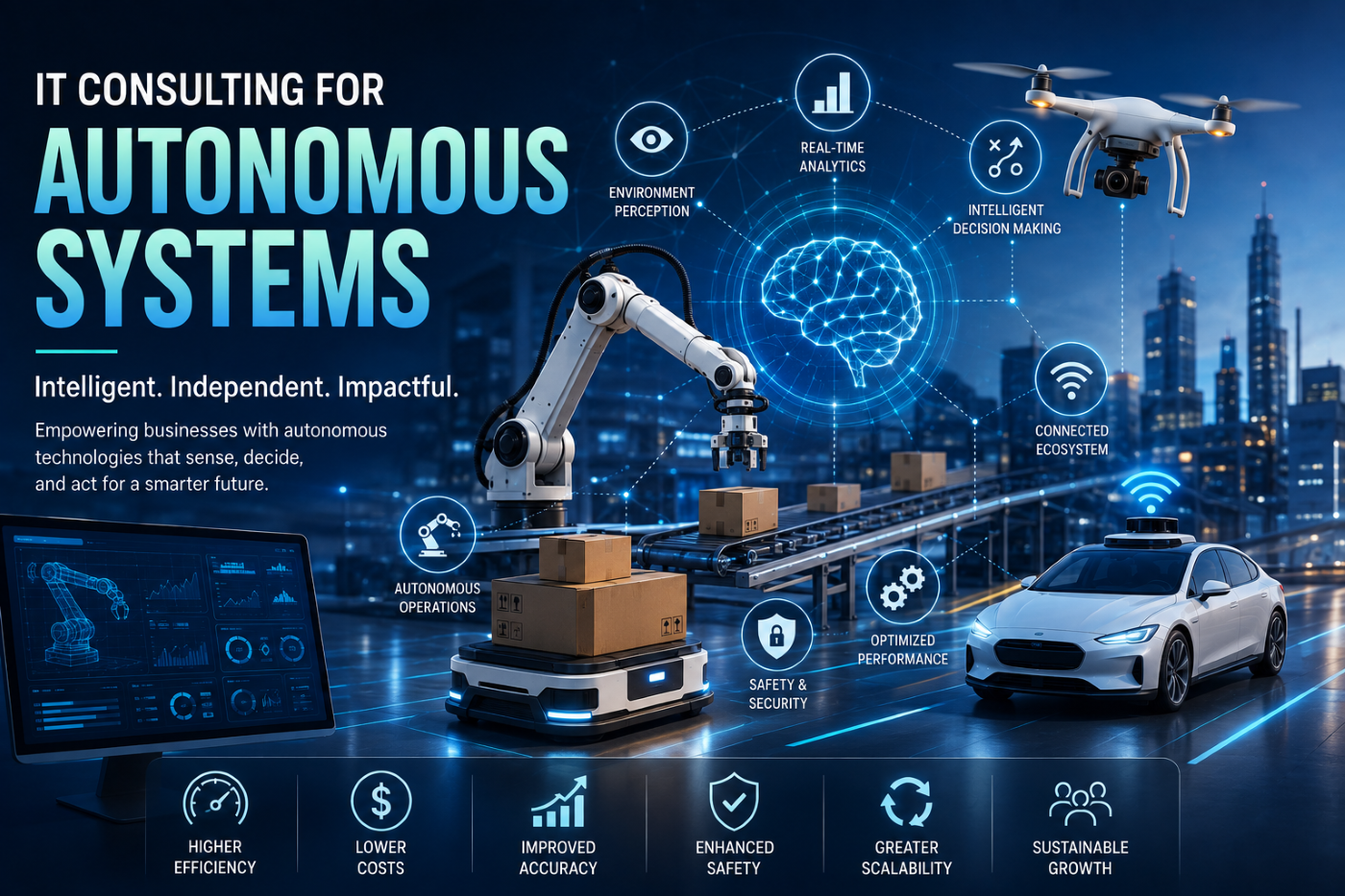
In an increasingly digital world, businesses are moving beyond traditional automation toward systems that can sense their environment, analyze information, make decisions, and perform actions with minimal human intervention. These technologies, known as autonomous systems, are transforming industries such as manufacturing, logistics, healthcare, transportation, energy, finance, and retail.
Autonomous systems can include intelligent robots, self-operating vehicles, automated industrial equipment, AI-powered software agents, drones, smart infrastructure, and other connected technologies capable of responding to changing conditions. Unlike basic automation, which generally follows predefined rules, autonomous systems can use data, artificial intelligence, machine learning, sensors, and real-time analytics to adapt their actions based on the situation.
However, implementing autonomous technology is a complex process. Organizations must consider infrastructure, data quality, artificial intelligence, cybersecurity, system integration, governance, safety, scalability, and business objectives. This is where IT consulting for autonomous systems plays an important role.
At CVDARGON IT Consulting, we help organizations evaluate, design, integrate, and optimize intelligent technologies that support greater efficiency, resilience, and innovation. Our approach focuses on connecting autonomous capabilities with practical business requirements to create systems that deliver measurable value.
Understanding Autonomous Systems
An autonomous system is a technology-based system capable of performing tasks or making certain decisions independently based on data, algorithms, sensors, and predefined operational objectives.
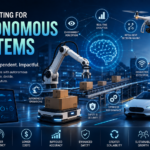
For example, an autonomous warehouse system may use robotics, cameras, sensors, and AI to move products and optimize workflows. A manufacturing environment may use intelligent equipment that monitors its own performance and adjusts operations when specific conditions are detected.
Similarly, AI-powered software systems can monitor business processes, identify patterns, make recommendations, and trigger approved actions without requiring continuous manual intervention.
The level of autonomy can vary significantly. Some systems operate with human supervision, while others may independently perform specific tasks within carefully defined boundaries.
Why Autonomous Systems Matter for Businesses
Modern organizations face increasing pressure to improve efficiency, respond faster to changing conditions, and manage growing volumes of operational data.
Manual processes can be time-consuming and may become difficult to scale. Autonomous systems can help organizations automate repetitive activities, monitor complex environments continuously, and respond to specific events more quickly.
The potential benefits include improved productivity, faster decision-making, reduced operational delays, better resource utilization, and increased visibility into business processes.
For example, autonomous systems can continuously monitor equipment, detect unusual behavior, and alert teams before a potential issue leads to significant downtime.
The goal is not necessarily to eliminate human involvement. In many successful implementations, autonomous technologies support employees by handling repetitive, data-intensive, or time-sensitive tasks while people remain responsible for strategic decisions, oversight, and exception management.
The Role of IT Consulting in Autonomous System Implementation
Implementing autonomous systems requires more than purchasing advanced technology. Organizations need a clear understanding of where autonomy can create value and what technical foundation is required to support it.
CVDARGON IT Consulting helps businesses assess their existing technology environment and identify practical opportunities for autonomous capabilities.
Our consulting approach can include evaluating business processes, data sources, infrastructure, connectivity, cybersecurity requirements, system integrations, and organizational readiness.
By developing a structured technology roadmap, organizations can begin with focused use cases and gradually expand successful autonomous solutions.
This approach helps reduce implementation risks while ensuring that technology investments remain connected to real business objectives.
Artificial Intelligence as the Foundation of Autonomous Systems
Artificial intelligence is one of the core technologies behind many autonomous systems. AI enables systems to analyze large volumes of information, identify patterns, recognize anomalies, and support intelligent decision-making.
Machine learning models can improve performance by analyzing historical and current data. Computer vision can help systems interpret visual information, while natural language processing enables intelligent interaction with users and digital content.
CVDARGON IT Consulting helps organizations identify appropriate AI capabilities based on their operational needs.
A successful strategy requires more than simply introducing AI. Businesses need reliable data, appropriate model governance, performance monitoring, security controls, and human oversight.
IoT and Connected Devices
The Internet of Things is another important component of autonomous environments. Connected sensors and devices provide the real-time information required for intelligent systems to understand their surroundings.
Sensors can monitor temperature, movement, pressure, location, equipment performance, inventory, energy consumption, and other operational conditions.
This information can be transmitted to cloud or edge computing platforms, where analytics and AI models can process it.
CVDARGON IT Consulting helps organizations design secure IoT architectures that connect physical assets with intelligent digital systems.
Reliable connectivity and data management are essential for ensuring that autonomous systems receive accurate and timely information.
Edge Computing for Faster Decisions
Some autonomous systems must respond quickly to changing conditions. Sending all information to a centralized cloud platform may introduce delays that are unsuitable for time-sensitive operations.
Edge computing allows certain data processing and decision-making activities to occur closer to where the data is generated.
For example, a connected industrial system may process sensor information locally to detect critical conditions and respond immediately.
CVDARGON IT Consulting helps organizations evaluate when cloud computing, edge computing, or a hybrid architecture is most appropriate for their autonomous systems.
The right architecture can improve responsiveness while maintaining scalability and centralized management.
Autonomous Systems in Manufacturing
Manufacturing is one of the industries where autonomous technologies are creating significant opportunities.
Smart factories can use autonomous robots, connected equipment, AI-powered quality monitoring, and predictive maintenance systems to improve operational efficiency.
Robotic systems can perform repetitive tasks, while AI-powered monitoring can identify unusual patterns in production equipment.
Autonomous systems can also support quality control through computer vision, helping organizations identify defects more efficiently.
CVDARGON IT Consulting helps manufacturers integrate these technologies with existing enterprise platforms, production systems, analytics environments, and cybersecurity frameworks.
Autonomous Systems in Logistics and Supply Chains
Logistics operations are increasingly adopting autonomous technologies to improve movement, inventory management, and operational visibility.
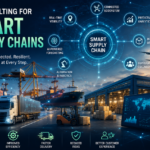
Autonomous mobile robots can assist with warehouse operations, while intelligent software can optimize delivery routes and coordinate supply chain activities.
AI-powered systems can also analyze demand patterns and recommend inventory adjustments.
CVDARGON IT Consulting helps organizations integrate autonomous technologies with warehouse management systems, transportation platforms, ERP applications, and real-time analytics environments.
The result is a more connected supply chain capable of responding faster to changes and disruptions.
| Autonomous System Technology | Potential Business Value |
|---|---|
| AI and Machine Learning | Intelligent analysis and decision support |
| Robotics | Automation of repetitive physical tasks |
| IoT Sensors | Real-time monitoring and data collection |
| Edge Computing | Faster response and low-latency processing |
| Computer Vision | Automated inspection and visual analysis |
| AI Software Agents | Intelligent workflow and task automation |
| Real-Time Analytics | Immediate operational visibility |
Intelligent Automation and AI Agents
Autonomous systems are not limited to physical machines. Software-based autonomous technologies are also becoming increasingly important.
AI-powered agents can analyze information, perform defined tasks, interact with business applications, and support workflows with varying levels of independence.
For example, an intelligent system may monitor incoming service requests, classify them, gather relevant information, and route them to the appropriate team.
In other cases, autonomous software may monitor infrastructure, detect anomalies, and initiate approved response procedures.
CVDARGON IT Consulting helps organizations design intelligent automation strategies that integrate AI capabilities with existing business processes while maintaining appropriate controls and human oversight.
Cybersecurity for Autonomous Environments
As systems become more connected and independent, cybersecurity becomes increasingly important.
Autonomous environments may include IoT devices, cloud platforms, APIs, enterprise applications, sensors, robotics, and third-party systems. Each connection can introduce potential security risks.
A compromised autonomous system could create operational disruptions, expose sensitive data, or affect the accuracy of automated decisions.
CVDARGON IT Consulting helps organizations integrate cybersecurity into autonomous system architecture through identity and access management, encryption, network segmentation, secure APIs, continuous monitoring, and threat detection.
Security should be considered from the beginning rather than added after implementation.
Data Governance and Decision Reliability
Autonomous systems depend on data to make or support decisions. If the underlying information is inaccurate, incomplete, outdated, or biased, the quality of system decisions can be affected.
Organizations therefore need strong data governance practices.
CVDARGON IT Consulting helps businesses establish frameworks for data quality, ownership, access control, monitoring, and responsible use.
AI-driven autonomous systems may also require model monitoring to identify performance changes or unexpected behavior over time.
Strong governance helps organizations maintain trust in autonomous technologies and improve their long-term reliability.
Human Oversight and Responsible Autonomy
The introduction of autonomous systems does not remove the importance of people. Human expertise remains essential for setting objectives, managing exceptions, monitoring outcomes, and making strategic decisions.
Organizations should clearly define where autonomous systems can act independently and where human approval is required.
For high-impact activities, businesses may implement human-in-the-loop or human-on-the-loop approaches.
CVDARGON IT Consulting helps organizations design governance structures that balance automation with accountability and responsible oversight.
The objective is to use autonomy where it creates value while maintaining appropriate control over critical decisions.
Integrating Autonomous Systems with Existing Technology
Many businesses already operate complex environments that include ERP systems, CRM platforms, cloud applications, databases, legacy software, and industry-specific technologies.
Autonomous systems must work effectively within this broader ecosystem.
CVDARGON IT Consulting helps organizations develop integration strategies using APIs, middleware, cloud services, event-driven architectures, and data pipelines.
Effective integration ensures that autonomous technologies can access relevant information and contribute insights back to business systems.
This prevents autonomous solutions from becoming isolated technology projects with limited operational value.
Measuring the ROI of Autonomous Systems
Organizations should establish clear goals before implementing autonomous technologies.
Success may be measured through improvements in productivity, reduced downtime, faster response times, lower operational costs, improved quality, increased throughput, or enhanced customer experiences.
CVDARGON IT Consulting helps businesses define measurable performance indicators and evaluate the impact of autonomous systems over time.
A phased implementation approach allows organizations to test use cases, measure results, and expand successful solutions.
This creates a more sustainable path toward intelligent automation.
Challenges in Autonomous System Implementation
Despite their potential, autonomous systems can present several challenges.
Organizations may face legacy infrastructure, fragmented data, limited technical expertise, cybersecurity concerns, integration difficulties, and uncertainty about the appropriate level of autonomy.
There may also be challenges related to employee adoption and process redesign.
A successful implementation requires collaboration between technology teams, business leaders, operational employees, data specialists, and cybersecurity professionals.
CVDARGON IT Consulting helps organizations address these challenges through technology assessments, strategic planning, architecture design, integration, governance, security, and continuous optimization.
The Future of Autonomous Systems
The future of autonomous systems will be shaped by continued advances in artificial intelligence, robotics, computer vision, edge computing, IoT, digital twins, and intelligent software agents.
Systems will become increasingly capable of understanding complex environments, predicting potential outcomes, and responding to changing conditions.
The combination of autonomous systems with digital twins may allow organizations to simulate decisions before applying them in real-world environments.
AI-powered agents may also become increasingly capable of coordinating complex digital workflows.
However, the future of autonomy will also require greater attention to security, transparency, governance, accountability, and responsible technology practices.
Organizations that build these foundations early will be better prepared to adopt increasingly sophisticated autonomous capabilities.
Why Partner with CVDARGON IT Consulting
Autonomous system implementation requires expertise across artificial intelligence, IoT, cloud computing, edge computing, cybersecurity, data management, enterprise integration, and digital transformation.
CVDARGON IT Consulting helps organizations navigate this complex technology landscape through strategic and practical consulting services.
Our approach can support technology assessments, use-case identification, architecture planning, AI integration, IoT connectivity, data pipelines, cybersecurity, governance, system integration, performance measurement, and continuous optimization.
We focus on helping businesses adopt autonomous technologies in ways that align with their operational requirements and long-term strategic goals.
Conclusion
Autonomous systems are changing how organizations operate by combining artificial intelligence, connected devices, analytics, robotics, and intelligent automation.
From smart manufacturing and autonomous logistics to AI-powered software agents and real-time operational monitoring, these technologies can help businesses improve efficiency, responsiveness, and innovation.
However, successful autonomous system implementation requires a strong technology foundation. Reliable data, secure infrastructure, effective integration, responsible governance, and human oversight are essential for achieving sustainable results.
With the guidance of CVDARGON IT Consulting, organizations can develop practical strategies for adopting autonomous systems and transforming advanced technology into measurable business value.
By taking a structured and responsible approach to autonomy, businesses can build more intelligent, connected, and resilient operations that are ready for the next stage of digital transformation.