
IT Consulting for Digital Twin Implementation: Transforming Business Operations with Virtual Intelligence
 August 10, 2026
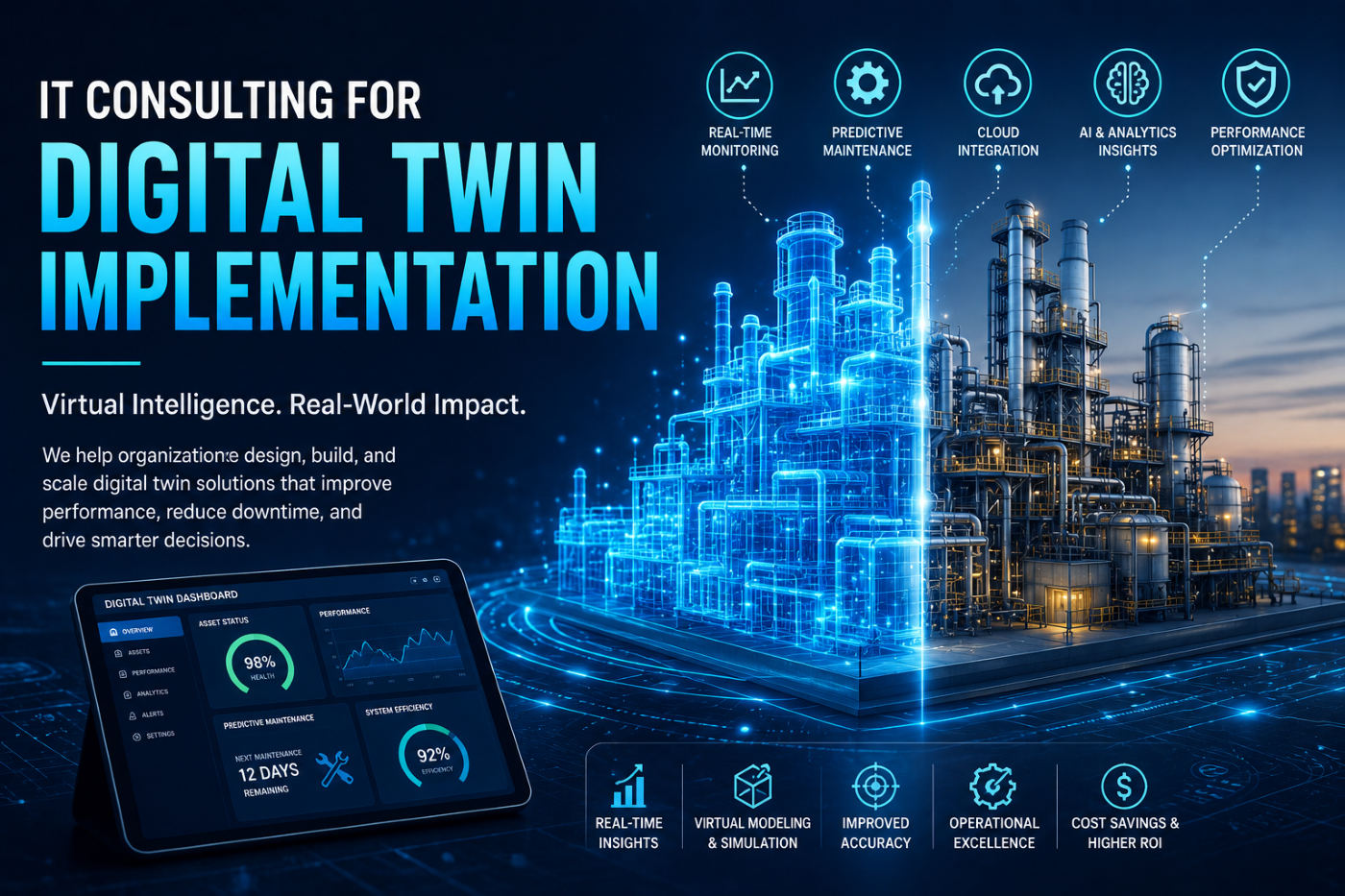
Businesses across industries are looking for smarter ways to understand their operations, predict potential problems, improve efficiency, and make better decisions. Traditional monitoring methods often provide information only after an event has occurred. Digital Twin technology offers a more proactive approach by creating a virtual representation of a physical object, system, process, or environment and continuously connecting it with real-world data.
Digital twins are becoming increasingly valuable in manufacturing, healthcare, logistics, energy, construction, transportation, hospitality, and other industries. By combining IoT sensors, cloud computing, artificial intelligence, data analytics, and simulation technologies, organizations can create dynamic digital models that reflect how physical assets and processes behave in the real world.
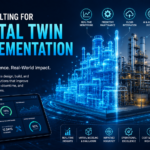
However, implementing a digital twin is not simply a matter of creating a 3D model. Organizations need the right data architecture, connectivity, analytics capabilities, security controls, and integration strategy. This is where IT consulting for Digital Twin implementation becomes important. At CVDARGON IT Consulting, we help organizations plan, design, integrate, and optimize digital twin solutions that support measurable business outcomes.
Understanding Digital Twin Technology
A digital twin is a virtual representation of a physical asset, process, system, or environment that uses real-world data to reflect its current condition and behavior. Unlike a static digital model, a digital twin can continuously change as new information becomes available.
For example, a manufacturing company can create a digital twin of a production machine and connect it to sensors that monitor temperature, vibration, pressure, and operating speed. The digital twin can then provide insights into machine performance and potentially identify signs of deterioration before a failure occurs.
Similarly, a logistics organization could use digital twins to model warehouses, delivery networks, or transportation operations. The organization can simulate different scenarios and determine how changes might affect efficiency, costs, or delivery times.
Why Digital Twins Matter for Modern Businesses
Digital twin technology allows organizations to move from reactive decision-making toward predictive and simulation-based operations.
Instead of waiting for equipment to fail, organizations can monitor asset conditions and identify potential issues earlier. Instead of changing an operational process based entirely on assumptions, teams can simulate possible scenarios in a virtual environment before implementing changes in the real world.
This can help businesses reduce operational risks, improve asset utilization, optimize resources, increase productivity, and support innovation.
Digital twins can also provide decision-makers with a more comprehensive view of complex environments by bringing together information from multiple data sources.
The Role of IT Consulting in Digital Twin Implementation
Digital twin projects typically involve multiple technologies and business systems. These may include IoT devices, sensors, cloud platforms, enterprise applications, databases, analytics platforms, artificial intelligence, visualization tools, and communication networks.
Without proper planning, these components can become difficult to integrate and maintain.
CVDARGON IT Consulting helps organizations develop a clear Digital Twin implementation strategy based on their operational goals and technology environment. Our consultants assess existing infrastructure, identify appropriate data sources, evaluate integration requirements, and design scalable architectures.
This approach ensures that digital twin investments solve real business problems instead of becoming isolated technology experiments.
Identifying the Right Digital Twin Use Case
Not every business process requires a digital twin. The first step should be identifying areas where virtual modeling and real-time data can deliver measurable value.
Potential use cases include predictive maintenance, production optimization, energy management, supply chain monitoring, building management, fleet optimization, asset performance monitoring, and process simulation.
CVDARGON IT Consulting helps organizations evaluate potential use cases based on business impact, data availability, implementation complexity, and expected return on investment.
Starting with a focused and measurable use case can help organizations demonstrate value before expanding digital twin capabilities across the enterprise.
Connecting IoT and Real-Time Data
Real-time data is one of the most important components of an effective digital twin. Sensors and connected devices collect information about physical assets and environments.
This information may include temperature, location, pressure, movement, energy consumption, machine performance, environmental conditions, or other operational metrics.
CVDARGON IT Consulting helps organizations develop IoT integration strategies that securely connect physical assets with digital systems.
Reliable data pipelines ensure that the digital twin remains synchronized with the real-world environment and provides meaningful information for analysis.
Cloud Infrastructure for Digital Twins
Cloud computing provides the scalability and processing capabilities required for many digital twin implementations.
Digital twins can generate and process large volumes of data, particularly when organizations monitor thousands of connected assets. Cloud infrastructure allows businesses to scale computing and storage resources as their requirements change.
CVDARGON IT Consulting helps organizations design cloud-based digital twin architectures that support scalability, availability, security, and cost efficiency.
Cloud platforms can also simplify integration with analytics, artificial intelligence, machine learning, and visualization services.
Artificial Intelligence and Digital Twins
Artificial intelligence can significantly increase the value of digital twins. While a digital twin provides a virtual representation of a physical system, AI can analyze the data generated by that system and identify patterns that may not be obvious to human operators.
Machine learning models can help predict equipment failures, identify anomalies, forecast demand, optimize processes, and recommend operational improvements.
CVDARGON IT Consulting helps organizations integrate AI and machine learning into digital twin environments where appropriate, enabling more intelligent and proactive decision-making.
Predictive Maintenance
Predictive maintenance is one of the most recognized applications of digital twin technology.
Traditional maintenance strategies may involve repairing equipment after a failure or performing maintenance according to a fixed schedule. Both approaches can result in unnecessary costs or unexpected downtime.
A digital twin can continuously monitor asset performance and use analytics to identify potential signs of failure.
By combining sensor data, historical information, and predictive models, organizations can schedule maintenance based on actual asset conditions.
This can reduce unexpected downtime, improve equipment utilization, and extend asset lifecycles.
Digital Twins for Process Optimization
Digital twins can also model business and operational processes rather than individual physical assets.
Organizations can create virtual representations of production lines, warehouses, supply chains, buildings, or other complex systems.
Teams can then simulate different scenarios and evaluate their potential outcomes.
For example, a manufacturer could simulate changes to production schedules before implementing them. A logistics company could evaluate different warehouse layouts or delivery strategies.
CVDARGON IT Consulting helps businesses identify processes where simulation and real-time analysis can produce measurable improvements.
| Digital Twin Capability | Business Benefit |
|---|---|
| Real-Time Monitoring | Provides continuous operational visibility |
| Predictive Analytics | Helps anticipate potential problems |
| Simulation | Allows decisions to be tested virtually |
| IoT Integration | Connects physical assets with digital systems |
| AI Integration | Enables intelligent predictions and recommendations |
| Cloud Infrastructure | Supports scalability and flexibility |
| Data Visualization | Makes complex information easier to understand |
Data Integration and Enterprise Systems
Digital twins rarely operate independently. They often need to exchange information with enterprise systems such as ERP, CRM, manufacturing platforms, asset management software, and supply chain applications.
Effective integration creates a more complete view of business operations.
CVDARGON IT Consulting helps organizations connect digital twin platforms with existing enterprise technologies through APIs, data pipelines, integration platforms, and modern cloud architectures.
This prevents digital twin initiatives from becoming isolated data environments and allows insights to influence broader business processes.
Digital Twin Visualization
A digital twin becomes more useful when users can easily understand the information it provides.
Interactive dashboards, 3D visualizations, charts, maps, alerts, and operational views can help employees understand asset conditions and system performance.
CVDARGON IT Consulting helps organizations design visualization strategies that present complex operational information in a clear and actionable format.
The objective is not simply to create attractive visual models but to ensure that users can quickly identify problems, understand trends, and make informed decisions.
Cybersecurity and Digital Twin Protection
Digital twins rely on connected devices, networks, cloud platforms, and enterprise systems. This creates cybersecurity considerations that must be addressed from the beginning.
Compromised sensors, unauthorized access, insecure APIs, or manipulated data could affect the accuracy and reliability of a digital twin.
CVDARGON IT Consulting integrates security measures such as identity and access management, encryption, network protection, API security, monitoring, and secure device management into digital twin architectures.
Protecting both physical and digital environments is essential for maintaining reliable operations.
Digital Twin Implementation Challenges
Although digital twins offer significant benefits, implementation can present several challenges.
Organizations may have legacy systems, inconsistent data, limited IoT infrastructure, cybersecurity concerns, insufficient technical expertise, or unclear business objectives.
Data quality can also become a major issue. A digital twin is only as reliable as the information used to represent the physical environment.
CVDARGON IT Consulting helps organizations address these challenges through structured assessments, phased implementation strategies, data architecture planning, integration, security, and ongoing optimization.
Measuring Digital Twin ROI
Organizations should establish clear performance indicators before implementing a digital twin.
Depending on the use case, success may be measured through reduced downtime, lower maintenance costs, improved production efficiency, reduced energy consumption, better asset utilization, improved forecasting, or faster decision-making.
CVDARGON IT Consulting helps businesses define measurable objectives and track performance after implementation.
A results-focused approach ensures that digital twin technology delivers tangible business value rather than becoming an expensive standalone technology initiative.
Future of Digital Twin Technology
Digital twins are expected to become increasingly sophisticated as artificial intelligence, IoT, edge computing, cloud platforms, and real-time analytics continue to evolve.
Future digital twins may become more autonomous, capable of identifying problems, recommending actions, and even triggering automated responses.
The combination of digital twins and generative AI could also make complex operational information easier for employees to understand by allowing users to interact with digital models using natural language.
As these technologies mature, digital twins will increasingly support strategic planning, operational optimization, sustainability initiatives, and intelligent automation.
Why Partner with CVDARGON IT Consulting
Digital Twin implementation requires expertise across cloud computing, IoT, data engineering, artificial intelligence, cybersecurity, enterprise integration, analytics, and software architecture.
CVDARGON IT Consulting provides end-to-end consulting support to help organizations move from initial digital twin concepts to scalable production environments.
Our services can include use-case identification, technology assessment, architecture design, IoT integration, data pipeline development, cloud implementation, AI integration, cybersecurity, visualization, performance monitoring, and continuous optimization.
Our customized approach ensures that every digital twin initiative is aligned with the organization’s operational requirements and long-term digital strategy.
Conclusion
Digital Twin technology is changing how organizations monitor assets, understand processes, predict problems, and make operational decisions. By creating dynamic virtual representations connected to real-world data, businesses can gain deeper visibility and test potential improvements before making changes in physical environments.
However, successful implementation requires more than advanced visualization. Organizations need reliable data, secure connectivity, scalable infrastructure, effective integration, analytics, and a clear business strategy.
With expert guidance from CVDARGON IT Consulting, businesses can develop digital twin solutions that transform real-time information into actionable intelligence. From predictive maintenance and process optimization to AI-powered forecasting and operational simulation, digital twins can become a powerful foundation for smarter and more resilient business operations.
As organizations continue to embrace connected technologies, digital twins will play an increasingly important role in digital transformation. Businesses that strategically invest in this technology today can gain greater operational visibility, reduce risks, improve efficiency, and build a stronger foundation for future innovation.