




Scalable Infrastructure
 May 14, 2026
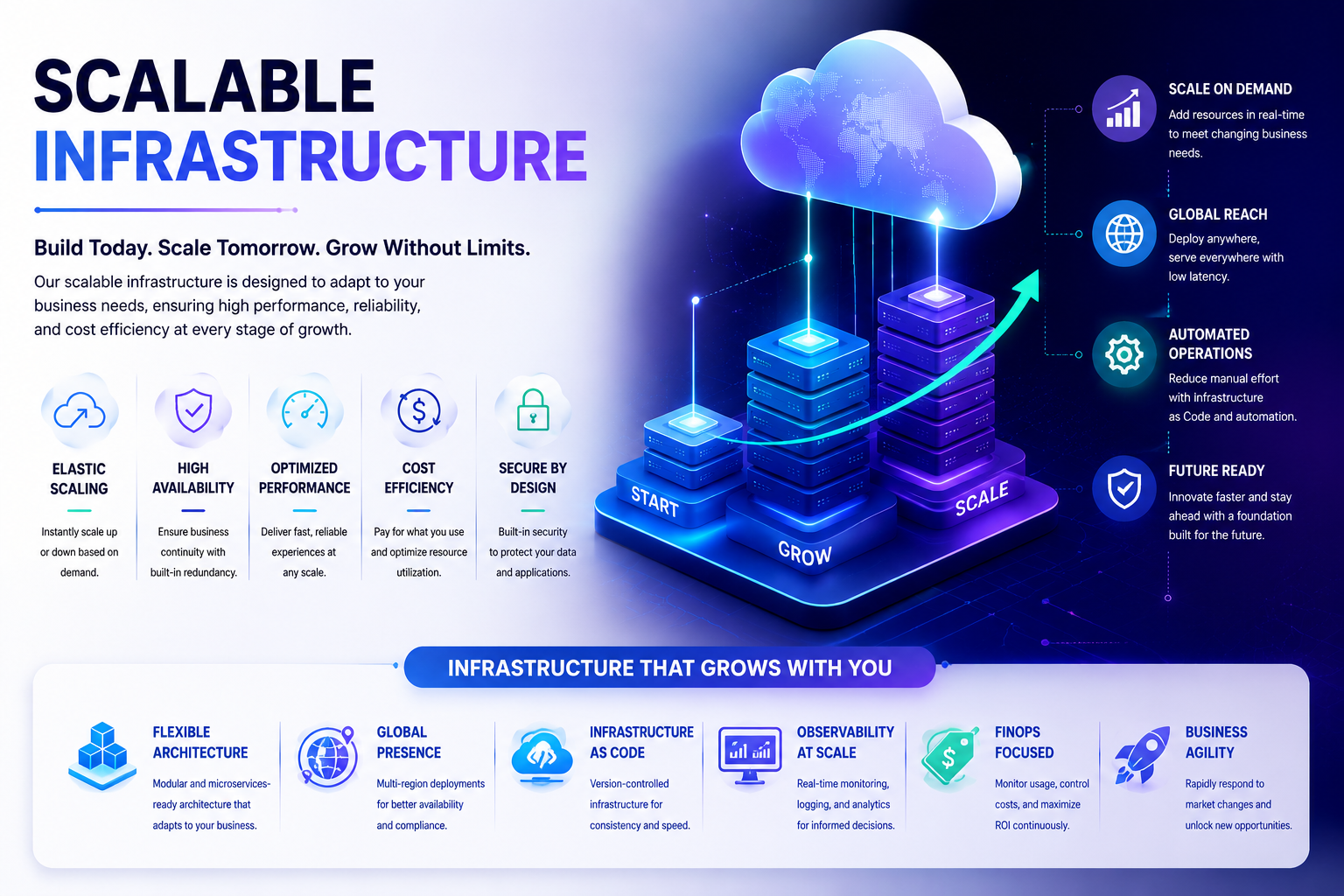
In today’s fast-changing digital economy, businesses cannot afford technology systems that limit growth. As organizations expand, customer demands increase, data volumes grow, and applications become more complex. Infrastructure that performs well today may struggle tomorrow if it cannot adapt to changing requirements. This is why scalable infrastructure has become a fundamental requirement for modern businesses. At CVDragon IT Consulting, we help organizations build scalable infrastructure solutions that support growth, improve performance, and ensure long-term operational success.
Scalable infrastructure refers to an IT environment that can expand or adapt efficiently as business needs evolve. It allows organizations to increase or decrease resources such as computing power, storage, network capacity, and application support without causing disruptions or requiring complete system redesigns. A scalable infrastructure ensures businesses remain agile and prepared for future opportunities.
One of the biggest advantages of scalable infrastructure is business flexibility. Market conditions, customer expectations, and operational requirements can change rapidly. Businesses need systems capable of responding to traffic spikes, increasing workloads, and changing user demands without affecting performance. IT consultants help organizations create infrastructure that adjusts dynamically based on real-time needs.
Cloud technology plays a central role in building scalability. Platforms such as Amazon Web Services, Microsoft Azure, and Google Cloud Platform provide businesses with the ability to scale resources instantly. Instead of investing heavily in physical hardware, organizations can use cloud environments to add or reduce capacity based on demand.
There are two primary forms of scalability: vertical scaling and horizontal scaling. Vertical scaling involves increasing resources such as CPU or memory on existing servers, while horizontal scaling adds additional servers or instances to distribute workloads. IT consultants assess business requirements and recommend the most effective scaling approach.
Performance optimization is a key component of scalable infrastructure. Growth should not come at the cost of slower applications or system instability. IT consultants design systems using load balancing, caching mechanisms, and optimized architectures to ensure consistent performance even during periods of high demand.
Another important aspect is resource efficiency. Traditional infrastructure often requires businesses to purchase more capacity than necessary to prepare for future growth. This can lead to underutilized systems and increased costs. Scalable environments allocate resources dynamically, ensuring organizations only use and pay for what they need.
Automation significantly enhances scalability. Manual infrastructure management becomes increasingly difficult as systems grow larger and more complex. IT consultants implement automation tools that handle provisioning, scaling, monitoring, and resource allocation automatically. This reduces operational effort and improves responsiveness.
Application architecture also plays a crucial role. Modern applications designed with microservices and containerized environments are easier to scale than traditional monolithic systems. IT consultants help businesses modernize application structures to support better scalability and flexibility.
Data growth presents another challenge for organizations. As customer interactions, transactions, and analytics requirements increase, storage systems must scale efficiently. IT consultants implement scalable data architectures and storage solutions that accommodate future expansion without performance issues.
Security must scale alongside infrastructure growth. Expanding systems create larger attack surfaces and additional risks. IT consultants integrate security measures such as identity management, access controls, encryption, and continuous monitoring into scalable environments to ensure protection remains strong as systems grow.
Business continuity and resilience are equally important. Scalable infrastructure should not only support growth but also maintain reliability during unexpected events. IT consultants design infrastructures with redundancy, failover systems, and disaster recovery capabilities to minimize disruptions.
Monitoring and analytics provide visibility into system behavior and growth trends. IT consultants deploy monitoring tools that track resource usage, performance metrics, and workload patterns. These insights help businesses plan future infrastructure needs and optimize scalability strategies.
Hybrid and multi-cloud strategies further strengthen scalability. Organizations can distribute workloads across multiple environments, reducing dependency on a single provider and improving flexibility. IT consultants help businesses create integrated environments that maximize scalability and performance.
At CVDragon IT Consulting, our scalable infrastructure approach includes:
- Infrastructure assessment and capacity analysis
- Cloud and scalability strategy planning
- Architecture modernization and optimization
- Automation and orchestration implementation
- Load balancing and performance enhancement
- Security integration and governance
- Monitoring and predictive analytics
- Continuous optimization and support
Real-world examples demonstrate the value of scalable infrastructure. An e-commerce company experiencing seasonal traffic surges can automatically scale server resources during major sales events. A SaaS business serving thousands of users can expand application capacity seamlessly without affecting user experience.
Another significant advantage is cost control. Scalable infrastructure reduces unnecessary spending by allocating resources efficiently and eliminating the need for excessive upfront hardware investments.
Employee productivity also benefits from scalable environments. Teams gain access to reliable systems that support collaboration, remote work, and rapid application deployment without infrastructure limitations.
Scalable infrastructure also creates a foundation for innovation. Technologies such as artificial intelligence, IoT, advanced analytics, and automation require flexible environments capable of handling changing demands and large data volumes.
In conclusion, scalable infrastructure is essential for businesses aiming to grow without technology limitations. By building adaptable systems, optimizing resources, strengthening security, and leveraging modern cloud technologies, organizations can create resilient environments ready for future challenges. At CVDragon IT Consulting, we help businesses design and implement scalable infrastructure solutions that support sustainable growth and long-term success.