
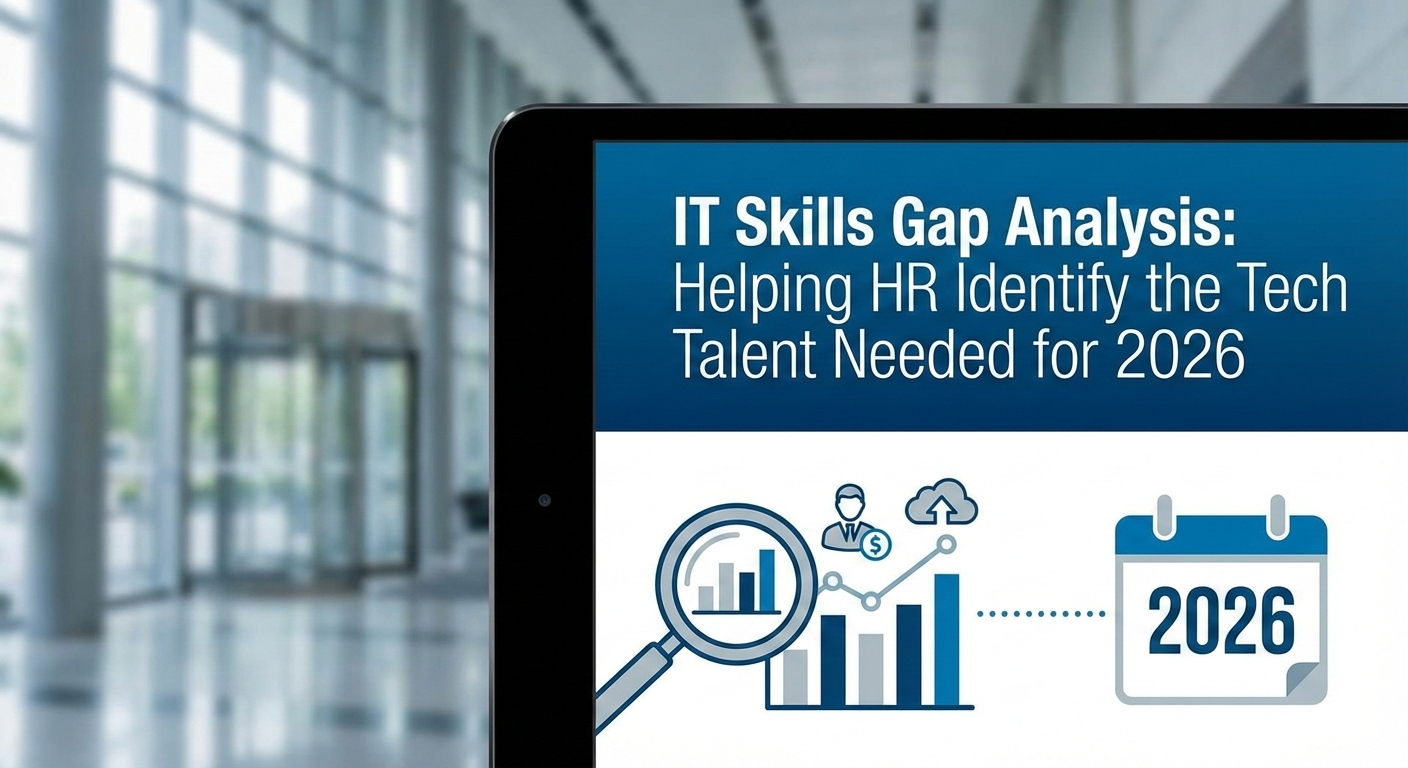
IT Skills Gap Analysis: Helping HR Identify the Tech Talent Needed for 2026
 January 15, 2026
As we move closer to 2026, organizations across industries are facing a defining challenge: technology is evolving faster than the workforce that supports it. Cloud-native systems, artificial intelligence, cybersecurity threats, automation, data analytics, and remote work models are no longer future concepts—they are business essentials. Yet many organizations are discovering that their current talent pool is not fully equipped to meet these demands.
This growing disconnect between business technology needs and workforce capabilities is known as the IT skills gap. Addressing it is no longer just an IT responsibility—it is a strategic priority for HR leadership. To remain competitive, resilient, and innovative, organizations must clearly understand which IT skills they have today, which ones they lack, and which they will need tomorrow.
This is where IT skills gap analysis, supported by expert IT consulting, becomes a powerful tool. At cvDragon IT Consulting, we help HR and leadership teams identify future-ready technology skills and build actionable strategies to prepare for 2026 and beyond.
Understanding the IT Skills Gap
An IT skills gap occurs when an organization’s workforce lacks the technical knowledge, capabilities, or experience required to support its current or future technology environment. These gaps can appear at multiple levels:
- Technical skills (cloud, AI, cybersecurity, DevOps)
- Strategic skills (IT governance, digital transformation leadership)
- Operational skills (system integration, automation, data management)
- Soft skills (collaboration, adaptability, problem-solving in tech roles)
Left unaddressed, IT skills gaps can slow innovation, increase security risks, inflate costs, and reduce competitiveness.
Why IT Skills Gap Analysis Is Critical for 2026
The pace of change in technology shows no signs of slowing. Several trends are shaping the IT talent requirements of 2026:
1. Rapid Adoption of Advanced Technologies
AI, machine learning, cloud-native platforms, and automation are becoming mainstream. Organizations need professionals who can not only implement these technologies but also manage and optimize them.
2. Growing Cybersecurity Threats
As digital footprints expand, so do cyber risks. Cyber resilience will be a core business requirement, increasing demand for security architects, analysts, and risk specialists.
3. Shift to Hybrid and Remote Work
Distributed workforces require secure infrastructure, collaboration platforms, and IT professionals who can manage complex, remote-first environments.
4. Data-Driven Business Models
Data is becoming a strategic asset. Skills in data engineering, analytics, and governance will be critical for informed decision-making.
5. Increasing Regulatory and Compliance Pressure
Technology roles must now include compliance awareness, especially in industries such as finance, healthcare, and e-commerce.
For HR leaders, the challenge is clear: hire and develop talent not just for today’s needs, but for 2026 and beyond.
What Is IT Skills Gap Analysis?
IT skills gap analysis is a structured process used to:
- Assess current IT skills within the organization
- Identify future technology and business requirements
- Compare existing capabilities with future needs
- Highlight gaps, redundancies, and risks
- Develop targeted hiring, training, and reskilling strategies
When supported by IT consulting, this analysis becomes more accurate, forward-looking, and aligned with business strategy.
The Role of IT Consulting in Skills Gap Analysis
HR teams often lack deep visibility into future technology requirements, while IT teams may not have the bandwidth or strategic perspective to assess workforce readiness. IT consulting bridges this gap.
At cvDragon IT Consulting, we work closely with HR, IT, and executive leadership to ensure skills planning is both technically accurate and strategically relevant.
1. Aligning Skills with Business and IT Strategy
The first step in skills gap analysis is understanding where the organization is heading. IT consultants help HR teams align talent planning with:
- Business growth objectives
- Digital transformation initiatives
- Technology roadmaps
- Industry trends and competitive pressures
This ensures that skills planning is proactive rather than reactive.
2. Assessing Current IT Capabilities
IT consulting supports structured assessments of existing talent by evaluating:
- Technical skill sets
- Certifications and experience levels
- Role effectiveness and overlap
- Dependency on key individuals
- Readiness for new technologies
This assessment provides HR with a realistic picture of current strengths and weaknesses.
3. Identifying Critical IT Skills for 2026
Based on industry trends and organizational goals, IT consultants help define future-critical skills. These may include:
Cloud and Infrastructure Skills
- Cloud architecture and migration
- Hybrid and multi-cloud management
- Infrastructure as Code (IaC)
Cybersecurity and Risk Management
- Security operations and threat detection
- Identity and access management
- Compliance and data protection
Data and Analytics
- Data engineering and integration
- Business intelligence and analytics
- AI and machine learning operations
Software and Automation
- DevOps and CI/CD pipelines
- Low-code and no-code platforms
- Process automation and RPA
Digital Leadership and Governance
- IT governance and compliance
- Vendor and technology portfolio management
- Digital transformation leadership
By identifying these skills early, HR can plan effectively for recruitment and development.
4. Mapping Skills Gaps and Risk Areas
Once current and future skills are defined, IT consulting helps map gaps such as:
- Skills that are missing entirely
- Skills that exist but lack depth
- Overreliance on a small number of experts
- Roles that will become obsolete by 2026
This mapping allows HR to prioritize actions based on business risk and impact.
5. Supporting Smarter Hiring Strategies
Rather than reactive hiring, IT skills gap analysis enables targeted recruitment. IT consultants help HR:
- Define future-ready job roles
- Create accurate technical job descriptions
- Avoid over-hiring or under-hiring
- Balance permanent hires with contract or managed services
This approach reduces recruitment costs and improves long-term workforce stability.
6. Enabling Reskilling and Upskilling Programs
Not every skills gap requires new hires. In many cases, existing employees can be reskilled with the right guidance.
IT consulting supports HR by:
- Identifying reskilling opportunities
- Designing role-based training roadmaps
- Aligning learning programs with technology strategy
- Measuring training effectiveness
Reskilling improves employee engagement while preserving institutional knowledge.
7. Workforce Planning for Emerging Roles
By 2026, many IT roles will be significantly different from today. IT consulting helps HR anticipate roles such as:
- Cloud security specialists
- AI operations engineers
- Digital compliance officers
- Automation architects
- Data governance leads
Planning for these roles early gives organizations a competitive edge in the talent market.
8. Reducing Dependency and Knowledge Silos
A common risk identified in skills gap analysis is dependency on a few key individuals. IT consultants help mitigate this risk by:
- Encouraging cross-training
- Supporting documentation and knowledge sharing
- Recommending role diversification
- Aligning skills with succession planning
This improves resilience and continuity.
9. Supporting Hybrid Talent Models
The future workforce will be a mix of:
- Full-time employees
- Contract specialists
- Managed service providers
- Virtual leadership roles (such as vCIOs)
IT consulting helps HR design flexible talent models that balance cost, expertise, and scalability.
10. Measuring Progress and Continuous Improvement
Skills planning is not a one-time exercise. IT consulting enables continuous improvement by:
- Monitoring evolving technology trends
- Updating skills requirements regularly
- Tracking training and hiring outcomes
- Adjusting workforce strategy as business needs change
This ensures organizations stay prepared beyond 2026.
Benefits of IT Skills Gap Analysis for HR and Business
Organizations that invest in IT skills gap analysis gain measurable benefits:
- Better alignment between talent and technology strategy
- Reduced hiring and training costs
- Improved digital transformation success
- Stronger cybersecurity and compliance posture
- Higher employee engagement and retention
- Increased organizational agility and resilience
Why cvDragon IT Consulting?
At cvDragon IT Consulting, we understand that technology success depends on people as much as platforms. Our IT skills gap analysis services are designed to help HR leaders move from uncertainty to clarity.
We combine:
- Deep technology expertise
- Industry insight
- Workforce planning experience
- Practical, actionable recommendations
Our goal is to help organizations build future-ready IT teams that can confidently support business goals in 2026 and beyond.
Conclusion: Preparing Today for the Tech Talent of Tomorrow
As 2026 approaches, the question is no longer whether organizations need new IT skills—but whether they are prepared to identify and develop them in time. The cost of inaction is high: stalled digital initiatives, increased security risks, and loss of competitive advantage.
IT skills gap analysis, supported by expert IT consulting, gives HR leaders the insight and direction needed to build the right teams for the future.
At cvDragon IT Consulting, we help organizations turn workforce planning into a strategic advantage—ensuring that the right skills, in the right roles, are ready for what lies ahead.
The future of technology belongs to organizations that prepare their people today.