
The “Clean Core” ERP Strategy: Avoiding Over-Customization in SAP and Dynamics
 January 22, 2026
Enterprise Resource Planning (ERP) systems like SAP and Microsoft Dynamics have long been the backbone of modern organizations. They integrate finance, supply chain, HR, manufacturing, and customer operations into a single system of record. Yet, despite their power, many ERP programs fail to deliver long-term value. The reason is rarely the technology itself—it is over-customization.
For years, organizations customized their ERP systems extensively to match existing business processes. While this approach solved short-term needs, it created long-term challenges: high maintenance costs, complex upgrades, slow innovation, and growing technical debt. As cloud ERP, continuous updates, and digital transformation become the norm, a new philosophy has emerged—the “Clean Core” ERP strategy.
At cvDragon IT Consulting, we help organizations adopt a clean core approach for SAP and Dynamics, enabling agility, scalability, and future-ready ERP landscapes. This article explores what clean core means, why it matters, and how businesses can avoid the pitfalls of over-customization.
What Is the “Clean Core” ERP Strategy?
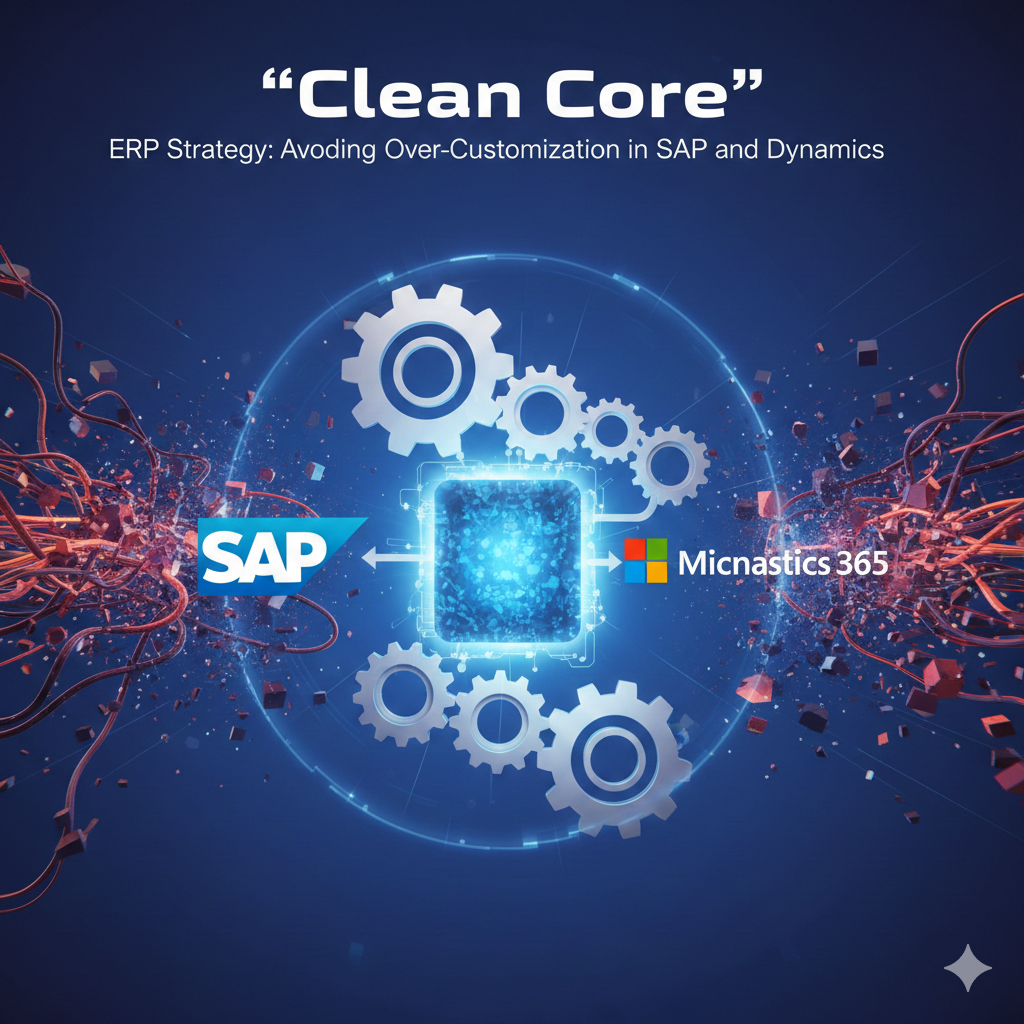
The clean core strategy is a design principle that emphasizes keeping the ERP core system as close as possible to standard, out-of-the-box functionality, while moving customizations and extensions outside the core.
Instead of modifying standard ERP code, organizations use:
- Configuration over customization
- Side-by-side extensions
- APIs and integration layers
- Low-code and cloud platforms
The goal is to preserve the integrity of the ERP core while still supporting unique business needs.
Why Over-Customization Became a Problem
Historically, ERP implementations were heavily customized for valid reasons:
- Legacy processes that could not easily change
- On-premise systems with infrequent upgrades
- Limited integration and extension options
- A belief that ERP should mirror every internal process
Over time, this led to ERP environments that were:
- Difficult to upgrade
- Expensive to maintain
- Dependent on niche skills
- Resistant to innovation
With modern cloud ERP models, these challenges are no longer sustainable.
The Shift to Cloud ERP and Continuous Innovation
Both SAP and Microsoft Dynamics have fundamentally changed how ERP systems evolve.
- SAP S/4HANA emphasizes standardized processes, embedded analytics, and cloud extensibility
- Dynamics 365 promotes modular apps, Power Platform extensions, and frequent updates
In this environment, over-customization becomes a liability. Every custom modification increases the effort, risk, and cost of staying current.
A clean core strategy aligns ERP systems with the reality of continuous innovation.
Core Principles of a Clean Core ERP Approach
At cvDragon IT Consulting, we define clean core around a few essential principles.
1. Standardize Where Possible
ERP vendors have embedded decades of best practices into standard functionality. Clean core encourages organizations to adopt these standards instead of recreating legacy processes.
This often requires a mindset shift—from “How do we customize ERP to fit us?” to “How do we evolve our processes to leverage ERP?”
2. Configure, Don’t Customize
Configuration allows organizations to adapt behavior without altering core code. Both SAP and Dynamics provide extensive configuration options for:
- Business rules
- Workflows
- Reporting
- Security and roles
Configuration preserves upgradeability and reduces long-term risk.
3. Extend Outside the Core
When differentiation is required, clean core promotes side-by-side extensions rather than core modifications.
Examples include:
- SAP Business Technology Platform (BTP) extensions
- Dynamics 365 Power Platform apps
- External microservices
- API-driven integrations
This keeps the ERP core stable while enabling innovation.
The Business Value of a Clean Core Strategy
A clean core is not just a technical preference—it delivers tangible business benefits.
1. Faster and Safer Upgrades
With minimal custom code, ERP upgrades become simpler, faster, and less risky. Organizations can adopt new features without extensive regression testing.
2. Lower Total Cost of Ownership
Reduced customization leads to:
- Lower maintenance costs
- Less dependency on specialized consultants
- Simplified support and troubleshooting
Over time, this significantly reduces ERP lifecycle costs.
3. Greater Agility and Innovation
By decoupling innovation from the core, organizations can experiment, scale, and adapt quickly without destabilizing critical systems.
4. Improved System Stability and Performance
Standard ERP code is thoroughly tested and optimized by vendors. Avoiding heavy customization improves reliability and performance.
Clean Core in SAP Environments
SAP’s clean core strategy has become especially important with S/4HANA and cloud adoption.
SAP encourages:
- Use of standard S/4HANA processes
- ABAP cloud-ready development
- Extensions on SAP BTP
- API-first integration
Custom code inside the core should be minimized and strictly governed.
At cvDragon IT Consulting, we help SAP customers analyze existing customizations, identify what can be retired, and redesign extensions in a clean, future-proof way.
Clean Core in Microsoft Dynamics 365
Microsoft Dynamics 365 is built around modularity and extensibility by design.
A clean core Dynamics strategy focuses on:
- Using standard Dynamics apps wherever possible
- Extending functionality with Power Apps and Power Automate
- Leveraging Dataverse for integration
- Avoiding direct modifications to base entities
This approach allows organizations to stay current with Microsoft’s rapid release cycles.
The Role of IT Consulting in Clean Core Adoption
Adopting a clean core strategy requires more than technical changes—it demands strategic guidance and change management.
This is where IT consulting plays a critical role.
1. Customization Assessment and Rationalization
Most organizations already have years of ERP customizations. Consulting helps:
- Inventory existing custom code
- Assess business value vs. technical debt
- Identify candidates for elimination or redesign
Not all customizations are bad—but many are no longer necessary.
2. Business Process Re-Engineering
Clean core often requires aligning processes with ERP standards. IT consulting supports workshops and process redesign initiatives that balance efficiency with differentiation.
3. Architecture and Extension Strategy
Consulting defines where customization belongs—inside configuration, outside the core, or in integrated systems.
This includes:
- Extension patterns
- Integration architecture
- Data ownership models
4. Governance and Controls
Without governance, clean core principles erode over time. IT consulting helps establish:
- Customization approval frameworks
- Development standards
- Documentation and monitoring
- Long-term ERP roadmap alignment
Governance ensures the ERP remains clean as the business evolves.
Common Misconceptions About Clean Core
Despite its benefits, clean core is often misunderstood.
- “Clean core means no customization.”
Not true. It means smart, controlled customization outside the core. - “Standard ERP can’t support our business.”
Most differentiation happens outside ERP—in customer experience, analytics, and innovation layers. - “It limits flexibility.”
In reality, clean core increases flexibility by reducing constraints caused by technical debt.
Change Management: The Human Factor
One of the biggest challenges in clean core adoption is organizational resistance. Teams may be attached to legacy processes or fear loss of control.
IT consulting plays a key role in:
- Educating stakeholders on long-term benefits
- Aligning leadership and IT teams
- Supporting training and adoption
- Creating a shared vision for ERP evolution
Clean core is as much a cultural shift as a technical one.
The Future of ERP Is Clean and Composable
ERP systems are no longer monolithic. They are becoming composable platforms, integrated with cloud services, analytics, AI, and industry solutions.
A clean core strategy positions organizations to:
- Adopt new technologies faster
- Respond to market change
- Scale globally with confidence
Those who cling to heavy customization risk falling behind.
Conclusion: Building a Sustainable ERP Foundation
The clean core ERP strategy represents a fundamental shift in how organizations think about SAP and Dynamics. By avoiding over-customization and embracing standardization, configuration, and smart extensibility, businesses can unlock the full value of their ERP investments.
At cvDragon IT Consulting, we help organizations transition from legacy-heavy ERP landscapes to clean, agile, and future-ready platforms. Our approach balances business needs with technical best practices—ensuring ERP systems remain an enabler, not a constraint.
A clean core is not about doing less. It’s about building ERP systems that can evolve, adapt, and support innovation for years to come.