
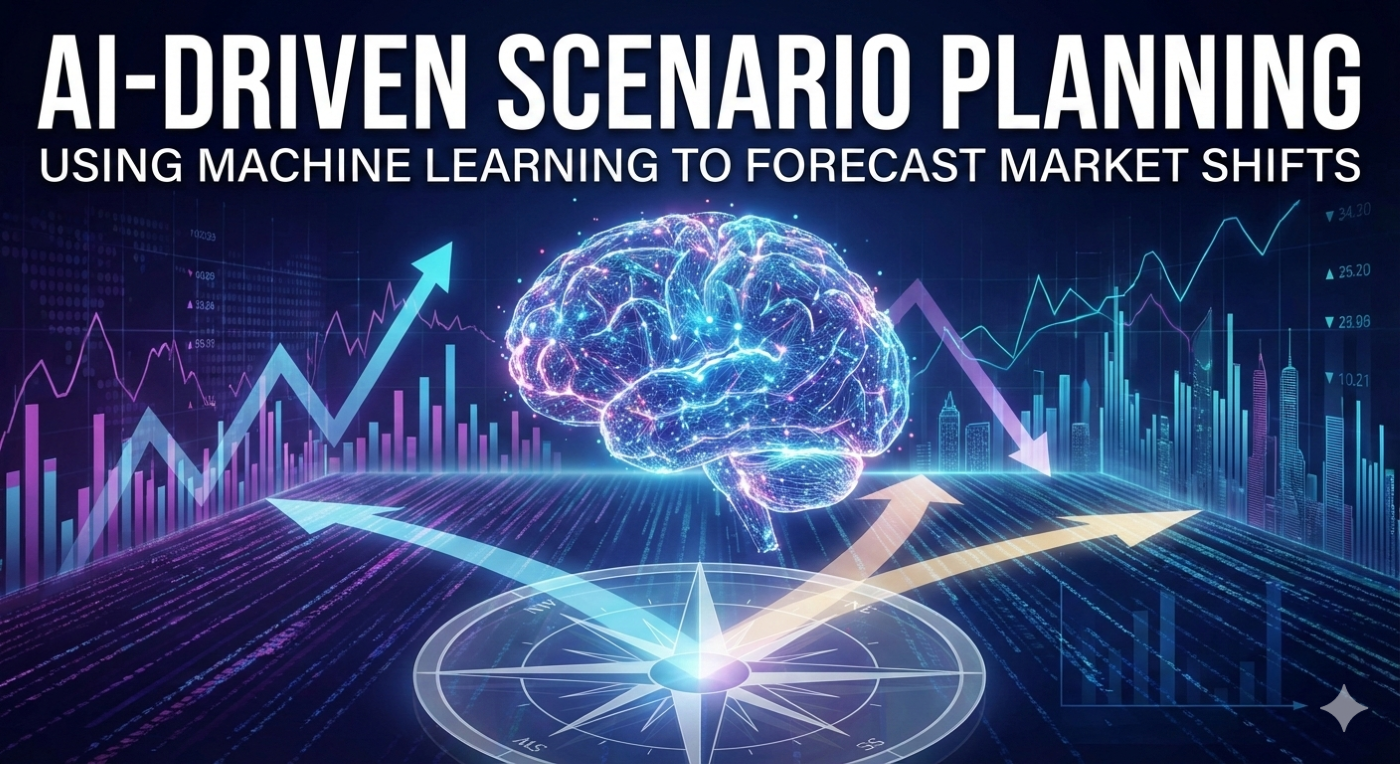
AI-Driven Scenario Planning: Using Machine Learning to Forecast Market Shifts
 January 16, 2026
In an era defined by uncertainty, rapid innovation, and global disruption, traditional business planning methods are no longer sufficient. Markets change faster than annual forecasts can keep up with. Consumer behavior evolves overnight. Supply chains are disrupted by geopolitical events, climate risks, and economic volatility. For business leaders, the challenge is no longer predicting a single future—but preparing for multiple possible futures.
This is where AI-driven scenario planning, powered by machine learning, is transforming how organizations anticipate and respond to market shifts. By analyzing vast amounts of data, identifying hidden patterns, and simulating alternative futures, AI enables businesses to move from reactive decision-making to proactive strategy.
At cvDragon IT Consulting, we help organizations harness AI-driven scenario planning to improve resilience, sharpen strategy, and gain a sustainable competitive advantage. This article explores how machine learning is reshaping scenario planning and why it has become a critical capability for modern enterprises.
The Limits of Traditional Scenario Planning
Scenario planning has long been used by organizations to prepare for uncertainty. Traditionally, it relies on expert judgment, historical trends, and qualitative assumptions to develop a small number of possible future scenarios.
While valuable, traditional approaches have clear limitations:
- Heavy reliance on subjective assumptions
- Limited ability to process large or complex datasets
- Static models that struggle to adapt to rapid change
- Difficulty capturing nonlinear market behavior
- Infrequent updates due to time and resource constraints
In today’s data-rich and fast-moving environment, these limitations can leave organizations unprepared for sudden market shifts.
What Is AI-Driven Scenario Planning?
AI-driven scenario planning uses machine learning (ML) and advanced analytics to enhance and automate the process of exploring future possibilities. Instead of relying solely on human intuition, AI systems analyze large volumes of structured and unstructured data to generate data-backed scenarios.
Key capabilities include:
- Continuous data ingestion from multiple sources
- Pattern recognition across historical and real-time data
- Predictive modeling of future market behavior
- Simulation of multiple “what-if” scenarios
- Dynamic updates as new data becomes available
The result is a more accurate, scalable, and adaptive approach to planning under uncertainty.
The Role of Machine Learning in Forecasting Market Shifts
Machine learning lies at the heart of AI-driven scenario planning. Unlike traditional models, ML systems learn from data and improve over time. They can detect subtle signals and complex relationships that are difficult for humans to identify.
Key ML Capabilities in Scenario Planning
- Predictive analytics: Forecasting demand, pricing, and market trends
- Anomaly detection: Identifying early warning signals of disruption
- Clustering: Grouping markets, customers, or behaviors with similar patterns
- Time-series analysis: Understanding seasonality, cycles, and trend shifts
- Natural language processing (NLP): Analyzing news, social media, and reports
Together, these capabilities allow organizations to anticipate market changes before they fully materialize.
Why AI-Driven Scenario Planning Matters Now
Several forces are driving the adoption of AI-driven scenario planning:
1. Increased Market Volatility
Economic uncertainty, geopolitical tensions, and technological disruption have made markets more unpredictable.
2. Explosion of Data
Organizations now have access to massive datasets—from customer behavior and financial performance to social sentiment and external market indicators.
3. Faster Decision Cycles
Businesses must make strategic decisions in weeks or days, not months.
4. Competitive Pressure
Organizations that anticipate change gain a significant advantage over those that react too late.
AI-driven scenario planning addresses these challenges by turning data into foresight.
How AI-Driven Scenario Planning Works
At cvDragon IT Consulting, we view AI-driven scenario planning as a structured, business-aligned process rather than a purely technical exercise.
1. Data Integration and Preparation
The foundation of effective AI models is high-quality data. AI-driven scenario planning draws from sources such as:
- Internal sales, financial, and operational data
- Market and industry reports
- Economic indicators
- Customer behavior and transaction data
- Supply chain and logistics data
- News, social media, and analyst commentary
IT consulting ensures data is cleaned, integrated, governed, and ready for advanced analytics.
2. Identifying Key Market Drivers
Machine learning models help identify the variables that most strongly influence market outcomes, such as:
- Price sensitivity
- Consumer sentiment
- Input costs
- Regulatory changes
- Competitive actions
- Macroeconomic indicators
Understanding these drivers allows organizations to focus scenario planning on what truly matters.
3. Building Predictive Models
ML algorithms are used to forecast how key drivers may evolve under different conditions. These models can predict outcomes such as:
- Demand fluctuations
- Revenue and margin changes
- Market share shifts
- Customer churn or acquisition rates
Unlike static forecasts, these models adapt as new data is introduced.
4. Generating Multiple Scenarios
AI enables the rapid generation of multiple plausible futures, such as:
- Best-case growth scenarios
- Moderate or baseline scenarios
- Disruption or downturn scenarios
- Competitive threat scenarios
- Regulatory or policy-driven scenarios
This allows leaders to explore a wide range of outcomes rather than relying on a single forecast.
5. Simulating “What-If” Decisions
One of the most powerful aspects of AI-driven scenario planning is simulation. Organizations can test decisions such as:
- Pricing changes
- Market entry or exit
- Investment in new products or technologies
- Supply chain restructuring
- Workforce expansion or reduction
Machine learning models estimate the potential impact of each decision across different scenarios, supporting more confident strategy choices.
6. Continuous Monitoring and Learning
AI-driven scenario planning is not a one-time exercise. Models continuously learn from new data, enabling:
- Real-time scenario updates
- Early detection of market shifts
- Faster strategic adjustments
This dynamic approach is essential in volatile markets.
The Role of IT Consulting in AI-Driven Scenario Planning
While AI technology is powerful, successful implementation requires expertise, governance, and strategic alignment. This is where IT consulting plays a critical role.
At cvDragon IT Consulting, we act as a bridge between business strategy and advanced analytics.
1. Aligning AI with Business Strategy
We ensure scenario planning focuses on real business questions—not just technical outputs. This includes aligning models with strategic objectives such as growth, risk mitigation, or market expansion.
2. Selecting the Right AI and ML Technologies
Not all tools are created equal. IT consulting helps organizations choose platforms and algorithms that fit their data, scale, and industry needs.
3. Ensuring Data Governance and Trust
Scenario planning is only as good as the data behind it. We establish governance frameworks to ensure data quality, transparency, and compliance.
4. Making Insights Actionable
AI outputs must be understandable and usable by decision-makers. We design dashboards, visualizations, and reporting structures that translate complexity into clarity.
5. Supporting Change Management
AI-driven planning often changes how decisions are made. IT consulting supports adoption by training teams and embedding AI insights into existing planning processes.
Business Benefits of AI-Driven Scenario Planning
Organizations that adopt AI-driven scenario planning gain measurable advantages:
- Improved accuracy in market forecasting
- Earlier identification of risks and opportunities
- Better-informed strategic decisions
- Increased organizational agility
- Stronger resilience to disruption
- Reduced reliance on guesswork and intuition
Industry Applications of AI-Driven Scenario Planning
AI-driven scenario planning is delivering value across industries:
- Retail: Forecasting demand shifts and pricing sensitivity
- Manufacturing: Planning for supply chain disruptions and capacity changes
- Financial Services: Stress-testing portfolios and economic scenarios
- Energy: Modeling regulatory and demand transitions
- Technology: Anticipating adoption curves and competitive moves
In each case, AI helps leaders prepare for uncertainty with confidence.
Challenges and Considerations
While powerful, AI-driven scenario planning requires thoughtful implementation. Common challenges include:
- Data quality and availability issues
- Overreliance on models without human judgment
- Skills gaps in analytics and interpretation
- Ethical and transparency concerns
At cvDragon IT Consulting, we emphasize a human-in-the-loop approach, combining AI insights with expert judgment.
The Future of Scenario Planning
Looking ahead, AI-driven scenario planning will become more:
- Real-time and automated
- Integrated with enterprise planning systems
- Explainable and transparent
- Collaborative across business functions
Organizations that invest now will be better positioned to navigate uncertainty and outperform competitors.
Conclusion: From Forecasting to Foresight
In a world of constant change, the ability to anticipate market shifts is a strategic necessity. Traditional forecasting methods are no longer enough. AI-driven scenario planning, powered by machine learning, enables organizations to explore multiple futures, test decisions, and respond with agility.
At cvDragon IT Consulting, we help businesses turn data into foresight. By combining advanced AI capabilities with strategic IT consulting, we empower leaders to make smarter, faster, and more resilient decisions.
The future cannot be predicted with certainty—but with AI-driven scenario planning, it can be prepared for with confidence.