





Data Gravity & Migration: Managing the challenges of moving massive datasets
 February 10, 2026
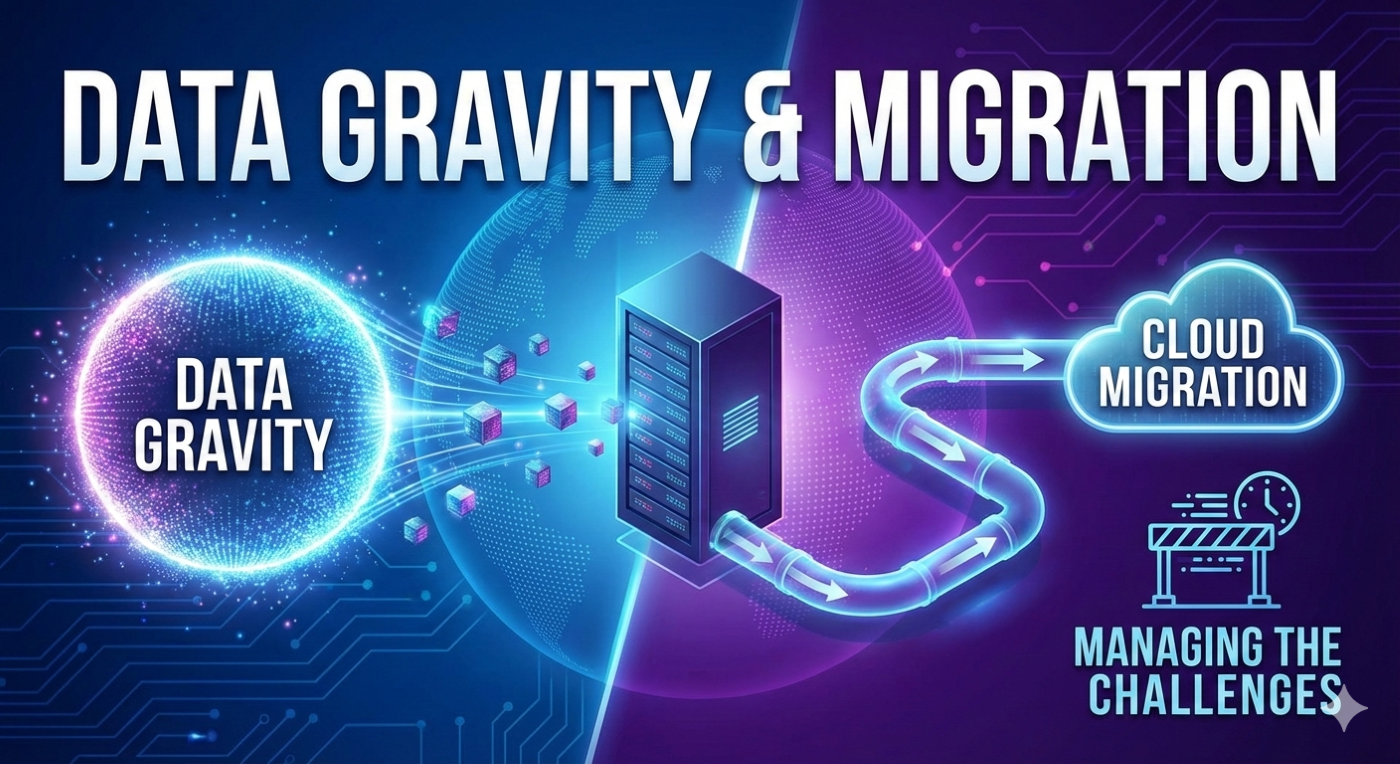
In the early days of digital transformation, moving data was relatively simple. Databases were smaller, applications were fewer, and infrastructure changes happened slowly. Today, that reality has completely changed. Organizations now manage petabytes of data spread across cloud platforms, data centers, SaaS applications, and edge environments. As data volumes grow, so does a powerful force that many organizations underestimate: data gravity.
Data gravity explains why data tends to attract applications, services, and workloads—and why moving it becomes increasingly difficult over time. When organizations attempt large-scale cloud migrations, platform modernization, or analytics transformations, data gravity often becomes the biggest obstacle.
At cvDragon IT Consulting, we help enterprises understand, plan for, and overcome data gravity challenges—ensuring that data migration strategies are realistic, cost-effective, and aligned with long-term business goals. This article explores what data gravity is, why it complicates migration, and how consulting-led strategies help organizations move massive datasets successfully.
Understanding Data Gravity
Data gravity is the concept that large datasets exert a “pull” on applications and infrastructure. The more data you have, the harder it is to move—and the more other systems become dependent on it.
Data gravity increases due to:
- Rapid data growth from digital channels
- IoT and sensor-generated data
- Analytics and AI workloads
- Regulatory data retention requirements
- Legacy system dependencies
Over time, data becomes deeply embedded in business operations, making migration not just a technical challenge, but an organizational one.
Why Data Gravity Complicates Migration Efforts
Many migration projects fail or stall because data gravity is addressed too late—or not at all.
Key challenges include:
- Extremely long data transfer times
- High network and egress costs
- Application downtime risks
- Data consistency and integrity issues
- Regulatory and residency constraints
- Dependency mapping complexity
When data moves slowly, everything else moves slowly with it.
Common Scenarios Where Data Gravity Becomes a Problem
Data gravity impacts organizations across industries and transformation initiatives.
Typical scenarios include:
- Migrating from on-premises data centers to cloud platforms
- Moving analytics workloads closer to AI and ML services
- Exiting or switching cloud providers
- Consolidating data platforms after mergers or acquisitions
- Modernizing legacy ERP, CRM, or core banking systems
In each case, the size, complexity, and criticality of data create friction.
Data Gravity Is Not Just a Technical Issue
A common misconception is that data gravity can be solved with faster networks or better tools. While technology matters, the real challenge is broader.
Data gravity affects:
- Business continuity
- Customer experience
- Compliance and risk posture
- Operating costs
- Transformation timelines
This is why data migration must be treated as a business-critical program, not an IT task.
The Role of Consulting in Data Gravity and Migration
At cvDragon IT Consulting, we approach data migration as a strategic initiative that balances speed, risk, cost, and long-term architecture.
Consulting plays a critical role in four key areas.
1. Data Discovery and Dependency Mapping
You cannot move what you don’t fully understand.
Consultants help organizations:
- Identify all data sources and volumes
- Map application and process dependencies
- Classify data by criticality and sensitivity
- Identify “hot” vs “cold” data
This visibility prevents surprises mid-migration.
2. Migration Strategy Design
Not all data needs to move at once—or at all.
Consulting helps define:
- Which datasets should move, stay, or be archived
- Phased vs big-bang migration approaches
- Rehosting, refactoring, or replatforming strategies
- Coexistence models during transition
A thoughtful strategy reduces disruption and cost.
Managing the Cost Impact of Data Gravity
Data movement is expensive—especially in cloud environments.
Hidden costs often include:
- Cloud egress charges
- Network bandwidth upgrades
- Extended parallel run environments
- Reprocessing and validation efforts
Consultants help organizations model total migration cost upfront, enabling informed decisions and avoiding budget overruns.
Techniques for Reducing Data Gravity Impact
While data gravity cannot be eliminated, it can be managed.
Data Minimization and Tiering
Not all data is equally valuable.
Organizations can reduce migration load by:
- Archiving inactive or low-value data
- Tiering data based on access frequency
- Retaining historical data in cost-efficient storage
Moving less data reduces complexity immediately.
Bringing Compute to the Data
Instead of moving data, organizations can move processing closer to where data resides.
This includes:
- Running analytics in-place
- Using hybrid or edge architectures
- Leveraging cloud-native data services
Consulting helps determine when this approach makes sense.
Incremental and Continuous Migration
Large-scale “lift-and-shift” migrations often fail under data gravity.
Incremental approaches include:
- Synchronizing data changes over time
- Migrating workloads in logical waves
- Maintaining temporary hybrid architectures
This reduces risk and downtime.
Ensuring Data Integrity and Trust During Migration
For business users, the biggest concern is trust.
Migration failures often occur when:
- Data is lost or corrupted
- Reports produce inconsistent results
- Applications behave unpredictably
Consultants implement:
- Validation and reconciliation processes
- Parallel testing environments
- Rollback and recovery plans
Trust is maintained through transparency and verification.
Security and Compliance Considerations
Moving massive datasets introduces new security risks.
Key concerns include:
- Data exposure during transfer
- Inconsistent access controls
- Cross-border data movement violations
- Incomplete audit trails
Consulting ensures that security and compliance are embedded into migration design—not added later.
Data Gravity in the Age of AI and Analytics
AI and advanced analytics amplify data gravity.
Why?
- AI models require large, high-quality datasets
- Data preparation pipelines are tightly coupled
- Latency impacts model performance
Organizations often discover that AI initiatives fail not because of algorithms—but because data is in the wrong place.
Consultants help align data location, compute power, and AI workloads for sustainable performance.
Organizational Challenges: The Human Side of Data Migration
Data migration affects more than systems—it affects people.
Challenges include:
- Resistance from application owners
- Conflicting priorities across teams
- Fear of downtime or performance loss
- Skills gaps in modern data platforms
Consulting brings structure, governance, and communication to keep stakeholders aligned.
Governance: Preventing Future Data Gravity Problems
One overlooked benefit of migration projects is the opportunity to redesign data governance.
Effective governance helps prevent future data gravity by:
- Standardizing data architectures
- Defining clear data ownership
- Controlling data sprawl
- Encouraging reuse and integration
Without governance, today’s migration becomes tomorrow’s bottleneck.
How cvDragon IT Consulting Helps Organizations Succeed
At cvDragon IT Consulting, we support organizations through the full data gravity and migration lifecycle:
- Data estate assessment and dependency mapping
- Migration strategy and roadmap development
- Cost, risk, and performance modeling
- Secure migration execution and validation
- Post-migration optimization and governance
Our goal is not just to move data—but to enable agility, scalability, and long-term value.
Measuring Success Beyond “Data Moved”
Successful data migration is not measured by terabytes transferred.
True success includes:
- Improved system performance
- Faster analytics and decision-making
- Reduced operational cost
- Increased flexibility for future initiatives
Data gravity is managed—not feared.
Conclusion: Respect the Gravity, Plan the Journey
Data gravity is a natural consequence of digital success. The more data an organization generates, the more powerful—and complex—it becomes. Ignoring data gravity leads to stalled migrations, cost overruns, and frustrated teams.
Managing data gravity requires strategy, discipline, and expert guidance. With the right consulting approach, organizations can turn massive datasets from a liability into a strategic asset—moving them when needed, leveraging them where they are, and designing architectures that scale with confidence.
At cvDragon IT Consulting, we believe successful data migration is not about fighting gravity—but about understanding it, planning around it, and using it to your advantage.
Because in the data-driven enterprise, how you move your data defines how fast you can move your business.